SWIFT announced its blockchain-based shared ledger is ready for initial use. Early adopter financial institutions across six continents will now support 24/7 cross-border payments using tokenized deposits.
The news spread fast, and the XRP community responded with equal parts excitement and confusion.
Some traders assumed this meant a direct integration. Others dismissed the announcement as irrelevant to XRP.
Both reactions miss the real story. The SWIFT blockchain news is bigger for XRP than most people realize. It validates the entire thesis behind the digital asset, even though SWIFT did not announce a partnership with Ripple.
What you'll learn 👉
What SWIFT Actually Announced, And What It Didn’t
SWIFT officially announced a blockchain-based shared ledger designed to support tokenized deposits, allow 24/7 payments, and improve transparency across financial institutions. The ledger records, sequences, and validates transactions with smart-contract functionality. Seventeen banks across six continents will pioneer the first phase and focus on cross-border payments.
SWIFT made no announcement of XRP integration. There is no official statement that XRP will power the ledger, that Ripple is partnering on this initiative, or that banks will settle using XRP. SWIFT called the ledger an extension of its infrastructure, not a replacement. The goal is interoperability and modernization.
But this distinction matters less than most people think. The industry does not need SWIFT to use XRP for the announcement to be important. It only needs SWIFT to move in the same direction Ripple has championed for more than a decade.
The Problem Both SWIFT and Ripple Are Trying to Solve
Current international payments rely on multiple correspondent banks, nostro/vostro accounts, different operating hours, and manual reconciliation. These create settlement delays, trapped liquidity, higher costs, and payment uncertainty.
SWIFT specifically cites 24/7 cross-border payments as a design objective of the new ledger. It also aims to improve interoperability between fiat, tokenized deposits, stablecoins, CBDCs, and tokenized securities.
This is exactly the problem Ripple set out to solve in the early 2010s. Instead of pre-funding accounts globally, liquidity can be sourced on demand. Ripple’s On-Demand Liquidity uses XRP as a bridge asset to reduce idle capital.
SWIFT’s new ledger does not adopt XRP, but it addresses the same objective. Both organizations are now pursuing faster settlement, interoperability, digital asset infrastructure, tokenization, and 24/7 payments.
Read also: XRP Price Finally Hits the Level We’ve Been Waiting Months For – $1.09 Support Test
Why This Validates XRP’s Entire Existence
Ripple has argued since its founding that cross-border payments need instant settlement, blockchain infrastructure, interoperability, continuous availability, and reduced liquidity costs. SWIFT’s blockchain roadmap now includes many of these same design priorities.
This moves blockchain from a crypto-native experiment to a viable infrastructure layer for major financial institutions. Tokenization is becoming a strategic priority, not a niche interest. The SWIFT blockchain news validates the thesis that distributed ledger technology can improve institutional payment rails.
Some might argue SWIFT did not copy Ripple. That is true. But the verifiable conclusion is stronger: both organizations now pursue similar goals.
Ripple has built products around Ripple Payments, On-Demand Liquidity, and the XRP Ledger. These target many of the same institutional payment inefficiencies SWIFT is now addressing through blockchain.
The industry is moving toward faster, tokenized, always-on settlement. That is exactly the environment the XRP Ledger was built for.
What This Means for XRP’s Price and Future
One of the strongest long-term signals is that traditional financial infrastructure providers are increasingly investing in blockchain rather than dismissing it. SWIFT’s ledger, BIS Project Agorá, tokenized deposits, and tokenized securities initiatives all show growing institutional interest in blockchain-based settlement.
When it comes to value, the XRP price is showing a short-term bullish recovery after rebounding from the $1.07 support area, with the price currently trading around $1.11. The asset is forming higher lows, although it remains below the key resistance zone at $1.16–$1.17.
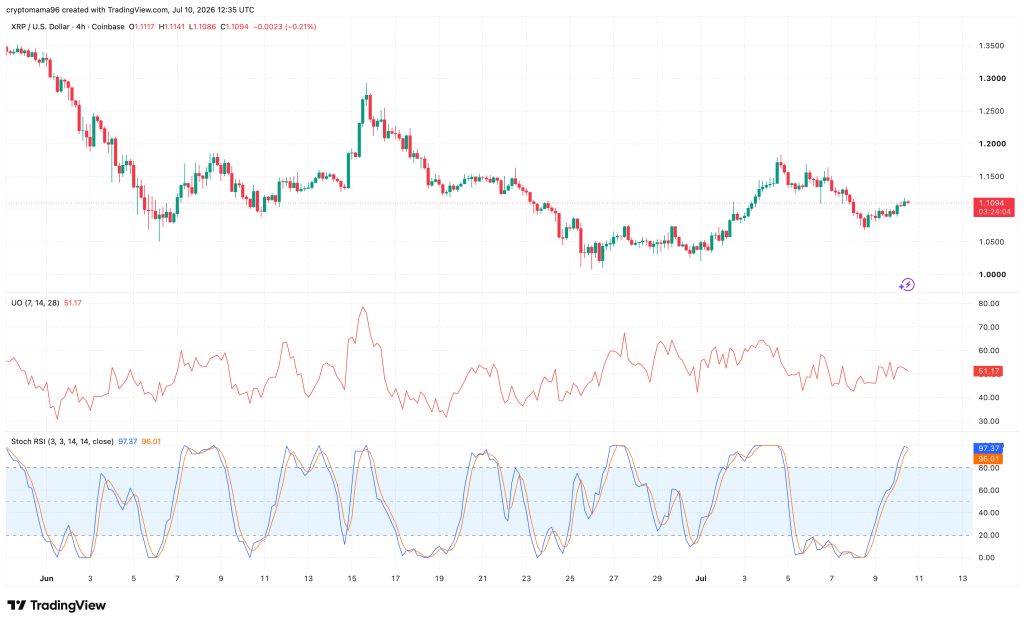
Immediate support lies at $1.08, followed by $1.05. The Ultimate Oscillator near 51 means neutral momentum and the Stochastic RSI above 96 means overbought conditions. This raises the possibility of a brief pullback before another move higher.
The technical outlook remains cautiously bullish, provided XRP holds above its recent higher-low structure. But the price action matters less than the structural change. The SWIFT blockchain news confirms that the largest financial messaging network in the world now sees blockchain as essential to its future.
That does not guarantee XRP adoption. It does guarantee that Ripple’s vision of a faster, more efficient settlement system aligns with where finance is heading.
Frequently Asked Questions
Subscribe to our YouTube channel for daily crypto updates, market insights, and expert analysis.