XRP is one of the most discussed cryptocurrencies in the market because it sits at the intersection of digital payments, blockchain infrastructure, institutional finance and crypto regulation. Unlike many crypto assets that focus mainly on store-of-value narratives or decentralised apps, XRP is closely associated with fast settlement, cross-border transfers and the Ripple ecosystem.
In recent years, XRP has returned to the spotlight as Ripple expanded its payment products, the XRP Ledger gained more institutional attention, and regulated crypto investment products became a stronger part of the market conversation. For users who follow digital assets, payments and online entertainment, XRP is also part of a wider shift toward faster, crypto-based online experiences.
That same shift is visible in modern entertainment platforms such as Qzino, where adult users can explore casino games, sports betting, esports, fast crypto withdrawals, VIP rewards and cashback in one crypto-friendly ecosystem. Qzino accepts major cryptocurrencies including BTC, ETH, USDT, USDC, SOL, BNB, TON and TRX, and offers 2,000+ games, no mandatory KYC for standard access, a Welcome Pack up to $6,500, a VIP Welcome Pack up to $10,500, cashback up to 40% and a $20,000 Weekly Race every week.
What you'll learn 👉
What Is XRP?
XRP is a digital asset connected to the XRP Ledger, a blockchain network designed for fast and low-cost transactions. It is often associated with Ripple, the company that builds payment solutions using blockchain technology, although XRP itself exists as a crypto asset on the public XRP Ledger.
The main idea behind XRP is speed and settlement efficiency. Transactions on the XRP Ledger are designed to move value quickly, which is why XRP has often been discussed in the context of cross-border payments, liquidity and financial infrastructure.
For everyday crypto users, XRP is usually seen as a payment-focused cryptocurrency. It can be held, transferred, traded and used within services that support it. For institutions, the broader XRP ecosystem is often viewed through the lens of payments, tokenisation, stablecoins and blockchain-based settlement.
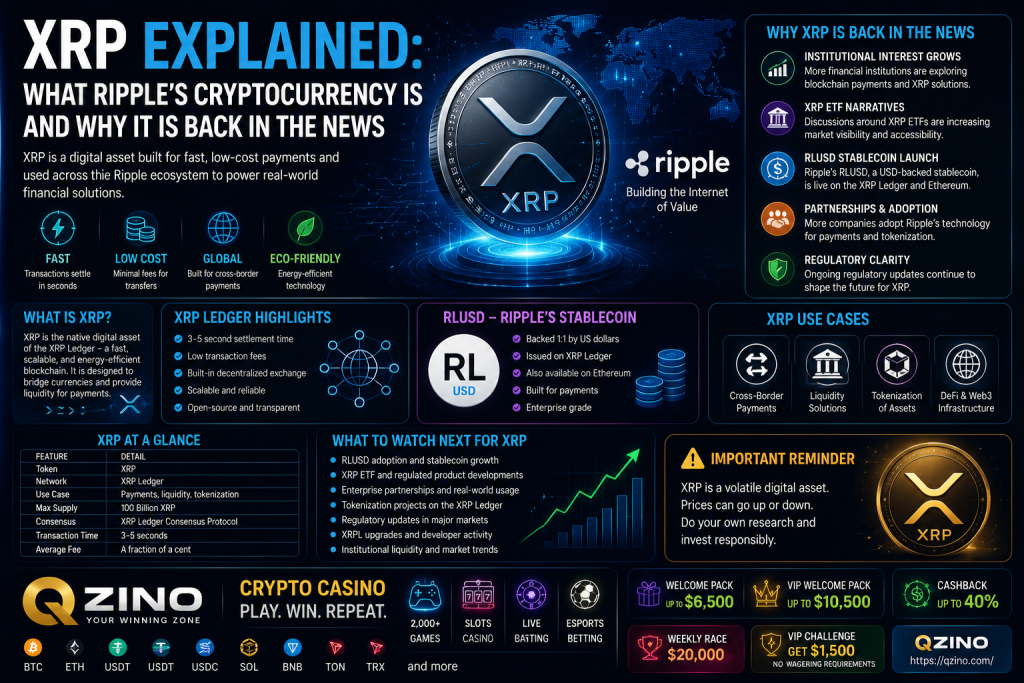
Why XRP Is Back in the News
XRP has been gaining renewed attention because institutional interest in crypto has become more structured. Regulated investment products, ETF discussions, tokenised assets and stablecoin use cases have made digital assets more visible to traditional finance.
Ripple has also continued to build around the XRP Ledger. One of the biggest developments is RLUSD, Ripple’s stablecoin designed to maintain a value of one US dollar. RLUSD is issued on the XRP Ledger and Ethereum, adding another payment-focused layer to Ripple’s ecosystem.
At the same time, XRP has remained a frequent topic in market news because of regulatory clarity, institutional adoption, ETF-related narratives and broader crypto market cycles. This does not mean XRP is risk-free, but it explains why the asset continues to attract attention from traders, analysts, institutions and blockchain users.
| XRP Topic | What It Means | Why It Matters |
| XRP Ledger | Blockchain network associated with XRP transactions | Supports fast and low-cost digital transfers |
| Ripple | Company building blockchain payment infrastructure | Connects XRP-related technology with financial use cases |
| RLUSD | Ripple stablecoin designed to track the US dollar | Adds stablecoin utility to the XRP Ledger and Ethereum |
| Institutional adoption | Interest from finance firms and regulated products | Can increase visibility and credibility |
| ETF narrative | XRP-related investment products and market access | Makes XRP easier to discuss in traditional finance |
| Tokenisation | Digital representation of real-world assets | Expands blockchain use beyond simple transfers |
| Regulation | Legal and compliance environment around crypto | Affects confidence, access and market structure |
XRP Ledger and Ripple’s Payment Vision
The XRP Ledger is built around speed, settlement and scalability. Its design is different from some other blockchain networks because it focuses heavily on payments and transaction efficiency rather than only general-purpose smart contract activity.
Ripple’s broader vision has often been connected to improving how money moves between institutions, markets and users. In that context, XRP can be viewed as part of a larger infrastructure story rather than only a speculative asset.
The introduction and growth of RLUSD also strengthens this payment narrative. Stablecoins are increasingly important in crypto because they give users a digital asset with more stable pricing compared with volatile coins. When combined with the XRP Ledger, stablecoin infrastructure can support faster settlement, liquidity and payment experimentation.
What XRP Means for Crypto Users
For crypto users, XRP is interesting because it represents a practical side of blockchain: fast transfers, lower transaction costs and payment-oriented infrastructure. While some crypto projects focus on culture, memes or decentralised applications, XRP’s identity is more closely tied to financial movement.
That makes XRP especially relevant for users who care about speed and usability. Whether someone is sending funds, trading crypto or following payment innovation, XRP remains one of the assets that often appears in discussions about real-world crypto utility.
However, users should remember that XRP is still a volatile digital asset. Price movements can be sharp, news-driven and influenced by broader crypto sentiment. Anyone buying or using XRP should understand the risks, research carefully and avoid treating any market narrative as a guarantee.
Things users should understand about XRP:
- XRP is connected to the XRP Ledger, not only to Ripple as a company
- Its main use case is often discussed around payments and settlement
- It remains volatile like other cryptocurrencies
- Ripple’s ecosystem includes payment tools and the RLUSD stablecoin
- Institutional interest can increase visibility, but does not remove risk
- Regulation and market sentiment can strongly affect XRP’s performance
Read also: How to Buy XRP – 9 Ways to Buy Ripple Tokens
XRP, Crypto Payments and Digital Entertainment
The rise of XRP is part of a wider trend: users increasingly expect online platforms to support faster, more flexible digital payments. This is visible in finance, gaming, ecommerce and online entertainment. Crypto is no longer only about trading; it is also about how users move value online.
Platforms like Qzino reflect that same direction. Instead of relying only on traditional payment methods, Qzino supports a crypto-first experience with fast withdrawals, no mandatory KYC for standard access, 2,000+ games, slots, Originals, live casino, sports betting and esports betting.
For adult users who already understand digital assets, the appeal is clear: faster access, more payment flexibility and reward-driven entertainment. Qzino also offers cashback up to 40%, a VIP Welcome Pack up to $10,500, and the option to transfer VIP status and receive an additional $1,500 with no wagering requirements after the VIP Challenge.
What to Watch Next for XRP
The next stage for XRP will likely depend on several factors: Ripple’s product development, RLUSD adoption, institutional interest, ETF-related developments, regulatory clarity and the broader crypto market cycle. These themes can shape how XRP is perceived by both retail and professional users.
Another important area is tokenisation. If more traditional financial assets move onto blockchain rails, networks like the XRP Ledger may continue to receive attention from companies exploring faster and more efficient settlement models.
Still, XRP’s future is not guaranteed. Like any crypto asset, it faces competition, volatility and regulatory uncertainty. The best way to follow XRP is to watch actual adoption, real product usage, liquidity trends, partnerships and regulatory updates rather than only short-term price headlines.
What to watch in XRP news:
- Growth of RLUSD and stablecoin usage
- XRP ETF and regulated product developments
- Ripple partnerships with financial institutions
- Tokenisation projects using the XRP Ledger
- Regulatory decisions in major markets
- XRP Ledger upgrades and developer activity
- Market liquidity and long-term adoption signals
Final Thoughts
XRP remains one of the most important cryptocurrencies to watch because it combines market attention with a clear payment-focused narrative. Its connection to Ripple, the XRP Ledger, RLUSD and institutional finance keeps it relevant in discussions about the future of blockchain-based settlement.
For users, the main point is balance. XRP has real infrastructure around it, but it also carries the risks of a volatile crypto asset. Understanding what XRP is, why it matters and what news actually affects it can help readers follow the market more clearly.
As crypto continues moving into payments, finance and entertainment, assets like XRP and platforms like Qzino show how digital value is becoming part of everyday online experiences, from blockchain settlement to gaming, betting, rewards and fast crypto transactions.