Buying XRP every month sounds almost too simple, especially when social media is full of predictions calling for explosive rallies or painful crashes. Reality is usually much less dramatic. Prices move up, prices move down, and nobody knows exactly where the next major swing will happen.
That uncertainty explains why many investors prefer a steady plan instead of chasing perfect entries. Putting $500 into XRP every month removes much of the guesswork and allows the portfolio to grow over time, regardless of whether the XRP price spends months climbing or falls into another correction first.
One question naturally follows. If someone committed to that plan from now until 2030, what could the final portfolio actually look like? The answer depends on several factors, including how XRP moves during the next 42 months and where the Ripple ecosystem stands by the end of the decade.
What you'll learn 👉
Why Dollar Cost Averaging Has Become a Popular Strategy for XRP
Dollar Cost Averaging, often called DCA, simply means investing the same amount of money on a regular schedule. Someone following this strategy would buy $500 worth of XRP every month instead of investing a large amount all at once.
Many investors choose this method because cryptocurrency remains highly volatile. Nobody consistently buys the exact bottom, and very few sell at the perfect top. DCA accepts that reality instead of trying to fight it.
Another benefit comes from simple mathematics. Lower XRP prices allow each $500 purchase to acquire more tokens. Higher prices buy fewer tokens. Over many months, that naturally smooths the average purchase price.
XRP also lends itself well to this strategy because its price history includes both explosive rallies and deep corrections. Those swings create opportunities for disciplined buyers who remain consistent throughout different market cycles.
A $500 Monthly Investment Would Reach $21,000 Before 2030
Assuming an investor starts now and continues through January 2030, the numbers stay straightforward.
Key figures include:
- Monthly investment: $500
- Investment period: 42 months
- Total capital invested: $21,000
Choosing a lump sum instead would require investing the entire $21,000 immediately. That strategy could produce better returns if XRP climbs from today’s levels without major pullbacks. Timing becomes much more important under that approach because a large correction shortly after buying could leave the portfolio underwater for months.
Monthly investing spreads that timing risk across dozens of purchases instead of placing everything on a single day.
Realistic XRP Buying Prices Could Produce Better Average Entries
Assuming XRP stays around today’s price for the next 42 months is probably unrealistic. Markets rarely move in straight lines, especially cryptocurrencies.
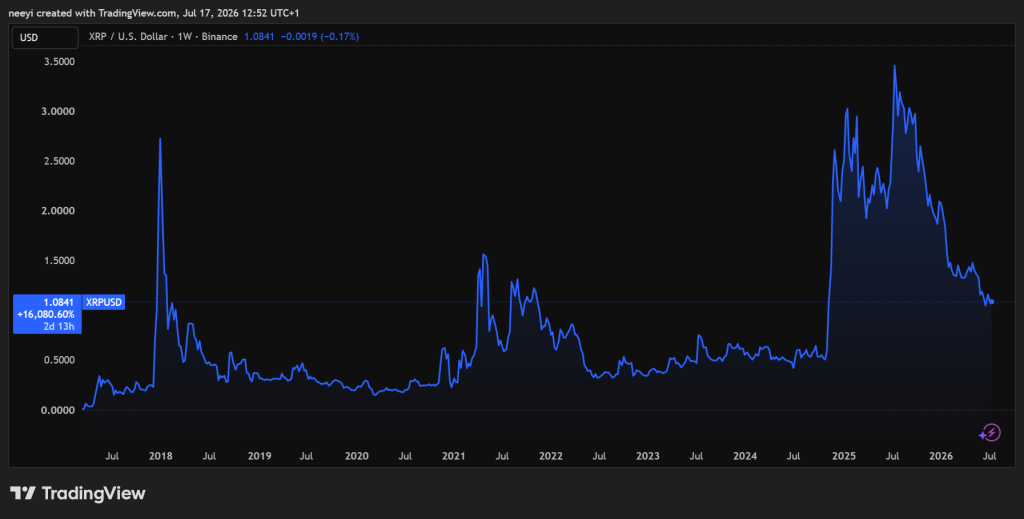
The XRP price currently trades close to $1.09. A look at the longer term chart shows that another correction toward $0.50 cannot be ruled out completely if the market enters another broad bear phase before the next expansion begins.
Several analysts also expect higher prices over the next few years. That means monthly purchases would likely happen across many different price zones instead of one fixed level.
One reasonable accumulation path could look something like this:
- Around 35% of purchases happen between $1 and $2.
- Roughly 20% occur between $0.70 and $1 during corrections.
- About 20% happen between $2 and $2.50 as XRP recovers.
- Close to 15% take place between $3 and $4.
- Nearly 7% occur around $5.
- Only about 3% happen near $8 to $10 toward the end of the period if XRP reaches those levels.
Those percentages illustrate how a long investment period naturally exposes buyers to several market environments instead of one single valuation.
Using that type of distribution, the average purchase price may end up somewhere around $1.30 to $1.50 instead of today’s $1.09. That would leave investors owning roughly 14,000 to 16,000 XRP after investing the full $21,000.
Another point deserves attention here.
Those higher purchase prices only make sense under bullish market conditions. They should not be applied to every scenario. If XRP never climbs above $3 by 2030, purchases above $5 obviously would not happen. Each future valuation should therefore use an accumulation path that matches its own market conditions.
That produces far more realistic projections than assuming the same buying pattern regardless of how XRP actually performs.
Read Also: ChatGPT Predicts Whether $10,000 Is Better Invested in XRP or Bitcoin
Ripple’s Long Term Growth Story Extends Beyond Price Charts
Future XRP performance depends on much more than technical analysis. Several developments could influence the Ripple ecosystem over the next few years.
Spot XRP ETFs remain one of the biggest potential catalysts. Approval could open the market to retirement accounts, institutional investors, and traditional asset managers that currently have limited exposure to XRP.
Ripple also continues expanding its cross border payment infrastructure. Greater adoption of Ripple’s payment network could increase activity across the XRP Ledger if financial institutions continue integrating those services.
RLUSD introduces another important piece of the ecosystem. Ripple’s stablecoin creates an additional entry point for businesses and developers building applications on the XRP Ledger.
Tokenization represents another major opportunity. Many financial institutions continue exploring real world asset issuance on blockchain networks. Successful adoption could bring much larger transaction volumes onto the XRP Ledger over time.
Regulatory clarity remains equally important. Clear legal frameworks reduce uncertainty for banks, payment companies, and institutional investors considering XRP related products.
None of these developments guarantees higher prices. Together, they help explain why many analysts continue watching Ripple closely beyond the current market cycle.
Different XRP Price Targets Produce Very Different Portfolio Values
Final portfolio performance depends on two major variables. The first is the number of XRP accumulated through monthly purchases.
The second is where the XRP price trades by 2030. Using a baseline accumulation close to 15,000 XRP under a more realistic purchasing schedule, several outcomes become possible.
| XRP Price by 2030 | Estimated XRP Accumulated | Total Invested | Estimated Portfolio Value |
|---|---|---|---|
| $3 | 15,000 | $21,000 | $45,000 |
| $5 | 15,000 | $21,000 | $75,000 |
| $10 | 15,000 | $21,000 | $150,000 |
| $20 | 15,000 | $21,000 | $300,000 |
If XRP reaches around $3, the portfolio would grow meaningfully but remain relatively conservative. That outcome assumes XRP never spends much time above $3 during the accumulation period.
A move toward $5 creates much stronger returns. Monthly purchases would become smaller near the end because XRP would cost more, although earlier accumulation would continue benefiting the overall portfolio.
Reaching $10 would transform the portfolio again. Only a small portion of purchases would likely happen near those levels because XRP would spend most of the investment period below that price.
A move toward $20 represents the most optimistic outcome. That scenario assumes Ripple achieves broad institutional adoption alongside favorable regulation and continued ecosystem growth.
Dollar Cost Averaging and Lump Sum Investing Each Have Advantages
Choosing between DCA and a lump sum investment depends largely on market conditions.
Investing the entire $21,000 today captures every future price increase if XRP climbs steadily from current levels. Historical data across many asset classes often favors lump sum investing during sustained bull markets.
DCA performs better when volatility creates repeated corrections. Buying throughout those declines lowers the average purchase price and reduces the emotional pressure of trying to predict market bottoms.
Neither strategy works best in every environment. Many investors even combine both methods by investing an initial amount before continuing with smaller monthly purchases.
Read Also: Ethereum Price Just Flashed the Same Signal That Triggered Its Last 2 Massive Rallies
Every XRP Investor Should Understand the Risks
Every investment plan deserves a balanced view, especially one extending several years into the future.
Several risks remain worth monitoring.
- XRP could stay below optimistic price targets for much longer than expected.
- Regulatory developments could slow institutional adoption in major markets.
- Competing payment networks could capture part of Ripple’s addressable market.
- Global recessions or tighter financial conditions could weigh on cryptocurrencies broadly.
- Missing monthly contributions would reduce the final XRP balance accumulated by 2030.
Those factors explain why future returns can never be guaranteed, even when the investment strategy stays disciplined.
FAQs
Subscribe to our YouTube channel for daily crypto updates, market insights, and expert analysis.