XRP and XLM entered 2026 with strong institutional expectations, but the year has delivered steep corrections instead. Both payment focused cryptocurrencies now trade near important support levels, even as their respective networks record new forms of adoption.
That combination creates an interesting possibility. XLM could produce the better percentage return during the next recovery without ever overtaking XRP by market capitalization, liquidity, or recognition.
XRP and XLM share a historical connection because Stellar cofounder Jed McCaleb was also one of Ripple’s original founders. Their networks both support quick and inexpensive international transfers, although each project has developed a distinct position.
XRP trades near $1.07 with approximately 62.5 billion tokens circulating. Those figures give XRP a market capitalization of about $66.7 billion.
XLM trades near $0.18 with roughly 34.2 billion tokens circulating. Stellar’s native token carries a much smaller market capitalization near $6 billion.
| Metric | XRP | XLM |
|---|---|---|
| Approximate Price | $1.07 | $0.18 |
| Market Capitalization | $66.7 Billion | $6 Billion |
| Circulating Supply | 62.5 Billion | 34.2 Billion |
| Recent 24 Hour Volume | $1.17 Billion | $128 Million |
XRP is valued at roughly 11 times XLM and recently recorded more than 9 times its daily volume. Both cryptocurrencies remain available through major exchanges, but XRP has deeper liquidity and much higher trading activity.
XLM would need to reach approximately $1.95 to match XRP’s current market capitalization. That outcome would require an advance of almost 1,000% from $0.18, assuming XRP’s valuation remained unchanged.
What you'll learn 👉
XRP and XLM Price Corrections Have Created Similar Technical Setups
XRP began 2026 near $1.85 before losing about 42%. January briefly carried the XRP price beyond $1.90 after the SEC dropped its remaining lawsuit appeals, which secured greater legal clarity for Ripple.
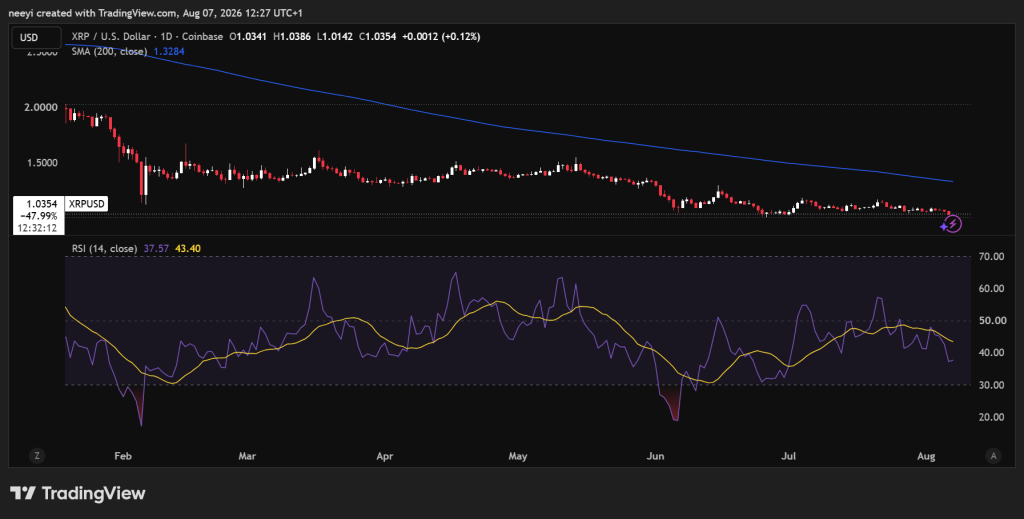
Recent conditions look much weaker. Buyers have defended the psychological $1 level since late June, whereas the 200 day moving average near $1.32 remains a major barrier.
Seven United States spot XRP ETFs have reportedly collected approximately $1.5 billion in combined inflows. Recent demand has cooled, however, and the products recorded a $3.58 million net outflow on August 5.
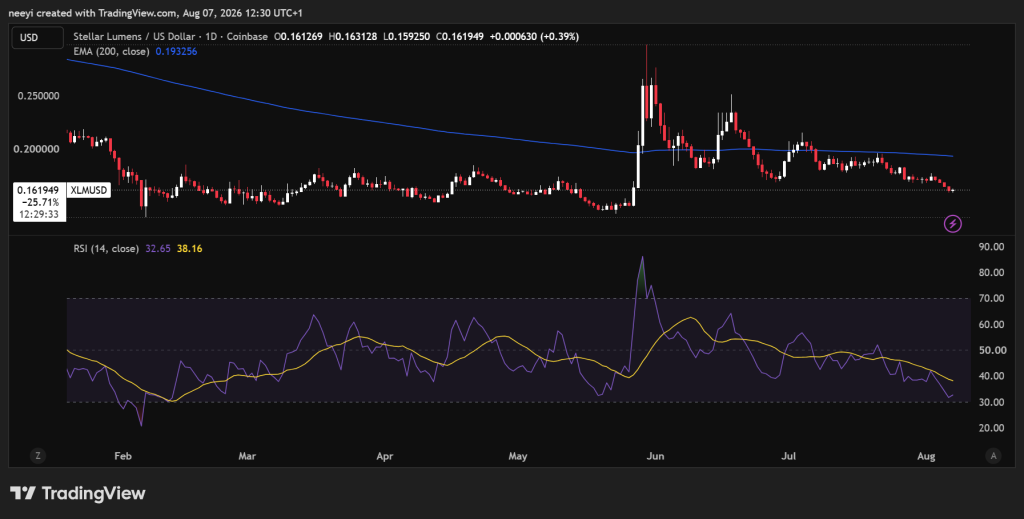
XLM has followed a similar path. The XLM price has fallen about 47% from its late 2025 peak near $0.30 and spent much of 2026 between $0.15 and $0.19.
A look at the XLM chart places its 200 day exponential moving average near $0.193. An RSI reading close to 33 shows weak momentum, although XLM has not entered fully oversold territory.
Stellar Adoption Gives XLM Its Own Case Beyond XRP Comparisons
Ripple concentrates heavily on enterprise payment infrastructure and institutional settlement. Stellar covers remittances, stablecoins, cash access, tokenized assets, and payments for users outside conventional banking systems.
Stellar reported several notable network figures during Q1 2026:
- Stablecoin payment volume reached $5.5 billion, up 72% from one year earlier.
- Tokenized real world assets crossed $2 billion shortly after the quarter ended.
- MoneyGram continued supporting cash conversions between local currency and USDC.
- Franklin Templeton, Ondo Finance, Amundi, and other institutions expanded activity around Stellar.
The Stellar Development Foundation’s Q1 report confirms the payment and tokenized asset figures.
Network growth does not guarantee an equal XLM price increase. Many Stellar applications transfer stablecoins or tokenized products, and the network charges extremely low fees. Greater adoption must create stronger demand for XLM before it can provide lasting price support.
XLM Price Needs Less Relative Demand to Outperform XRP Price
A smaller starting valuation gives XLM greater room for large percentage moves. Market capitalization calculations illustrate that difference clearly.
- A 100% XRP increase would lift its market value from $66.7 billion to $133.4 billion.
- A 100% XLM increase would lift its market value from $6 billion to $12 billion.
- XRP would remain more than 5 times larger after XLM doubled.
Those figures do not mean exactly $66.7 billion must enter XRP or $6 billion must enter XLM. Prices move through exchange orders, and market capitalization revalues the full circulating supply at the latest quoted price.
Smaller size creates downside risk as well. XLM’s lower liquidity could produce faster losses whenever broad market conditions deteriorate.
Read Also: XRP vs. Stellar (XLM): Which Is the Better Crypto to Hold in 2026?
Price Scenarios Show How XLM Could Beat XRP Without Replacing It
- Bullish XLM Scenario: Stellar adoption translates into stronger token demand. XLM rises 80%, whereas XRP advances 30%.
- Balanced Scenario: Both cryptocurrencies recover, but their percentage returns remain similar. XRP retains its large valuation advantage.
- Bearish Scenario: Weak altcoin demand pushes both assets lower. XLM falls faster because its liquidity is thinner.
A hypothetical 80% XLM advance would lift its market capitalization to about $10.8 billion. A 30% XRP advance would raise its valuation to approximately $86.7 billion. XLM would deliver the better return, but XRP would remain about 8 times larger.
FAQs
Subscribe to our YouTube channel for daily crypto updates, market insights, and expert analysis.