Bitcoin took a heavy hit today. The price dropped around 4% and now trades just slightly above $70,000. What makes this crash unusual is that top altcoins like Ethereum are down much less – roughly 1‑2%.
That means the current crypto market crash is affecting Bitcoin the most. Let’s break down why.
What you'll learn 👉
Why Is the Crypto Market Down Today?
The drop triggered a violent unwinding of leveraged positions. Over $408 million in Bitcoin positions were liquidated in the last 24 hours, with long positions making up 96% of that total. Forced selling accelerated the decline as traders who borrowed to buy BTC got squeezed out.
The core driver behind the sustained weakness is capital withdrawal from US spot Bitcoin ETFs. Nearly $3 billion in outflows have occurred over the past ten days, turning year‑to‑date net flows negative for the first time in months. Institutions are pulling money out, not buying the dip.
Geopolitical news also spooked the market. Iran announced it is ending all negotiations with the United States and vowed to “completely” block the Strait of Hormuz, according to CNBC. Iran cited repeated ceasefire violations, including Israeli strikes in Lebanon, as the reason.
BREAKING: President Trump responds after Iran ends all negotiations with the US, per CNBC.
— The Kobeissi Letter (@KobeissiLetter) June 1, 2026
"I really don’t care. I couldn’t care less," Trump says.
He also said he was "going to ask" Israeli Prime Minister Netanyahu "what’s going on with Lebanon."
The country also threatened to block the Bab el‑Mandeb Strait, another critical shipping chokepoint. President Trump responded dismissively: “I really don’t care. I couldn’t care less.” He added that he would ask Israeli Prime Minister Netanyahu “what’s going on with Lebanon.”
Markets, however, do care. The threat to oil shipping lanes pushes energy prices higher, revives inflation fears, and reduces the likelihood of Fed rate cuts – all bad for risk assets like Bitcoin.
Michael Saylor’s Strategy Sold 32 BTC – A Psychological Tipping Point
Another factor that likely contributed to today’s crash is purely psychological. On June 1, Strategy (formerly MicroStrategy) sold 32 Bitcoin for approximately $2.47 million. This marks the company’s first Bitcoin sale in more than three years. The last sale was in December 2022, when Strategy sold 704 BTC at $16,776 only to buy back 810 BTC two days later at $16,845.
The numbers put this sale in perspective. Strategy holds over 843,706 Bitcoin. Selling 32 BTC represents just 0.0038% of its total holdings – a rounding error. When Michael Saylor bought billions of dollars worth of Bitcoin over the years, the market barely reacted. But now, he sells $2.5 million worth, and suddenly everyone is calling for a dump.
The reaction is irrational but understandable. After years of “never sell” rhetoric, any sale – no matter how small – breaks the narrative. Traders interpreted the move as a signal that even Saylor is losing confidence, even though the sale was likely for operational or tax reasons. The market is acting as if 32 BTC changed everything. Combined with ETF outflows and Iran tensions, this tiny sale added fuel to the fire. In reality, it is noise. But in a fragile market, noise can trigger panic.
Read also: Benjamin Cowen Makes a Rare Bitcoin Price Prediction
Santiment: The Growing Gap Between Equities and Crypto
Santiment reported striking divergence data. From May 6 through June 1, the S&P 500 climbed another +4%, while Bitcoin fell -13% and gold dropped -5%. The gap between traditional equities and crypto has become increasingly difficult for traders to ignore.
The attached chart (from Santiment) shows three lines: the S&P 500 (green) rising steadily from May 6 to June 1, while Bitcoin (blue) and gold (orange) both trend downward. Bitcoin’s decline is the steepest, falling from near $83K to just above $70K. Gold fell from roughly $4,800 to $4,500. The S&P, in contrast, moved from around 7,450 to over 7,670.
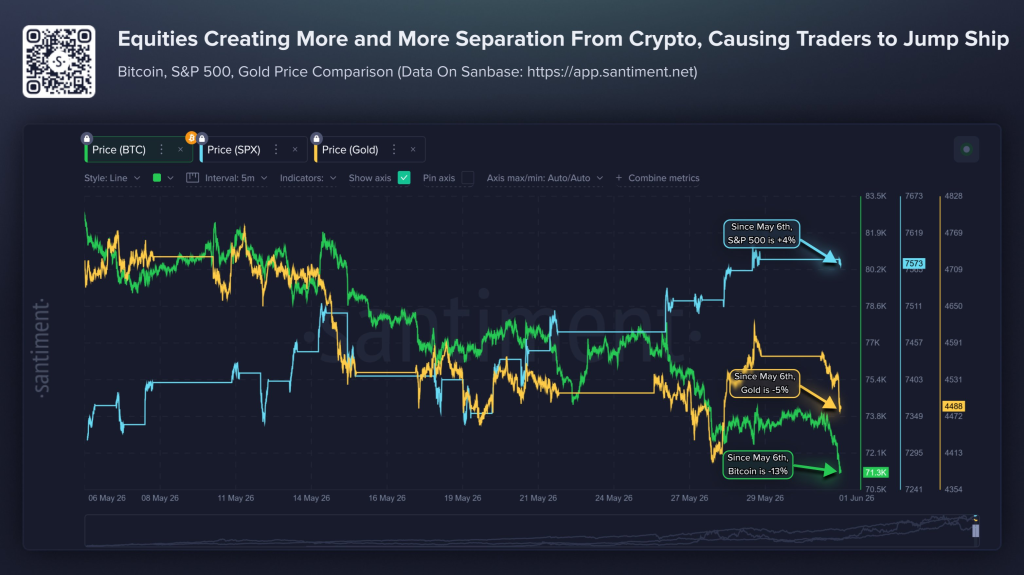
Santiment explains that US stocks, in particular, have grown under the Trump administration’s corporate‑favorable policies, attracting a disproportionate share of investing capital. This performance gap creates a self‑reinforcing cycle. When traders see equities consistently generating better returns with lower volatility, capital rotates away from crypto and into stock markets.
The trend becomes especially noticeable when the Bitcoin price struggles to maintain momentum despite favorable long‑term narratives like ETF adoption and institutional participation.
However, Santiment notes that this pattern won’t last forever. Mainstream influencers are now discussing stock dominance over crypto – a sign that the crowd is leaning too far into equity FOMO and crypto FUD. Markets generally move opposite to the majority of traders’ expectations. The current extreme divergence may be setting up for a reversal.
Crypto Market Predictions After the Crash
Where could Bitcoin and crypto go from here? The short‑term outlook remains fragile. If Iran follows through on blocking the Strait of Hormuz, oil prices would spike further, inflation fears would intensify, and the Fed would have no room to cut rates. In that scenario, Bitcoin could drop to $68,000 or even $65,000 in the coming days.
However, several factors point to a possible bounce. The liquidation flush removed a lot of leveraged long positions, which often marks a short‑term bottom. The RSI on the daily chart is near 30 – oversold territory. Santiment’s contrarian signal (crowd favoring stocks) also suggests that a reversal could be near.
If ETF outflows slow or reverse, and if geopolitical tensions de‑escalate even slightly, Bitcoin could rally back toward $73,000‑$75,000.
Realistically, the market is likely to stay choppy over the next few days. Expect a range between $68,000 and $72,000. A break below $68,000 would open $65,000. A reclaim of $72,000 would signal that the worst is over. Traders should watch daily ETF flow data and Hormuz headlines closely. The crash is painful, but it may also be the capitulation event that sets up the next leg higher – once the crowd finally gives up.
FAQs
Subscribe to our YouTube channel for daily crypto updates, market insights, and expert analysis.