
Bitcoin price fell by about 2% over the last 24 hours towards the $73,300 mark amid growing geopolitical risks and bearish sentiments across the entire cryptocurrency industry. In this regard, Bitcoin lagged behind the performance of the market as the increase in selling pressure was triggered by new US airstrikes in the area of the Strait of Hormuz.
In this respect, all markets demonstrated risk aversion with oil going up, gold being sought for its safe haven properties, and risky assets being sold off. Data over the past week even showed Bitcoin maintaining an 84.4% correlation with gold, which explains why both assets reacted so strongly to the same geopolitical developments.
At the same time, the BTC price was already dealing with weak market structure before the latest sell-off arrived. Over $338 million in leveraged Bitcoin positions were liquidated within 24 hours, with long traders taking most of the damage. Once the first support zones failed, liquidation pressure pushed price down even faster as overleveraged positions were forced out of the market.
What you'll learn 👉
ETF Outflows Continue Pressuring the BTC Price
Another major issue for Bitcoin has been the continued weakness in spot ETF flows. US spot Bitcoin ETFs recorded eight straight days of outflows, including one of the largest single-day withdrawals from BlackRock’s IBIT fund. That matters because ETF inflows were one of the biggest drivers behind Bitcoin’s rally earlier in the cycle.
When those flows slow down or reverse, the BTC price loses one of its strongest sources of demand. The market is now watching daily ETF data closely because sustained outflows continue adding direct sell pressure into an already fragile market.
Even with that weakness, institutional adoption has not disappeared entirely. Earlier in 2026, Bitcoin ETFs attracted over $1.3 billion in net inflows during a strong recovery phase. Large financial firms also continue integrating Bitcoin products into broader institutional infrastructure. That is one reason many traders still believe the current correction may stay within the range of a normal cycle pullback instead of turning into a full bear market.
Read Also: Saylor’s MicroStrategy Stops Buying Bitcoin for First Time Since 2020, Spends $1.38B On…
Whale Accumulation Is Starting to Stand Out
One interesting part of the current correction is what large holders are doing behind the scenes. The on-chain data revealed that there were 753 additional wallets that have held more than 100 BTC over the last three months. In May, whales purchased an estimated amount of 61,568 BTC, worth approximately $4.2 billion today.
That type of buying activity usually appears during fear-driven corrections when larger players start absorbing supply from weaker hands. Even though the BTC price has remained under pressure, whale accumulation has helped prevent a more aggressive collapse so far.
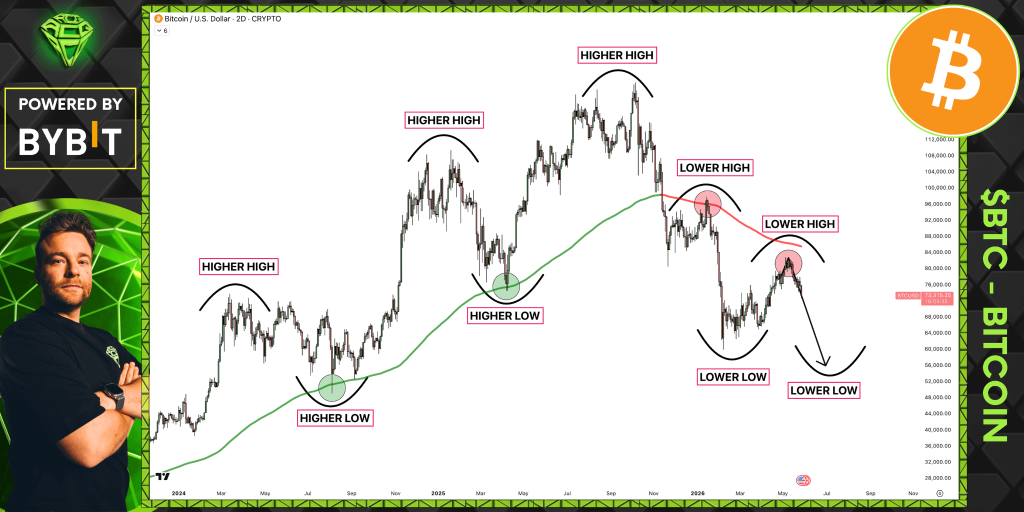
We also had a look at the BTC chart shared by crypto analyst Sjuul from AltCryptoGems, and the structure has clearly weakened compared to the strong trend seen throughout 2024 and early 2025. Bitcoin rallied from below $40,000 to above $110,000 during that cycle, but the market has now transitioned into lower highs and lower lows on the 2-day timeframe.
The BTC price will test a highly crucial ascending trendline that has been supporting the overall bullish pattern from 2024 onwards. The support level will be in the region of $72,000-$74,000. Should the buyers manage to hold this level, then there could be a possibility of a rebound towards the $80,000-$85,000 level.
Why the Next Few Weeks Matter for Bitcoin
The current setup leaves Bitcoin at an important decision point. A decline below the $73,000 level may see bulls target even lower support regions around $65,000 to $68,000. Such a scenario would have Bitcoin falling by 40% from its record highs around $112,000, which would still be within the normal correction levels for any given cycle.
The bigger picture, however, does not show any complete breakdown just yet. Bitcoin continues to maintain its multi-year ascending support line, while the whales continue their accumulation activities.
Three primary factors that bulls will be watching in the coming sessions include geopolitical events in the Middle East, daily ETF flows, and whether Bitcoin is able to remain above its current support level.
FAQs
Subscribe to our YouTube channel for daily crypto updates, market insights, and expert analysis.