The KAS price is showing signs of life again after spending months trading in a recovery range. Analyst Manohar Malagi believes the bigger picture still favors the bulls, and his chart points to a key resistance zone that could determine whether Kaspa’s next major move is about to begin.
At the time of the analysis, KAS was trading at $0.03898. That puts it about 81.2% below its all-time high of $0.2074 from July 2024. Even so, KAS is still more than 22,700% above its all-time low of $0.000171 from May 2022.
What you'll learn 👉
Kaspa Has Already Completed a Full Market Cycle
One reason Malagi remains optimistic is the way Kaspa’s long-term structure has developed. The chart breaks Kaspa’s history into four phases. The first phase covered accumulation and growth between 2022 and 2023, when the KAS price climbed from $0.000171 to around $0.05.
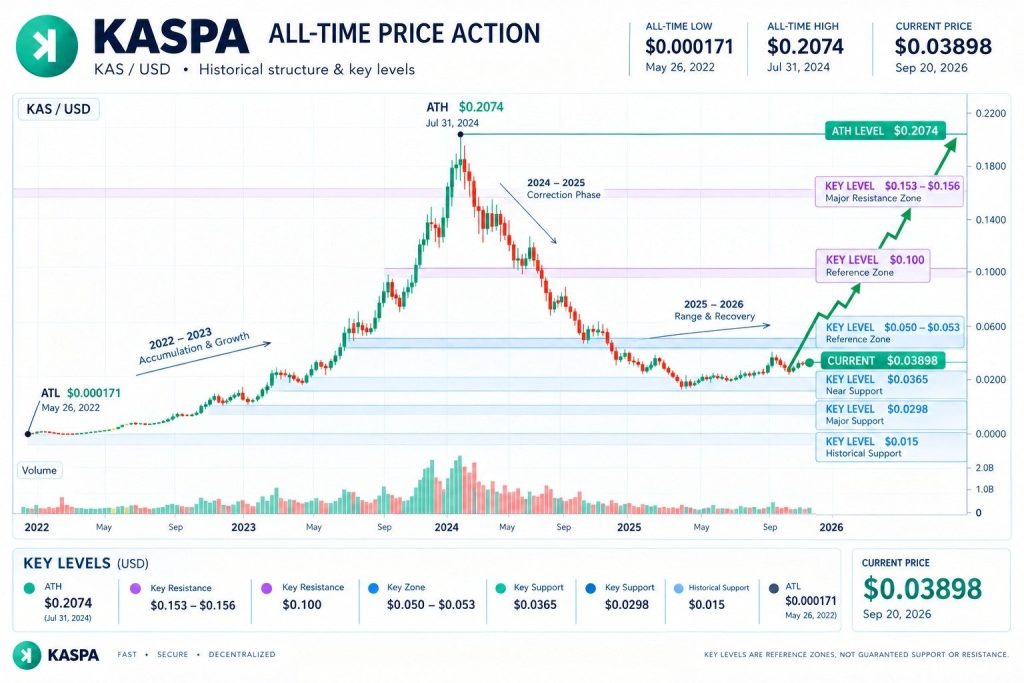
That was followed by the explosive 2024 rally that carried the token to its all-time high of $0.2074. After reaching that peak, the market entered a correction phase. The KAS price fell to roughly $0.03, a decline of about 85.5% from the top. Since then, Kaspa has moved into what Malagi describes as a range-and-recovery phase.
The recovery has already pushed the KAS price from approximately $0.03 to $0.03898. That may not sound like much compared to the previous rally, but it represents a gain of about 30% from the correction low.
Read Also: Bitcoin Could Send Kaspa Price Into a Monster Bull Run After 2.4 Billion Transaction Milestone
Kaspa’s Technology Continues to Be Part of the Bullish Story
Price action is only part of the discussion. Crypto commentator mikro pointed to Kaspa’s network performance as one of the reasons many investors continue to follow the project closely.
$KASPA the speed king. 🏆
— mikro (@mikroweller) September 21, 2026
Everyone wants their money to move fast. Nobody likes waiting.
Bitcoin is the reserve asset. Kaspa is built for moving value.
0.1-second blocks.
10 blocks per second.
Already live.
3,500+ TPS.
~10-second confirmations.
Fees so small they barely… pic.twitter.com/rOLyjWjL9B
Kaspa operates with 0.1-second block times and produces 10 blocks per second. The network is already capable of processing more than 3,500 transactions per second, with confirmations taking around 10 seconds. Transaction costs also remain extremely low.
Those figures stand in contrast to Bitcoin, which processes roughly seven transactions per second and creates a new block every 10 minutes. Bitcoin serves a different purpose, but the comparison shows why some investors view Kaspa as a network designed for fast value transfer.
Mikro also noted that the network launched without a premine, distribution has spread across the market over time, and Kaspa’s emission schedule continues to decline.
What Comes Next for the KAS Price?
The KAS price appears to be in the recovery stage of a broader market cycle. The drop from $0.2074 to roughly $0.03 reset the market. Since then, buyers have managed to defend key support levels.
For now, the focus is on $0.050–$0.053. A break above that zone would strengthen the case for a move toward $0.10, the same level both Malagi and mikro have pointed to.
Until that happens, the KAS price remains in a consolidation range. The structure remains constructive, but the next major signal will likely come from whether buyers can finally push Kaspa through resistance and turn the recovery into a larger advance.
FAQs
Subscribe to our YouTube channel for daily crypto updates, market insights, and expert analysis.