Kaspa has spent months under heavy pressure, and the recent KAS price action has done little to ease concerns. The token now trades near $0.028, which leaves it more than 85% below its all-time high. Short-term charts still point to weakness, though a growing number of analysts continue to focus on what could happen several years from now instead of the next few weeks.
That contrast has created an interesting situation. Technical indicators still favor the bears, although supporters believe the network itself looks much stronger than it did during previous market cycles. Their argument centers on technology, developer activity, and infrastructure that did not exist when Kaspa previously traded at much higher prices.
The KAS price continues to trade close to a major support zone near $0.026. That level has become one of the most important areas on the chart because a breakdown could open the door to another leg lower.
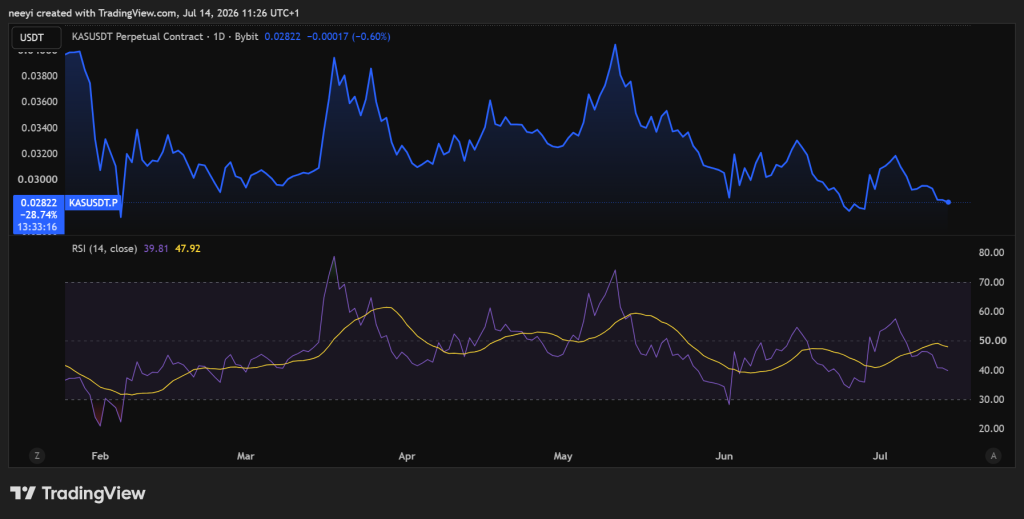
A look at the KAS chart shows that losing the $0.026 support could send the price toward roughly $0.024, which marks the 2026 low. Another decline below that level would place the psychological $0.02 support under pressure. Such a move would leave the market in a much weaker position.
Current technical indicators also lean to the bearish side.
- RSI (14): 39 – Sell
The Relative Strength Index remains close to oversold territory. That reading shows selling pressure still dominates, although extremely low RSI levels can sometimes appear before a recovery begins. - MACD (12,26): Sell
The MACD continues to produce a bearish signal. Momentum has not turned positive, which means buyers have not regained control of the trend. - Ultimate Oscillator: 37.563 – Sell
This indicator combines multiple timeframes to measure market strength. A reading below 50 points to weak buying pressure across both short and longer periods.
Taken together, these indicators suggest the KAS price may continue to face challenges unless buyers defend the current support zone.
What you'll learn 👉
Kaspa Supporters Believe the Network Looks Stronger Than Ever
Despite the weak KAS price, several well known Kaspa community members continue to focus on the project’s longer term development.
MoralBalance noted that Kaspa previously traded above $0.20 before many of today’s technological improvements even existed. The analyst pointed to several major developments that have arrived since then.
Those improvements include:
- The live 10 BPS network
- The Toccata upgrade
- Crescendo development
- Progress toward smart contracts
- Continued zk opcode research
- More of the DAGKnight roadmap
- Better mining and network optimization
- A more mature ecosystem for developers
The argument is straightforward. Supporters believe today’s network offers far more utility than it did when Kaspa reached much higher prices in the past.
KaspaDanijel also shared a longer time horizon. The analyst said the focus remains on 2028 through 2030 instead of quick price moves. The post pointed to the live Toccata Hard Fork, upcoming vProgs, future DAGKnight upgrades, and the eventual 100 BPS target as reasons behind that outlook.
Read Also: Kaspa Price Could Be About to Explode as 82% of KAS Supply Goes Silent
Developer Activity Gives Kaspa Bulls Another Reason for Optimism
Kaspa Daily recently reviewed development activity during the first 2 weeks after the Toccata upgrade went live. The data showed development continued at a healthy pace.
GitHub recorded 39 new Kaspa repositories between July 1 and July 14. June produced 58 repositories across the entire month, which means July opened at the fastest pace seen this year.
Two weeks since Toccata went live on Kaspa mainnet. I checked the actual developer numbers instead of the vibes. Here's what the data says:
— Kaspa Daily (@DailyKaspa) July 14, 2026
– New Kaspa repos on GitHub: 39 in July 1–14 alone, vs 58 in all of June. Fastest monthly pace this year (March was 52, April 78, May 70).… pic.twitter.com/sID37hz95p
The report also noted covenant-focused repositories now appear at roughly twice the rate seen before the hard fork. New tools have already entered development, including a covenant explorer, a native Layer 1 covenant token, a covenant pattern library, wallet standards, a Swift SDK, and several additional applications.
Another notable point involved artificial intelligence. Multiple independent teams started building covenant-based guardrails that could allow AI agents to spend funds only within predefined rules. Kaspa Daily also noted that the community approved $25,000 for an AI agent hackathon at Imperial College that aims to attract more than 1,000 developers.
Challenges still remain. Silverscript has not completed an audit, breaking changes continue to appear, and some developers have reported RPC deployment issues. Even so, Kaspa Daily concluded that developer activity has continued to expand since the Toccata upgrade.
FAQs
Subscribe to our YouTube channel for daily crypto updates, market insights, and expert analysis.