Kaspa has completed its largest-ever protocol upgrade, and the implications for the crypto market are crucial. The Toccata hard fork went live on June 30, 2026 and changed Kaspa from a high-speed payments network into a fully programmable Layer 1 blockchain.
This upgrade introduces native smart contracts, KRC-20 tokens, and crucially, EVM compatibility. The question now facing the market is direct: Can Kaspa leverage its technical advantages to challenge Ethereum’s long-standing dominance?
What you'll learn 👉
Kaspa’s EVM Breakthrough: Why the 200x Lower Fees Matter for KAS
The Toccata upgrade is a change in Kaspa’s value proposition. Before this upgrade, Kaspa operated primarily as a payments-focused network and relied on its GHOSTDAG protocol to process 10 blocks per second with near-instant finality. The addition of native Layer-1 covenants and EVM compatibility changes the equation entirely.
Transaction fees tell the clearest story. Ethereum’s average gas fees have remained persistently high, often exceeding $5-10 per transaction during periods of network congestion.
Kaspa's EVM layers passed a full stress test at 200x cheaper than Ethereum
— BSCN (@BSCNews) July 12, 2026
Independent testing put Kasplex and Igra through 66 operations covering token transfers, DEX swaps, lending, and NFT minting. Both scored a 100% success rate with execution identical to Ethereum Sepolia.… pic.twitter.com/iefG9wa2vn
Kaspa’s BlockDAG architecture processes transactions with fees approximately 200 times lower than Ethereum’s current rates. This cost differential is not marginal but notable for developers building DeFi applications, NFT marketplaces, and other on-chain services.
Ethereum’s scalability challenges have pushed developers toward Layer 2 solutions like Arbitrum and Optimism. While these networks reduce costs, they introduce fragmentation and additional complexity. Kaspa offers native programmability without the need for users to go through bridging mechanisms or trust additional security assumptions.
How Kasplex and Igra Passed Ethereum-Equivalent Stress Tests
The technical validation for Kaspa’s EVM implementation comes from real-world testing. Kasplex, the network’s smart contract platform, and Igra, its token standard implementation, recently passed stress tests equivalent to Ethereum’s mainnet activity levels.
These tests simulated thousands of concurrent transactions, complex smart contract executions, and token transfers across the network.
Kaspa’s BlockDAG structure processed the load without congestion and maintained confirmation times under one second throughout the testing period. The results showed that Kaspa’s throughput capabilities extend beyond simple payments to complex programmable interactions.
Ethereum’s network has historically struggled with congestion during periods of high demand and led to fee spikes and delayed confirmations. Kaspa’s ability to maintain performance under equivalent stress conditions suggests its architecture may offer a stronger foundation for mainstream DeFi adoption.
Read also: Where Is Cardano (ADA) Price Headed This Week?
What a Working EVM Could Mean for Kaspa’s Ecosystem Growth
A functioning EVM on Kaspa opens the door for quick ecosystem expansion. Developers who have built applications on Ethereum can deploy their existing code with minimal modifications and frameworks.
The introduction of KRC-20 tokens allows token creation, DeFi protocols, and NFT projects natively on Kaspa. This functionality creates network effects through liquidity pools, yield farming opportunities, and secondary marketplaces.
The Toccata upgrade also includes zero-knowledge proof verification opcodes and allows privacy features and scaling solutions directly on the base layer. This capability reduces the need for external privacy protocols or separate ZK-rollups.
KAS Price Analysis: Can the Chart Confirm the Fundamental Bullish Narrative?
Kaspa’s price is down approximately 2.39% over the last 24 hours. The 4-hour chart shows a short-term downtrend with the formation of lower highs and lower lows since the rejection from the $0.0318-$0.0320 area.
The immediate support zone is at $0.0285-$0.0287, with major support at $0.0278-$0.0280. This range produced a strong bounce previously, and buyers are expected to defend this level again. A break below $0.0280 would change focus toward $0.0270 and a sustained move above $0.0300 would mean a potential bullish reversal.
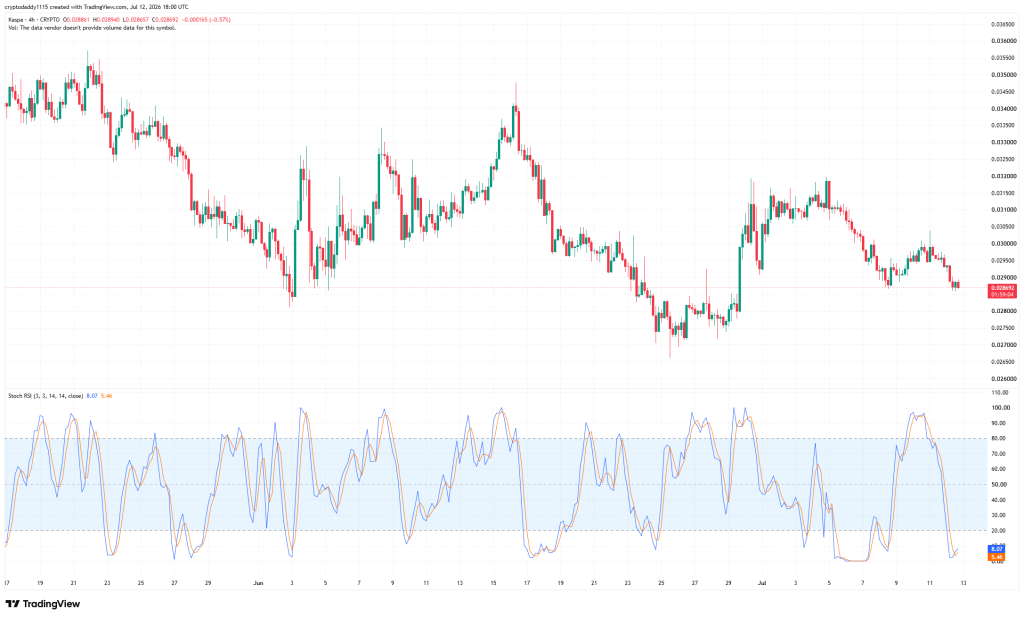
The Stochastic RSI currently reads approximately 8 for %K and 5 for %D and places the indicator deep in oversold territory. While oversold conditions do not guarantee an immediate rally, they suggest selling momentum has become stretched.
Resistance levels at $0.0296-$0.0300 are the first hurdle for any recovery attempt. The major resistance zone at $0.0308-$0.0312 has rejected price multiple times in recent weeks.
Kaspa Price Prediction: Will EVM Momentum Push KAS Toward Higher Levels?
The fundamental case for Kaspa rests on the network’s ability to bring in developers and users following the Toccata upgrade. Successful ecosystem growth would drive demand for KAS tokens for transaction fees, staking, and collateral across DeFi protocols.
Near-term price action depends on whether the current support holds. The bullish scenario needs Kaspa to maintain $0.0285-$0.0280, followed by a reclaim of $0.0300 and a breakout above $0.0312. Upside targets in this scenario sit at $0.0298, $0.0308, and $0.0318.
The bearish scenario sees support fail at $0.0280, with downside targets at $0.0270 and $0.0265. A decisive close below $0.0270 would confirm continuation of the short-term downtrend and could extend losses toward the $0.0250 area.
Frequently Asked Questions
Subscribe to our YouTube channel for daily crypto updates, market insights, and expert analysis.