Kaspa has spent months moving sideways, and patience is beginning to wear thin. KAS price remains far below its previous highs, despite the project once being viewed as a serious contender for a spot among the largest cryptocurrencies in the market.
That situation could soon face an important test.
A recent analysis from the FireHustle YouTube channel argues that June 30 may become one of the most important dates in Kaspa’s history. Several developments are lining up at the same time, and they could dramatically change the narrative around KAS. Even so, one major risk continues to hang over the project.
FireHustle points to the upcoming Toccata hard fork as the first major reason for optimism.
The upgrade was released to network nodes on June 5 and is expected to activate automatically around June 30. No additional vote is required because the activation process is already underway.
The most important feature arriving with the upgrade is covenant functionality. This technology allows developers to place conditions directly on coins. Those rules can determine who receives funds, when transactions become valid, and how assets move across the network.
That functionality opens the door to native tokens, vaults, programmable assets, and more advanced applications.
FireHustle notes that Bitcoin’s own covenant proposal has remained under discussion for years. Kaspa is preparing to deploy similar functionality on a proof of work network that processes roughly 10 blocks per second.
Zero knowledge verification is another part of the upgrade. That feature gives applications privacy related capabilities without requiring the network to become a dedicated privacy coin.
The result could be a much broader ecosystem than the simple payment network many critics currently associate with Kaspa.
What you'll learn 👉
Kaspa’s Fair Launch And Supply Structure Remain Important Advantages
The second factor revolves around token supply.
More than 95% of all KAS coins have already been mined. Less than 5% remains to enter circulation. Block rewards continue to decline gradually each month, reducing the pace of new supply.
FireHustle argues that this creates a different situation from many competing projects.
Kaspa launched without a premine, initial coin offering, venture capital allocation, or team token reserve. Every coin entered circulation through mining.
That distinction matters because many cryptocurrencies still face scheduled unlock events. New tokens entering the market can create selling pressure during periods of strong demand.
Kaspa does not carry that same overhang. If demand increases after the Toccata upgrade, there is no large insider allocation waiting to enter circulation.
Supporters of KAS often point to this fair launch model as one of the project’s strongest foundations.
Kaspa Could Occupy A Unique Position In The Crypto Market
The third argument centers on Kaspa’s combination of features.
Several networks offer individual parts of what Kaspa is attempting to build. Bitcoin Cash supports covenant functionality. Ergo offers proof of work smart contracts. Stacks delivers Bitcoin connected programmability.
FireHustle argues that Kaspa could become one of the few networks that combines proof of work security, fair launch distribution, scalability, smart contract style functionality, and native programmability within a single ecosystem.
That combination could help Kaspa stand apart from other proof-of-work projects if adoption follows the technology.
Privacy features arriving through zero knowledge verification may also help the network enter conversations that have become increasingly important throughout 2025.
Adoption Remains The One Threat That Could Undermine Everything
Despite the bullish arguments, FireHustle identifies one challenge that cannot be ignored.
Technology alone has never guaranteed success.
Cardano introduced smart contracts after years of anticipation. EOS delivered impressive technical capabilities. Tezos offered strong innovation and development tools.
Each project demonstrated that advanced technology does not automatically attract developers and users.
Kaspa faces the same challenge today. Ethereum and Solana already host large developer communities, mature infrastructure, and deep liquidity. Convincing developers to move elsewhere remains difficult.
Read Also: Claude AI Predicts Kaspa (KAS) Price If Bitcoin Reclaims $80K in Q3 2026
Projects such as Kasplex and the Egra Layer 2 ecosystem show that activity is already emerging. Even so, ecosystem growth remains small compared with the industry’s largest networks.
FireHustle argues that adoption will ultimately decide whether the June upgrade becomes a turning point or simply another technical achievement.
KAS Price Analysis Shows Several Key Levels Ahead
A look at the KAS price chart shows a market that has spent months consolidating.
Kaspa has traded between roughly $0.031 and $0.04 since the end of January. That range has contained price action for several months, which makes the upper boundary especially important.
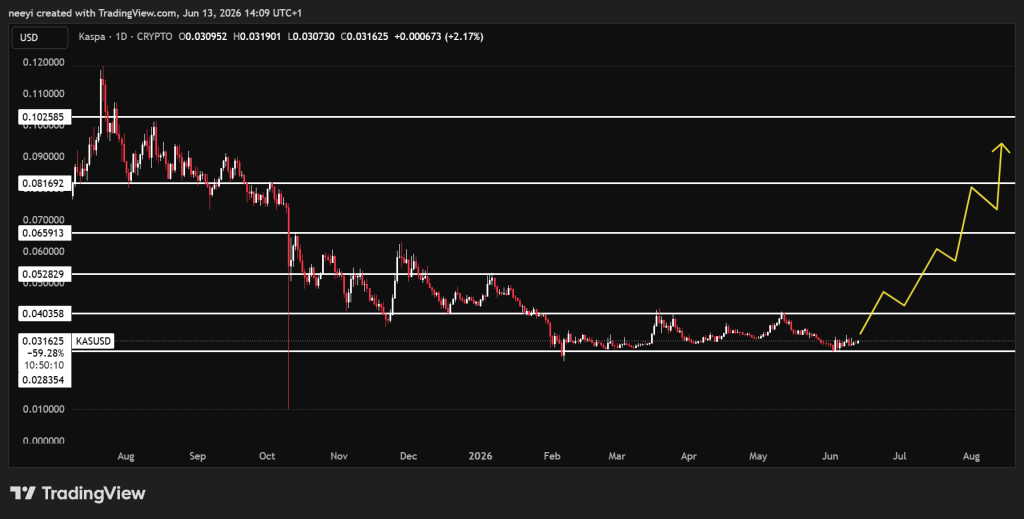
A breakout above $0.04 could open the door toward the next target near $0.052.
Buyers who successfully clear that level may then focus on resistance around $0.065. Another move higher could place $0.081 into view.
Those resistance zones may play a major role in determining how far KAS can advance during 2026.
Strong acceptance above each level would strengthen the bullish case. Repeated rejection at resistance could keep KAS price trapped below those areas for an extended period. Continued weakness could even allow lower prices to develop over time.
FAQs
Subscribe to our YouTube channel for daily crypto updates, market insights, and expert analysis.