Kaspa price has struggled a lot in recent months, and bullish moves have been difficult to sustain. Many cryptocurrencies lost ground during the more recent crypto market corrections, but Kaspa managed to hold a relatively stable trading range for some of that period.
Bitcoin price has experienced a volatile few weeks. During the past 4 weeks, BTC dropped from a high near $82,500 to a low around $59,000. Recovery efforts followed afterward, and Bitcoin price now trades close to $64,000.
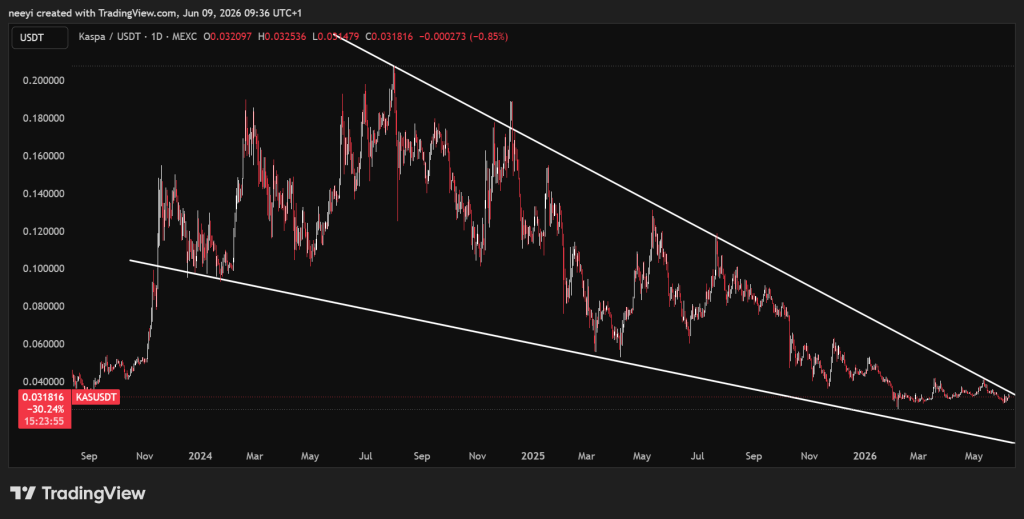
Kaspa faced pressure during the same period. KAS price declined from roughly $0.04 before entering a consolidation phase. Throughout last week, Kaspa price spent most of its time trading between $0.028 and $0.03.
A closer look at the KAS/BTC ratio reveals that Kaspa has quietly shown resilience against Bitcoin during a difficult period for the wider crypto market. That raises an interesting question. What could happen to Kaspa price if Bitcoin climbs back above $80,000 during Q3 2026?
What you'll learn 👉
Kaspa Has Recently Outperformed Bitcoin Despite Market Weakness
Recent market conditions created heavy pressure across digital assets. Despite that environment, Kaspa delivered stronger relative performance than Bitcoin over the last 30 days.
The KAS/BTC ratio has increased by 7.98% during the past month. Performance unfolded across several distinct phases.
Early May saw Kaspa outperform Bitcoin. Relative performance reached a temporary peak on May 12. Market conditions then deteriorated through the second half of May. Macro uncertainty pushed many assets lower, and KAS also lost ground against BTC during that period. The ratio eventually reached a monthly low between May 31 and June 1.
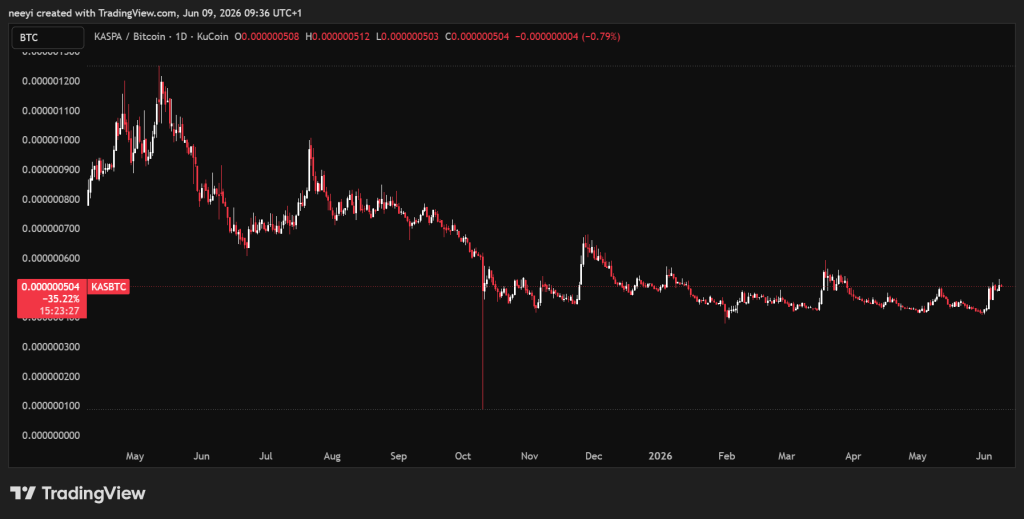
June brought a different picture. Kaspa recovered aggressively against Bitcoin and erased earlier losses. As of June 9, the KAS/BTC ratio stands at approximately 0.000000504 BTC. That recovery pushed monthly performance back into positive territory.
That development matters because relative strength often reveals where capital is holding up best during difficult market conditions.
Kaspa Price Remains Closely Connected to Bitcoin Price
Kaspa no longer trades independently from Bitcoin the way it did during its earlier growth phase.
Current market data shows a strong positive correlation near 0.81 between KAS and BTC. That means Kaspa usually follows the same direction as Bitcoin price. The difference is that Kaspa often moves much more aggressively.
Early in its history, Kaspa traded mostly on project specific developments and smaller liquidity pools. Mid-2023 through mid-2024 brought a major period of price discovery. Technology developments such as GHOSTDAG and KRC-20 generated strong standalone interest and allowed Kaspa to move independently from Bitcoin.
Conditions changed after the 2024 market peak. Deeper exchange liquidity and broader market participation tied Kaspa much more closely to Bitcoin’s direction. Since then, KAS has generally traded within a correlation range between 0.70 and 0.85.
Historical performance shows another important pattern. Kaspa often acts as a high beta version of Bitcoin.
During a bullish phase in spring 2025, a 21% Bitcoin rally translated into a 41% gain for KAS. The opposite effect appears during corrections. A previous 33% decline in Bitcoin coincided with a much deeper 70% drop for Kaspa.
That multiplier effect remains one of the key reasons investors monitor Bitcoin price so closely when evaluating Kaspa’s outlook.
Several Major Catalysts Could Influence Kaspa Price in Q3 2026
Q3 2026 could become one of the most important periods in Kaspa’s development history.
The first catalyst is the upcoming DAGKnight protocol upgrade. The hard fork is expected near the end of Q3 and aims to improve network efficiency and security. Successful deployment could strengthen confidence in the network. Any delays could slow price appreciation during the quarter.
Another important development comes from the upcoming Toccata hard fork. That upgrade will transform Kaspa into a programmable Layer 1 network capable of supporting KRC-20 tokens, decentralized applications, and advanced smart contract functionality.
Adoption now becomes the critical factor. Growth in decentralized finance activity, rising developer participation, and increasing on chain usage could create stronger demand for KAS tokens.
August could introduce another major event. Kasplex plans to launch its EVM compatible Layer 2 solution during Q3. Ethereum developers would gain the ability to migrate applications onto Kaspa without rebuilding everything from scratch.
Supply dynamics may also play a role. Kaspa’s Chromatic emission schedule continues reducing new token issuance. More than 95% of the maximum 28.7 billion supply is already circulating. Lower daily issuance means future demand growth could have a larger impact on price.
Claude AI Provides Three Kaspa Price Scenarios If Bitcoin Returns Above $80,000
We asked Claude AI what Kaspa price could look like if Bitcoin reclaims the $80,000 level during Q3 2026. The model outlined 3 possible outcomes based on different market conditions.
Pessimistic Scenario Places Kaspa Price Between $0.045 And $0.055
This scenario assumes Bitcoin moves above $80,000 but fails to ignite a broad altcoin rally.
Kaspa benefits from Bitcoin’s recovery, yet upside remains limited. Minor delays surrounding DAGKnight reduce enthusiasm, and adoption of Toccata features develops more slowly than expected.
Kasplex launches successfully but attracts only modest developer activity. Reduced sell pressure provides support for KAS price, though demand remains moderate.
Under those conditions, Kaspa could finish Q3 between $0.045 and $0.055.
Realistic Scenario Places Kaspa Price Between $0.07 And $0.09
This outcome assumes Bitcoin establishes itself comfortably above $80,000 and market conditions improve across major altcoins.
Kaspa’s historical multiplier effect begins to appear. Developer activity increases after the Toccata upgrade, and early decentralized applications start attracting users.
Kasplex receives meaningful attention from developers looking for lower fees and faster transactions. DAGKnight remains on schedule, which supports positive sentiment heading into deployment.
Supply tightening adds another supportive factor. Combined demand growth could push KAS into a range between $0.07 and $0.09 before the end of Q3.
Optimistic Scenario Places Kaspa Price Between $0.13 And $0.18
The bullish scenario assumes Bitcoin’s move above $80,000 develops into a much larger market rally.
Capital rotates aggressively toward utility-focused altcoins. Toccata adoption accelerates quickly, decentralized finance activity expands, and developer participation grows sharply.
Read Also: XRP Price Hits the Level We’ve Waited Months For – Two Paths Forward
Kasplex becomes a major success story. Several established Ethereum applications migrate into the ecosystem and bring new capital with them.
DAGKnight launches smoothly and strengthens Kaspa’s reputation as a scalable proof-of-work network. Tight supply conditions amplify the impact of rising demand.
Those combined factors could push Kaspa price into a range between $0.13 and $0.18 by the end of Q3 2026.
FAQs
Subscribe to our YouTube channel for daily crypto updates, market insights, and expert analysis.