
Gold and Bitcoin moved in opposite directions on September 21, even though both assets are often described as protection against weaker fiat currencies. Bitcoin price climbed more than 7% and reached approximately $87,000 for the first time since January. Gold price dropped toward the $4,340 region during the same period.
That unusual split becomes easier to understand once interest rates, the US dollar, market liquidity, and leveraged crypto positions enter the picture. Gold currently faces pressure from several macroeconomic forces. Bitcoin received support from an entirely different combination of catalysts that turned an initial price rise into a much larger move.
The difference does not mean investors have permanently abandoned gold for Bitcoin. Current market conditions simply favor each asset in very different ways.
What you'll learn 👉
Higher Interest Rates And A Stronger Dollar Are Hurting Gold Price
Gold price has fallen about 20% from its January 2026 record of $5,595.46 per ounce. The latest decline extended that medium term correction and brought gold back toward $4,300 at th time of writing.
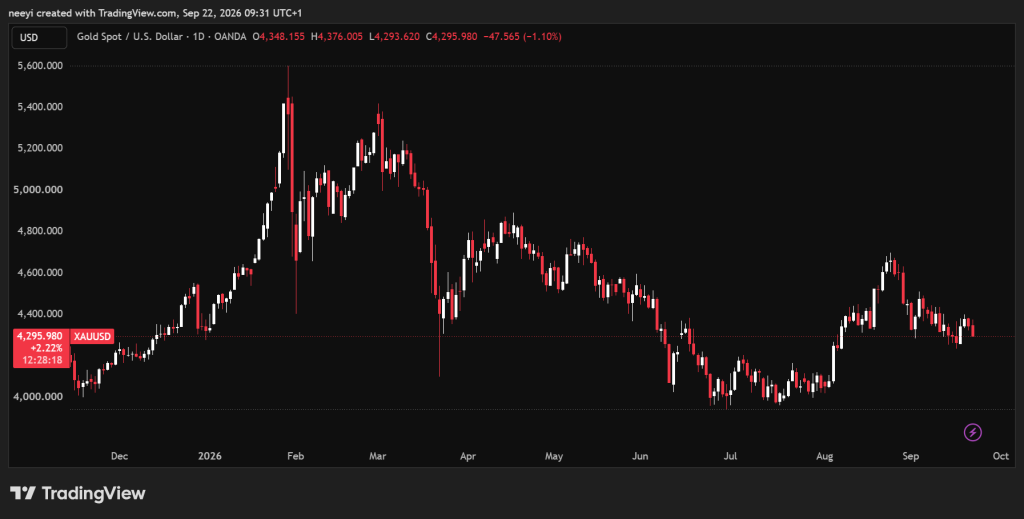
Federal Reserve policy remains one of the main reasons behind the weakness. The central bank recently increased interest rates by 25 basis points, which took its benchmark range to 3.75% to 4.00%.
Comments from Federal Reserve officials also pointed to inflation remaining stubborn across several parts of the economy. Market pricing consequently placed the chance of another rate increase near 88%.
Higher interest rates usually create problems for gold because the metal does not produce interest. Short term government bonds, savings products, and other yield bearing assets become more appealing whenever rates rise. Investors must therefore accept a larger opportunity cost when they hold gold instead.
The US dollar has also strengthened as expectations for tighter monetary policy have increased. Gold carries a dollar denominated price across international markets. Buyers who use other currencies must pay more whenever the dollar becomes stronger, which can reduce demand around the edges.
Several forces are currently working against gold:
- Higher interest rates make yield bearing assets more competitive against gold.
- Stronger dollar conditions make bullion more expensive for international buyers.
- Lower oil prices have reduced immediate concerns about energy driven inflation.
- Stronger equity markets have encouraged capital to leave defensive assets.
Gold often performs well during geopolitical uncertainty and economic stress. Currency movements and bond yields can still overpower that safe haven role during shorter periods.
Lower Oil Prices Have Reduced Gold’s Inflation Hedge Appeal
Crude oil prices have declined across several consecutive sessions. That decline matters because energy costs can affect transportation, manufacturing, and consumer prices throughout the economy.
Rising oil prices had previously added pressure to inflation expectations. Recent weakness across the oil market has reduced some of those immediate concerns. Gold becomes less urgent as an inflation hedge when investors expect price pressures to cool.
This creates an unusual policy combination for the gold price. Inflation remains high enough to keep the Federal Reserve hawkish, but falling oil prices have weakened demand for traditional inflation protection.
Gold’s earlier 2026 record came during very different conditions. Aggressive trade policies, conflict across the Middle East, and expectations for Federal Reserve rate cuts supported demand during January.
Kevin Warsh’s appointment as Federal Reserve chair changed the policy outlook. A resilient US economy and stubborn inflation led markets to prepare for tighter policy instead of rate cuts. Real bond yields remained elevated as a result, which limited gold’s ability to return toward its record.
Bitcoin Price Benefited From A $648 Million Short Squeeze
Bitcoin price faced the same interest rate environment as gold, although crypto market positioning created a very different outcome. Bitcoin’s initial rise forced bearish leveraged positions to close across major exchanges.
The move produced approximately $648 million in short liquidations across the broader crypto market. Short sellers borrow or use leveraged contracts to bet that an asset will decline. A rising price can force those traders to repurchase the asset or close their contracts before losses become larger.
Those forced purchases can push Bitcoin price higher and place even more pressure on remaining short positions. That cycle helps explain how an ordinary recovery can quickly become an outsized daily move.
Gold futures also involve leverage, although the gold market does not usually face crypto’s combination of retail leverage, round the clock trading, and rapid liquidations. Bitcoin therefore reacts more aggressively when too many traders gather on one side of the market.
The short squeeze did not create the entire Bitcoin rally. It acted as an accelerator after demand had already started improving.
ETF Inflows And Stronger Technology Stocks Supported Bitcoin
Broader market conditions also favored assets connected to growth and speculation. Technology shares advanced during Monday’s session, AMD crossed a $1 trillion market value, and the Nasdaq reached a new record.
Bitcoin often carries 2 identities during different market periods. Investors can treat it as a scarce asset over longer periods, but its daily price movements frequently resemble those of a high growth technology asset.
Improved confidence across technology stocks therefore supported Bitcoin. Gold responded differently because investors usually treat bullion as a defensive holding. Capital can leave gold when confidence returns and investors pursue assets with greater upside potential.
Spot Bitcoin exchange traded funds provided an additional source of demand. Those products recorded approximately $999 million in net inflows, which brought fresh institutional liquidity into the crypto market.
Crypto policy developments also contributed to the improved environment. The CLARITY Act remains stalled in the Senate, but public support for digital asset adoption from the CFTC and SEC helped sentiment during the weekend.
Gold received no comparable burst of new demand during the same 48 hour period. The difference in immediate capital flows helped Bitcoin price reach $87,000 as gold price continued lower.
Gold And Bitcoin Still Serve Different Roles
Gold and Bitcoin share several broad investment arguments. Both have limited supplies compared with currencies that governments can create, and both have benefited from concerns about US debt exceeding $40 trillion.
Their shorter term behavior remains very different. The 120 day correlation between Bitcoin and gold recently reached a 6 year high of positive 0.52, but that number does not guarantee that both assets will move together every day.
| Feature | Gold | Bitcoin |
|---|---|---|
| Main recent driver | Higher real yields and a stronger dollar pressured gold price | ETF inflows and forced short liquidations supported Bitcoin price |
| Volatility profile | Gold usually records smaller daily price movements | Bitcoin can record large intraday price movements |
| Reaction to stronger confidence | Defensive demand can weaken as equities rise | Crypto can benefit alongside technology stocks |
| Main investment role | Gold serves as a traditional store of value | Bitcoin combines scarcity with speculative technology exposure |
This distinction explains the latest divergence. Gold currently trades like a defensive asset during a period of stronger risk appetite. Bitcoin currently trades closer to a high beta technology asset supported by institutional flows and a leveraged short squeeze.
Gold Analyst Expects A Possible Reversal Above $4,300
Itsadiee_Fx believes gold’s decline could be preparing the market for another reversal. The analyst noted that gold spent much of Monday moving sideways before price pressure weakened buyers and restored confidence among sellers.
Friday’s close below $4,400 encouraged bearish positions. A double bottom style formation near Friday’s lows also gave buyers a reason to enter. Monday’s decline then placed those buyers under pressure and created a lower high structure.
XAUUSD .
— Itsadiee_Fx (@Itsadiee1) September 21, 2026
🚨GOLD IS ABOUT TO FOOL EVERYONE AGAIN
Gold spent most of Monday trading sideways, but underneath that consolidation, something interesting was happening.
The market started shaking buyers out.
Traders who tried to build buying positions during Monday were trapped… https://t.co/GmAM9BuB5f pic.twitter.com/k3K7vFip1A
Itsadiee_Fx expects Monday’s low near $4,323 could break before a meaningful recovery begins. Such a move would remove liquidity below that level and could prepare gold for a rebound toward $4,370.
Price could face another temporary decline near $4,370 before attempting a larger move above $4,400. The analyst believes that breakout could arrive within several hours or during Tuesday’s New York session if buyers regain control.
The important levels from this analysis include:
- A break below $4,323 could remove liquidity before a reversal develops.
- A recovery above $4,340 would support the analyst’s bullish intraday view.
- The $4,370 region could become the first major recovery target.
- A firm move below $4,300 would weaken the bullish outlook.
The analyst’s argument focuses on market psychology. A direct decline toward $4,300 would offer sellers a relatively clear path. An early reversal could instead trap late sellers and leave prospective buyers waiting for an entry that never arrives.
Gold price remains under macroeconomic pressure, but its technical structure leaves room for a shorter recovery if $4,300 survives. Bitcoin price has stronger immediate liquidity support, although a rally powered partly by liquidations can remain volatile.
FAQs
Subscribe to our YouTube channel for daily crypto updates, market insights, and expert analysis.