
Gold price per ounce is worth around $4,350 after a relatively quiet week, with little overall movement despite renewed investor interest in the precious metal.
Even though gold has struggled to establish a convincing recovery, investors have continued adding to gold-backed exchange-traded funds (ETFs).
The Kobeissi Letter has identified a growing divergence between ETF holdings and the price of bullion, raising the possibility that gold could eventually return above $5,000.
What you'll learn 👉
Gold ETF Holdings Are Rising Even as Prices Struggle
According to The Kobeissi Letter, gold ETF holdings tracked by Bloomberg have climbed to approximately 100 million ounces, approaching their highest level in at least nine months.
Holdings have increased by more than 4 million ounces since their July low, recovering the decline recorded between April and July.
The report also identifies eight consecutive trading days of inflows into gold-backed ETFs, the longest such streak since October 2025.
The broader demand trend is supported by data from the World Gold Council. Its September 9 report showed that global physically backed gold ETFs attracted $18 billion in August, bringing their holdings to a record 4,189 tonnes.
These figures demonstrate that investment demand has remained substantial even as gold prices have encountered resistance.
However, ETF inflows represent only one component of the gold market. Futures positioning, central bank purchases, jewelry demand, interest rates and currency movements can all influence the price.
Gold Price Chart Reveals an Unusual Divergence
The Kobeissi Letter’s chart compares gold ETF holdings, represented by the orange line, with spot gold prices, shown in white.
From March through mid-August, the two series generally moved in the same direction.
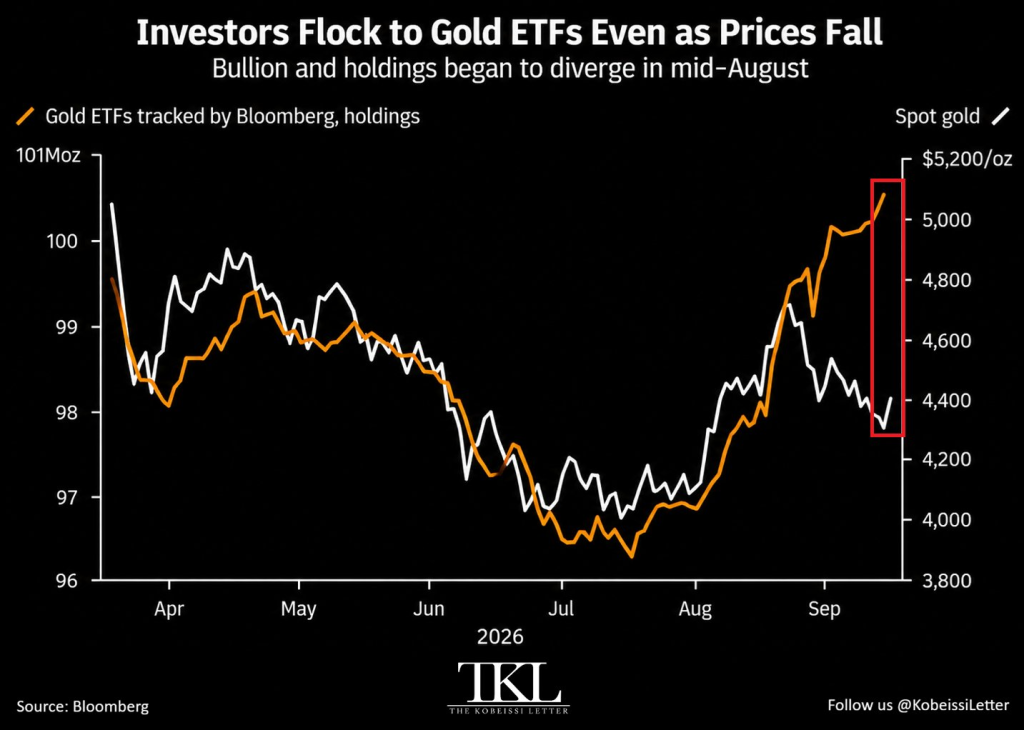
Both declined into the summer, with ETF holdings approaching 96 million ounces in July while gold fell toward $3,900.
The relationship began to change in mid-August.
ETF holdings recovered rapidly, climbing from approximately 97 million ounces to nearly 100 million ounces by September. Gold initially followed the recovery, rising toward $4,800, but subsequently reversed course.
The most recent section of the chart shows the divergence clearly: ETF holdings continue climbing toward their previous highs, while gold has retreated toward $4,350–$4,400.
This is the central observation behind The Kobeissi Letter’s bullish argument.
If bullion prices eventually catch up with the increase in ETF holdings, the publication believes gold could climb above $5,000 in the coming months.
From the current price of approximately $4,350, reaching $5,000 would require a gain of around 15%.
Nevertheless, the chart does not establish that gold must follow ETF holdings higher. The two lines use different vertical scales, and their historical relationship is not a predictive formula.
It is also possible for the divergence to close through slower ETF buying or declining holdings rather than a rally in bullion.
Read also: This Analyst’s Gold Price Prediction Is Surprisingly Simple
Gold Price Outlook: Could $5,000 Be Next?
The growing demand for gold ETFs provides a potentially supportive backdrop, but the price still needs to overcome several technical and macroeconomic obstacles.
The $4,400–$4,500 region is the first area to monitor. A sustained recovery above it could bring $4,600–$4,800 back into focus, followed by the psychologically important $5,000 level.
On the downside, $4,300 is an immediate reference point, while a deeper decline could put the $4,000–$4,100 region back in play. These are approximate price zones, of course.
Interest rates remain another important consideration. Higher bond yields increase the opportunity cost of holding non-yielding gold, while a stronger dollar can make bullion more expensive for buyers using other currencies. These pressures were evident in gold-market reporting ahead of the Federal Reserve’s September decision.
The takeaway is that gold ETF investors are buying aggressively, but bullion prices have yet to reflect that demand. A recovery above $4,500 would improve the near-term picture, while a move toward $5,000 remains a conditional scenario rather than an inevitable consequence of ETF inflows.
For more financial news and price predictions, click here.
Subscribe to our YouTube channel for daily crypto updates, market insights, and expert analysis.