The Clarity Act just cleared its first big test. The Senate Banking Committee voted 15 to 9 to move it forward. Two Democrats joined Republicans on that vote. So this is not just one party’s thing anymore. People see it as a market need.
Now the bill goes to the full Senate. Lawmakers there will decide if the U.S. finally gives digital assets a real set of rules.
The bill is not law yet. It still needs a full Senate vote. Then someone has to match it with versions from the House and the Agriculture Committee. That will take more work.
For Kaspa, the timing of this bill lines up with one of the busiest stretches the project has ever seen.
Kaskad, KAS DeFi mainnet on the Igra Network goes live on May 24. People can now borrow USDT and USDC by putting up KAS as collateral. The protocol set a $250,000 goal for total value locked. The Kaspa Ecosystem Foundation is helping with oracle data. This is one of the first real DeFi uses built directly on Kaspa.
Kaspa is also getting ready for the Toccata hard fork. That is set to happen between June 5 and June 20. The upgrade will bring native KRC-20 tokens, SilverScript covenant programming, and zero-knowledge proof tools.
Meanwhile, the network has already handled over 2.1 billion transactions. It runs at 10 blocks per second. Data also shows that more than 95.5% of all KAS that will ever exist, 28.7 billion coins, is already mined.
With the KAS price trading near $0.03438, traders are now watching one question closely. Which one moves the price more: new rules in Washington or new things built on the network?.
What you'll learn 👉
What Will the CLARITY Act Do for Kaspa and Other Crypto?
The CLARITY Act could be one of the biggest things to happen for proof-of-work coins in years.
The bill sets up a test. It asks whether a blockchain is truly decentralized. If it is, then it can be called a digital commodity. Kaspa fits most of the boxes. It launched fairly. No pre-mine. No early VC deals. Just a clean proof-of-work system. If the bill passes, KAS would likely go under CFTC watch, not the SEC.
That matters. Big investors have stayed away from many altcoins because they did not know if the law would come after them later. A clear commodity label could make U.S. exchanges, custodians, and investment firms feel safe supporting Kapsa (KAS) without fearing a future lawsuit.
Kaspa already has some big names involved. MARA Holdings mines it. Zodia Custody, backed by Standard Chartered, holds it too. Clear rules could open the door for even more money to flow in.
The bill also changes the rest of crypto. Coins that raised money through ICOs may still fall under SEC oversight. Decentralized projects get clearer protection. Stablecoins get handled by banking regulators. Exchanges face tougher rules about keeping customer money separate from their own.
Projects like XRP, which fought legal battles for years, could finally get permanent labels. That kind of clarity could remove a huge wall that has slowed crypto adoption in the U.S.
What Is Pushing the Kaspa Price Today?
The biggest driver behind the KAS price right now is the Toccata upgrade. The hard fork turns Kaspa into a programmable Layer 1.
It adds native token support and covenant scripting. Traders usually price in big upgrades weeks before they go live. That is especially true when those upgrades make the network do more than just send payments.
Supply economics are also supporting the KAS price. About 95.4% of the total supply is already circulating, leaving limited future emission pressure compared to many Layer 1 competitors. Most newer chains still face large unlock schedules that dilute holders over time.
Kaspa’s monthly reward reductions create a tighter supply structure, which means price reacts more directly when new demand enters the market.
Institutional infrastructure and DeFi development are adding another bullish factor. Kaskad’s mainnet launch introduced lending and borrowing directly into the ecosystem, while Zodia Custody and MARA Holdings continue adding institutional credibility.
Also, traders are still cautious because previous rallies saw network activity cool sharply afterward. Sustainable adoption will matter more than speculation if Kaspa wants to maintain higher valuations through 2026.
Related Kaspa News: Here’s Where Kaspa (KAS) Price Could Be Headed This New Week?
Kaspa Chart Analysis
We had a look at the KAS chart, and the market is trying to stabilize after a strong rejection near $0.041. Price rose steadily in early May. Then sellers stepped in hard near the local top. Since then, KAS has made lower highs and drifted back toward $0.034. Buyers are trying to build a floor there.
Signals from momentum tools are mixed. The stochastic oscillator moved back above 50 after resting near oversold territory. That points to short-term recovery tries.
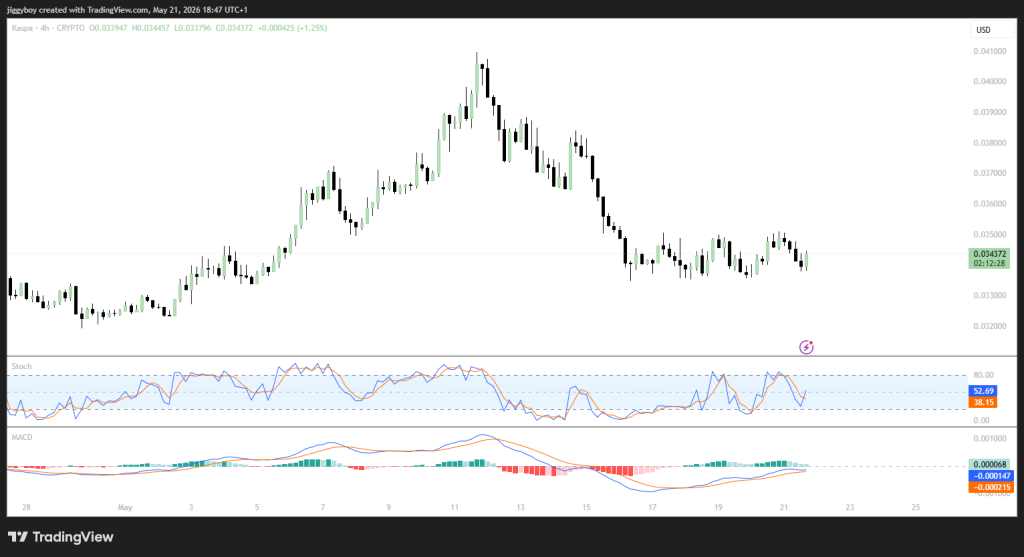
The MACD histogram bars turned green again after a long red stretch. This is a clear indication that selling momentum is waning. However, the MACD lines remain fairly tight. This indicates that traders have not been able to completely commit to a breakout move.
From the buyers’ side, the important area remains between $0.038 and $0.041. A breakout past this level would give bulls room to run higher.
Looking lower, support around $0.033 has been tested repeatedly throughout May. Breaking this level would put focus on another key area just below $0.030
GROK AI Predicts the Kaspa (KAS) Price if the CLARITY Act Gets Delayed to 2027
Likely Case
If the CLARITY Act is delayed to 2027, GROK expects the KAS price to trade between $0.028 and $0.045 through late 2026 as institutional participation stays limited by regulatory uncertainty.
Even with slower U.S. adoption, Kaspa’s fundamentals remain strong because of the Toccata hardfork, the Kaskad DeFi launch, and more than 2.1 billion recorded transactions. GROK projects KAS could finish 2026 between $0.038 and $0.042 if network usage continues expanding organically.
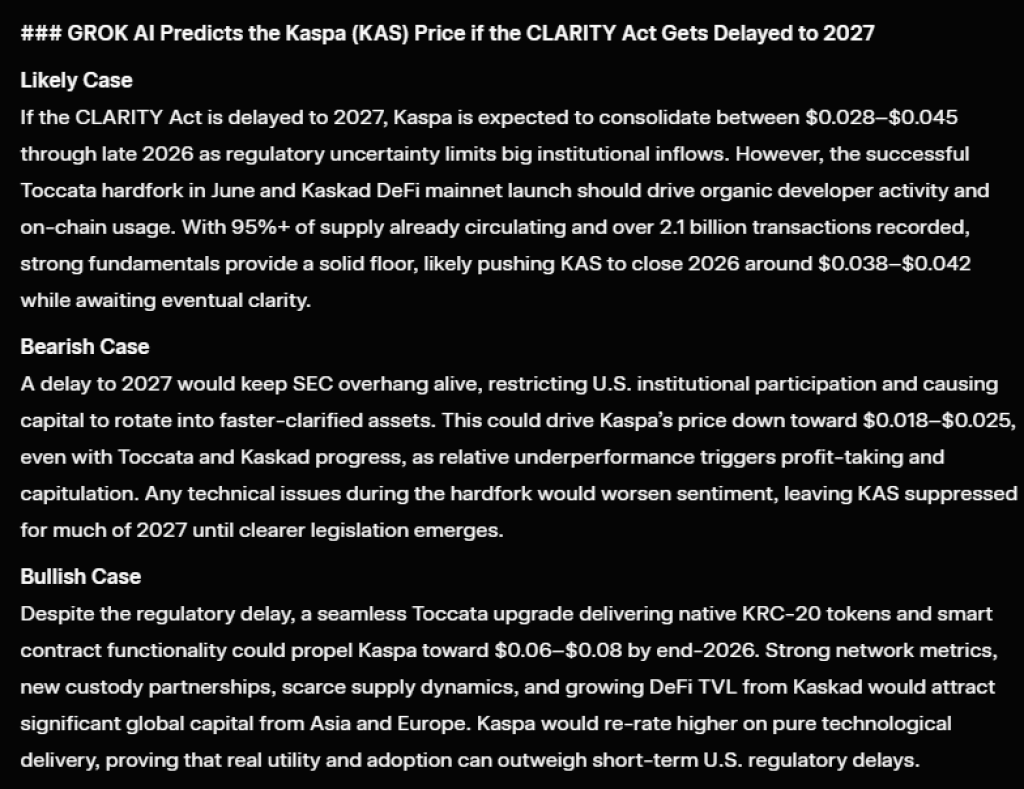
Bearish Case
The delayed legislation keeps SEC uncertainty alive and pushes capital toward assets with clearer regulatory status. GROK estimates the KAS price could fall toward $0.018 to $0.025 if market sentiment weakens and traders rotate into larger established cryptocurrencies. Any technical problems tied to the Toccata rollout would also increase downside pressure and keep KAS suppressed for most of 2027.
Bullish Case
The hopeful view assumes Kaspa keeps growing even without clear U.S. rules right away. GROK predicts the Kaspa price could rise toward $0.06 to $0.08 by the end of 2026. That depends on three things: the Toccata launch going smoothly, more people using KRC-20 tokens, and more value locked in Kaspa’s DeFi apps.
Tight supply, more big investors holding KAS, and active building on the network could help Kaspa do better than many other Layer 1 projects, even with delays around the CLARITY Act.
Frequently Asked Questions
Subscribe to our YouTube channel for daily crypto updates, market insights, and expert analysis.