Crypto portfolios no longer live on one chain. A typical user holds tokens on Ethereum, stablecoins on Base, and positions on Arbitrum or Solana. Add a couple of exchange accounts and a hardware wallet, and the picture fragments fast. Any app that wants to show a clear net worth has to pull all of that together.
That aggregation is the hard part. Balances sit across dozens of chains. DeFi positions hide inside lending markets, liquidity pools, and staking contracts. Prices move by the second. A multichain portfolio API does this heavy lifting for you. It returns normalized balances, positions, and values through one interface.
“Portfolio API” still means different things, though. A consumer wallet needs fast net-worth totals and clean token lists. A tax or accounting tool needs deep transaction history. A DeFi dashboard needs per-protocol position detection. No single provider wins every category, so teams sometimes combine two.
This guide covers five providers worth weighing in 2026. For a wider view, our developer deep dive on top crypto APIs compares the field. Teams building on a single chain can also check our Ethereum API providers guide. Each provider below is built around wallet and portfolio data, not just market prices.
What you'll learn 👉
At a Glance
Here is a side-by-side view of what matters most when picking a multichain portfolio API.
| CoinStats Wallet API | Zapper API | Covalent GoldRush | Dune SIM API | Unmarshal | |
| Primary focus | All-in-one wallet, portfolio analytics, and market data | Onchain portfolio and DeFi positions | Foundational multichain wallet data | Realtime onchain data primitives | Multichain DeFi data and notifications |
| Wallet balances | Yes (Solana, EVM, Bitcoin incl. xpub) | Yes (tokens, apps, NFTs) | Yes (ERC-20, native, more) | Yes (ordered by USD value) | Yes (balances and P/L) |
| DeFi position detection | Yes (per-wallet, 10,000+ protocols) | Yes (LPs, lending, staking) | Via balance and staking data | Yes (protocol coverage) | Yes (lending, borrowing, LP) |
| Market / exchange data | 100,000+ coins, 200+ exchanges | Onchain token prices | Spot and historical prices | Token metadata and prices | DEX price feeds |
| Chains supported | 120+ | 60+ | 100+ | 60+ | 40+ |
| Free tier | Yes | Trial credits | Yes (free API key) | Yes | Yes |
1. CoinStats Wallet API
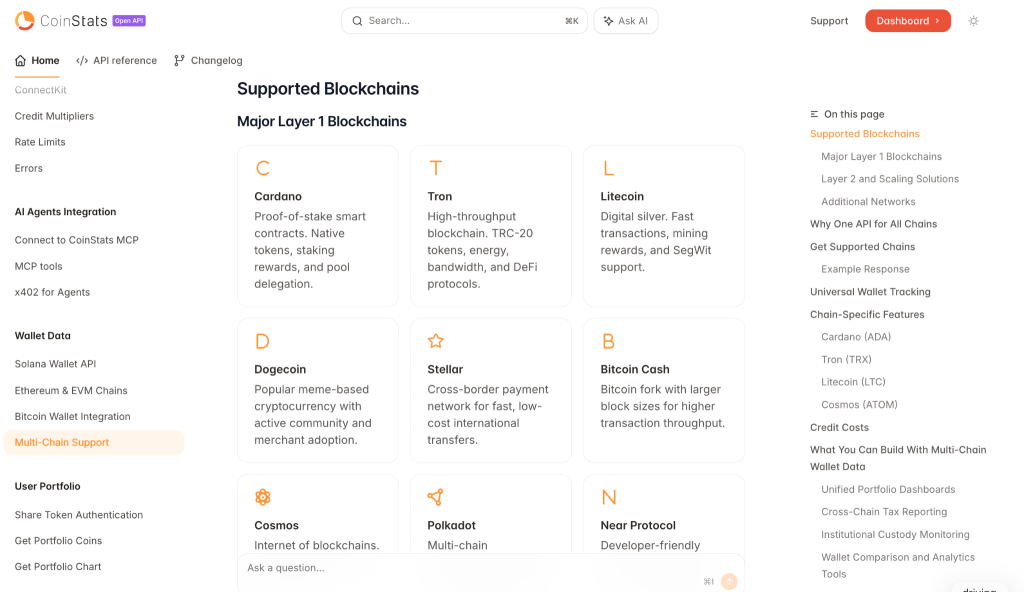
CoinStats Wallet API covers a wider surface than most providers in this category. Many specialize in one layer. Some return raw onchain balances. Others focus on DeFi positions or market prices. CoinStats covers all of it in one platform, with portfolio analytics on top.
The data spans 100,000+ coins, 200+ exchanges, and 120+ blockchains. Exchange coverage includes Binance, Coinbase, and Hyperliquid. The same API reads wallet data for Solana, EVM chains, and Bitcoin. Bitcoin support extends to extended public keys, so xpub, ypub, and zpub addresses resolve to full balances.
What the wallet layer looks like. One endpoint returns the token inventory of any address. A single call pulls EVM balances across Ethereum, Polygon, BNB Chain, Arbitrum, and more. Transaction histories follow the same shape on every chain. There is one response format to learn, not one per network.
Per-wallet DeFi detection. CoinStats auto-detects positions across 10,000+ DeFi protocols. That means staking, lending, and liquidity positions tied to a specific wallet. It is not a generic protocol directory. This is the layer most portfolio APIs leave you to build yourself.
Portfolio analytics. Developers can read portfolio data users already manage inside CoinStats. That includes total value, holdings breakdown, P/L charts, and allocation over time. It suits backtesting, risk metrics, or an embedded live portfolio view.
Token risk scanning. CoinStats scores any token for smart-contract risk. It runs on Hexens’ Glider analysis engine. The response returns an overall score and severity-ranked findings in plain English. It flags honeypots and other exploit patterns across 22 risk categories. It uses the same API key, with no separate security vendor.
Developer communities often describe it with a simple formula: CoinStats API = market data + wallets + DeFi + portfolio analytics + token security. The wallet, DeFi, and security layers set it apart, usually at a lower price.
CoinStats also ships an MCP server. CoinStats MCP Server exposes wallet, DeFi, and portfolio data as tools for AI agents and coding assistants. It uses the same API key as REST, so there is no extra setup. Most competitor MCP servers expose market data alone.
Pricing is credit-based with a free tier. For breadth across wallet, DeFi, market, and portfolio data, it is the best option for most crypto use cases. CoinStats breaks the category down further in its crypto wallet API guide.
2. Zapper API
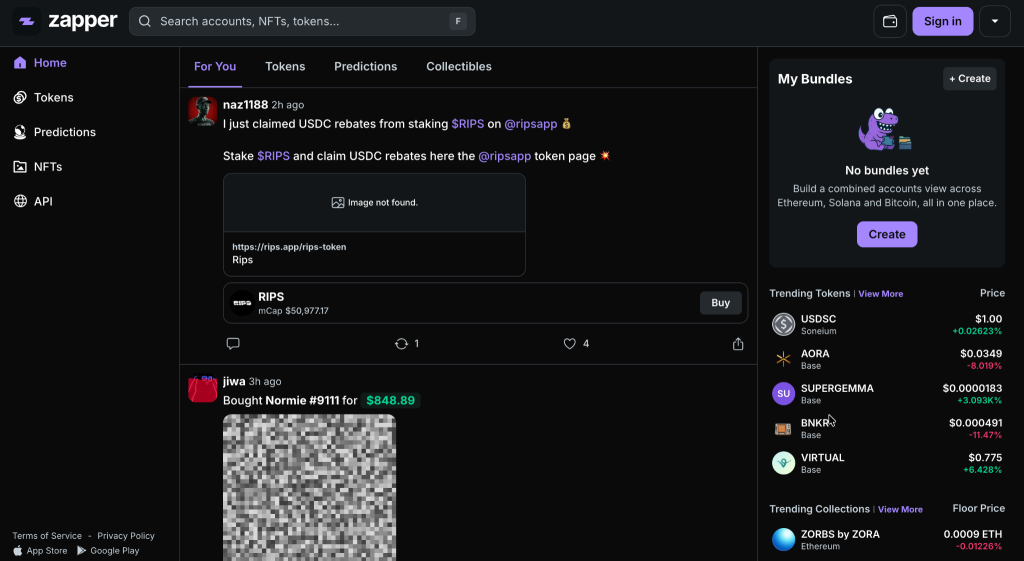
Zapper API began as a DeFi dashboard and grew into a developer data API. It aggregates onchain portfolio data through a single GraphQL endpoint. Coverage spans 60+ chains across major Layer 1 and Layer 2 networks.
One query returns tokens, DeFi app positions, and NFT holdings with USD values. The response breaks balances down by network, so net worth is easy to assemble. DeFi coverage includes liquidity pools, lending, and staking across major protocols.
Transactions come back in human-readable form. Instead of raw logs, you get descriptions and asset deltas. The GraphQL interface lets you request only the fields you need, which keeps responses lean.
Zapper stays focused on onchain data. It does not aggregate exchange accounts or carry the market-data breadth of an all-in-one provider. Pricing runs on a credit model, and an API sandbox lets you test queries before integrating.
Zapper fits teams building DeFi dashboards and onchain portfolio views where position depth matters more than exchange coverage.
3. Covalent GoldRush
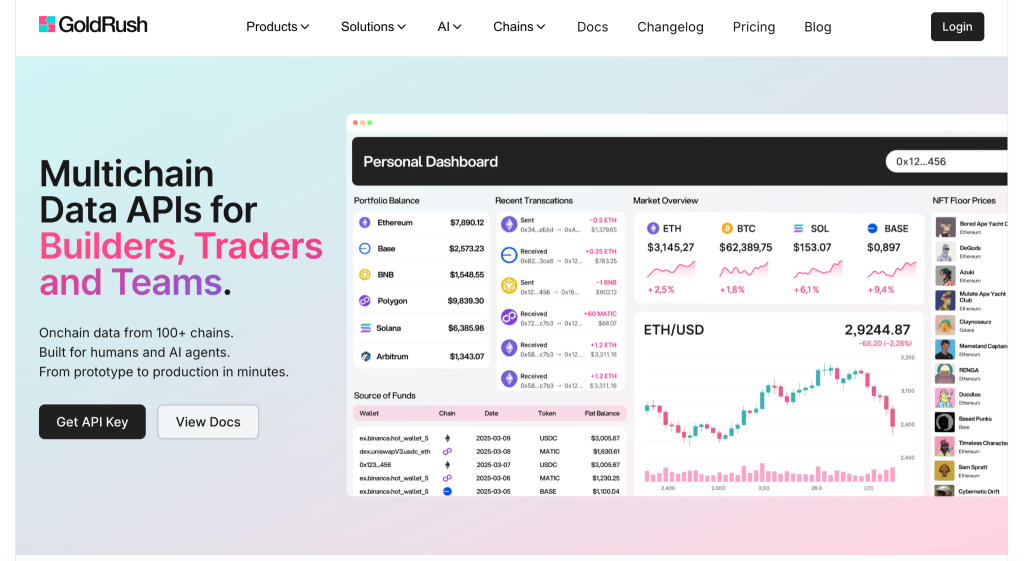
Covalent GoldRush provides foundational multichain wallet data across 100+ chains. It has run in production since 2018 and is SOC 2 compliant. Teams like Rainbow and ThorWallet use it for balances and transactions at scale.
The wallet API returns ERC-20, native, and other token balances through a unified schema. Responses include spot and historical prices with built-in fiat conversion. Every supported chain is archived from the genesis block, so historical queries stay reliable.
The schema is consistent across chains. One integration gives you balances, transactions, and event logs everywhere. Balances are queried per chain, though a wallet-activity endpoint surfaces which chains an address uses. GoldRush also ships React components for common portfolio and token views.
Pricing starts with a free API key and scales on a usage-based credit model. Enterprise plans add higher limits and support.
GoldRush suits wallets, portfolio trackers, and tax tools that need broad EVM coverage and deep historical data.
4. Dune SIM API
Dune SIM API brings Dune’s analytics backbone into a realtime developer API. It serves normalized onchain data across 60+ chains, spanning EVM networks and Solana. Latency is low, with data available shortly after block propagation.
The Balances API returns token balances ordered by USD value. The Activity and Transactions APIs cover decoded history and derived actions like swaps and transfers. Coverage extends to DeFi positions and stablecoin balances. One call can pull positions across multiple chains.
SIM leans toward primitives rather than packaged analytics. You get fast, clean data and build your own interpretation on top. That trade is worth it when you want control over how positions and history are presented.
Pricing is usage-based, with tiers that scale by volume.
SIM fits analytics platforms and custom portfolio backends where low latency and raw control matter most.
5. Unmarshal
Unmarshal is a multichain data network focused on DeFi. It indexes token balances, transactions, and protocol positions across Ethereum, BNB Chain, Polygon, Solana, and other networks.
The wallet endpoints return balances, decoded transactions, and per-token profit and loss. Transaction decoding produces single-line, human-readable descriptions. Protocol coverage tracks lending, borrowing, and liquidity positions for portfolio views. Price feeds pull real-time and historical token prices from DEX sources.
Unmarshal also offers smart notifications. Apps can trigger realtime alerts on wallet transactions, protocol positions, and new listings. That helps wallets and DeFi apps keep users updated without constant polling.
Pricing scales by usage, with plans aimed at production DeFi apps.
Unmarshal fits DeFi-first products that want position tracking, P/L, and event alerts in one network.
Choosing the Right Provider
There is no single best multichain portfolio API for every job. The five above solve different problems.
For all-in-one breadth, CoinStats Wallet API covers the most ground. It combines wallet data, per-wallet DeFi detection, portfolio analytics, and market data across exchanges. That makes it the best option for most crypto use cases, especially apps that need a full portfolio picture from one source.
For onchain DeFi depth, Zapper API and Unmarshal center on positions across protocols. Zapper leans on a flexible GraphQL interface. Unmarshal adds notifications and per-token P/L.
For broad EVM coverage and history, Covalent GoldRush offers archival data from genesis across 100+ chains with a consistent schema.
For realtime primitives, Dune SIM API delivers low-latency data you can shape yourself.
Many production setups combine two providers. A common pattern pairs a realtime or onchain data source with an all-in-one provider for portfolio totals, market prices, and exchange balances. Every provider here offers a free way to start, so testing the fit before committing is straightforward.