Cardano price has returned to a level that has blocked its recovery since June. ADA now trades close to $0.23, and its reaction around that resistance could decide whether the current bounce extends or ends with another pullback.
Technical analyst More Crypto Online believes the ADA bounce remains intact. Cardano also has several September developments involving network upgrades, governance, real world adoption, and possible futures trading. Those events provide useful context, but the chart still holds the clearest clues about the next Cardano price move.
More Crypto Online explained that the bounce on the ADA chart remains valid. The analyst identified a break above $0.23 as the next objective for buyers.
A look at the 4 day Cardano chart shows ADA trading near $0.225. The price has recovered from its June low near $0.13 and now moves inside an ascending channel.
The channel’s lower boundary has helped buyers defend several higher lows. However, its upper boundary now meets the $0.23 resistance area.
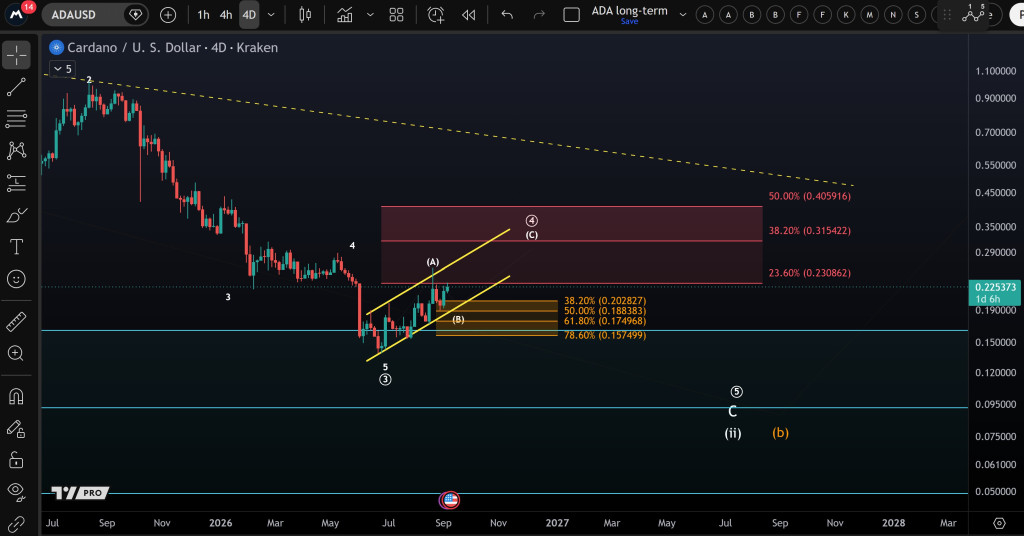
The chart places the 23.6% Fibonacci retracement at $0.230862. This nearly matches the resistance that has controlled Cardano price since June.
More Crypto Online’s outlook means the recovery structure remains active. ADA still needs a confirmed breakout because another rejection could send the price back toward lower support.
What you'll learn 👉
Cardano’s September Upgrades Could Improve Network Performance
Cardano released node version 11.1.1 on September 7. The software removed outdated code and corrected technical issues before the planned Dijkstra upgrade.
Dijkstra is designed to improve Cardano’s speed and transaction capacity. Node version 11.2 is also expected soon, which should open a public test network for broader testing.
Leios has produced early test results that were about 6 times faster than before. However, Cardano developers still need to resolve questions surrounding future validator rewards.
The main technical developments include:
- Node version 11.1.1 prepared Cardano for Dijkstra.
- Node version 11.2 should introduce public network testing.
- Leios testing produced about 6 times greater performance.
- Future validator payments still require a sustainable model.
Validators confirm transactions and protect the blockchain. Cardano therefore needs enough network fees and rewards to keep them active once the early reserve funds decline.
Cardano Governance Narrowly Avoided An Operational Problem
Four positions on Cardano’s 7 member Constitutional Committee required renewal before September 6. The vote passed by only 0.18%.
Failure would have left the committee without enough members to operate. Treasury access and future upgrades could have faced delays as a result.
The Constitutional Committee reviews whether governance proposals comply with Cardano’s network constitution. Its continued operation allows treasury decisions and protocol planning to proceed.
Elections for 2 more leadership positions are scheduled between September 14 and September 25. Those votes will provide another important test for Cardano’s decentralized governance process.
Cardano Expands Its Real World Use And Market Access
Blockforce is using Cardano to track 500,000 supply chain records for fashion exporters in Brazil. The project demonstrates how the network can record and verify commercial information outside regular cryptocurrency transfers.
Cardano also appeared at a Dubai crypto conference on September 9. Discussions focused on bringing assets such as property and bonds onto blockchain networks before a larger launch planned for October 1.
Kraken has also applied to offer ADA futures trading in the United States. Approval would expand regulated access to Cardano price movements, although futures also allow market participants to trade against ADA.
These developments cannot guarantee higher prices. Their value will depend on adoption, network activity, and successful execution over time.
Cardano Price Prediction Depends On The $0.23 Breakout
Cardano used $0.23 as support before June and traded mainly between that level and $0.29. The June breakdown turned $0.23 into resistance, which explains why the current test matters.
A confirmed breakout could return ADA to its former range and open the path toward $0.29. Cardano would then need to clear the $0.29 to $0.30 region before targeting higher Fibonacci levels.
| ADA Scenario | Important Condition | Possible Price Target |
|---|---|---|
| Bullish Recovery | ADA breaks and holds above $0.23 | $0.29 |
| Stronger Breakout | ADA clears the $0.29 to $0.30 zone | $0.315 |
| Extended Rally | ADA breaks above $0.315 with strong demand | $0.406 to $0.43 |
| Mild Pullback | ADA fails near $0.23 but holds the channel | $0.203 to $0.188 |
| Bearish Breakdown | ADA loses the ascending channel | $0.175 to $0.157 |
The Elliott Wave labels show a possible A, B, C recovery inside the ascending channel. Wave C could carry ADA toward $0.315 if buyers first overcome $0.23 and $0.30.
Cardano’s chart places higher Fibonacci targets at $0.315422 and $0.405916. Those levels broadly support possible upside targets around $0.315 and $0.43.
Read Also: 3 Reasons Kaspa Is Back on Crypto Traders’ Radar
Another rejection would make $0.202827 the first support to watch. Greater selling pressure could expose $0.188383, $0.174968, and $0.157499.
A deeper bearish path toward $0.095 also appears on the chart. That outcome would become more likely only if ADA loses the ascending channel and every nearby support level.
FAQs
Subscribe to our YouTube channel for daily crypto updates, market insights, and expert analysis.