
Bitcoin has spent years being linked to global liquidity. The basic idea is simple: when the global money supply expands, more capital should become available for risk assets such as BTC.
But the latest data is showing something different. Global M2 continues to rise, yet the BTC price has moved lower. That growing gap has raised an important question for the market: is Bitcoin entering a period where global liquidity no longer has the same influence on its price?
What you'll learn 👉
Global M2 Is Rising, but Bitcoin Is Moving the Other Way
The data provided by TFTC relates to January 2024 until September 2025 and provides normalized indexes to compare global M2 and Bitcoin. At the beginning of 2024, the global M2 index was close to 104 whereas the Bitcoin index stood at 102. In July 2024, M2 index grew up to 116 while Bitcoin index was approximately 99.
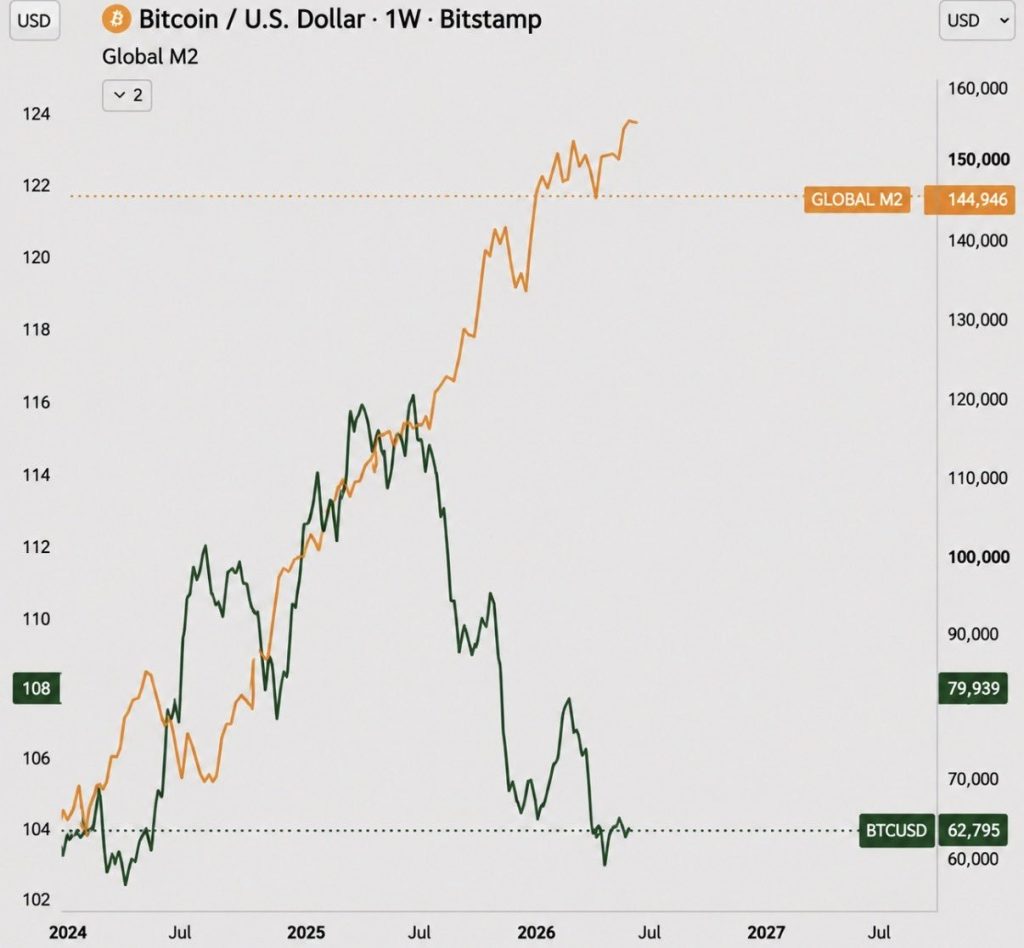
It became more significant in 2025: Global M2 index increased up to 128 while Bitcoin index declined to 93 in January 2025. By September 2025, the global M2 index increased to 144.9 while the Bitcoin index declined to 85.
That puts the gap at almost 60 index points. From January 2024 to September 2025, global M2 increased by about 39%, yet the Bitcoin index declined roughly 17%. The BTC price therefore has not followed the liquidity expansion that many investors would normally expect.
Read Also: Silver or Bitcoin: We Asked 3 AI Models Which Could Perform Better by 2028
Why Is Bitcoin Decoupling From M2?
There are several possible reasons for the disconnect. The investment landscape has changed. Investors now have access to far more blockchain-based financial products than they did in previous cycles. Stablecoins, tokenized Treasury products, commodities, funds and equities give capital to other destinations within the digital-asset market.
The tokenized asset market in the supplied data grew from roughly $15 billion in January 2024 to $339.7 billion by August 2026. Tokenized funds reached $34.6 billion, commodities reached $7.4 billion and tokenized stocks reached $2.8 billion.
These markets also offer characteristics that Bitcoin does not. Tokenized Treasuries can generate yield, tokenized stocks can provide equity exposure, and commodities can provide exposure to assets such as gold. So, more global liquidity does not necessarily mean more money has to flow into BTC.
ETF Flows Are Becoming More Important for BTC
The BTC price also has a much stronger connection to traditional financial markets than it did in Bitcoin’s earlier years. Spot Bitcoin ETFs give institutional investors a regulated way to gain exposure to BTC. This means ETF inflows and outflows can have a direct effect on demand, independent of what global M2 is doing.
Bitcoin can therefore behave more like a standalone investment asset, responding to institutional positioning, risk appetite and traditional market conditions. That helps explain why rising M2 has not translated into a corresponding rise in the BTC price.
FAQs
Subscribe to our YouTube channel for daily crypto updates, market insights, and expert analysis.