Kaspa price remains far below its record high, but a Bitcoin recovery could change the picture before 2026 ends. BTC would need a powerful rebound to reach $100,000 from its current range, and KAS has historically produced larger percentage moves during broad market recoveries.
That relationship creates an interesting question. How much could Kaspa price be worth if Bitcoin price returns to $100,000? Several possible outcomes emerge once KAS volatility, Bitcoin dominance, network development, and altcoin liquidity are considered.
What you'll learn 👉
Kaspa Price Remains Under Pressure After Its 2024 Peak
Kaspa currently trades near $0.028 with a market capitalization of approximately $766.7 million. That valuation places the Proof of Work network among the top 80 digital assets globally.
KAS price remains about 86.5% below its $0.2075 all time high from July 31, 2024. Kaspa entered a broad correction during 2025 after the excitement around its fast BlockDAG ledger began to fade.
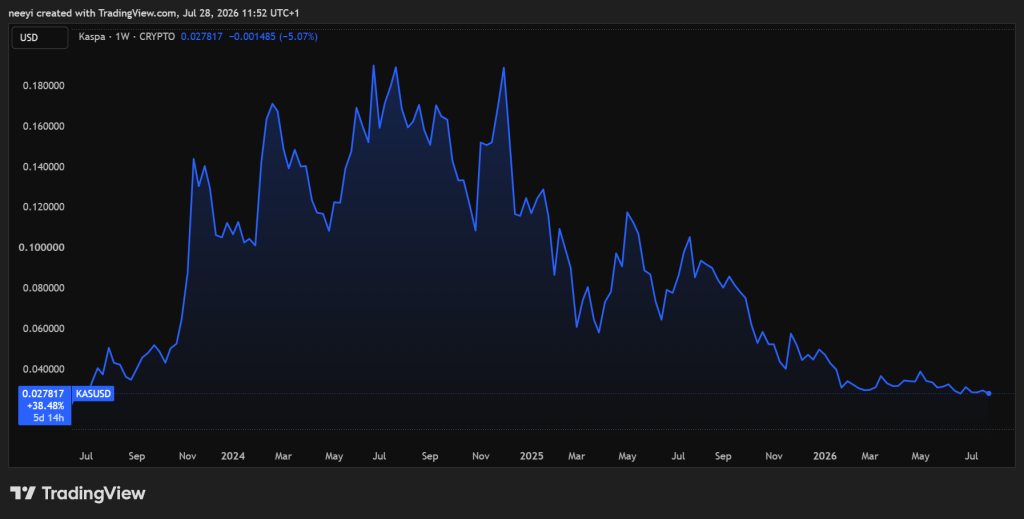
Network upgrades produced several recovery attempts, although KAS failed to return near its previous peak. Selling pressure eventually pushed the asset through lower support areas.
Early 2026 brought more weakness as Kaspa dropped from local resistance near $0.0532. Broader market pressure later pushed KAS price toward a multimonth low near $0.0249.
Bitcoin Price Has Lost Nearly Half Its Value Since October 2025
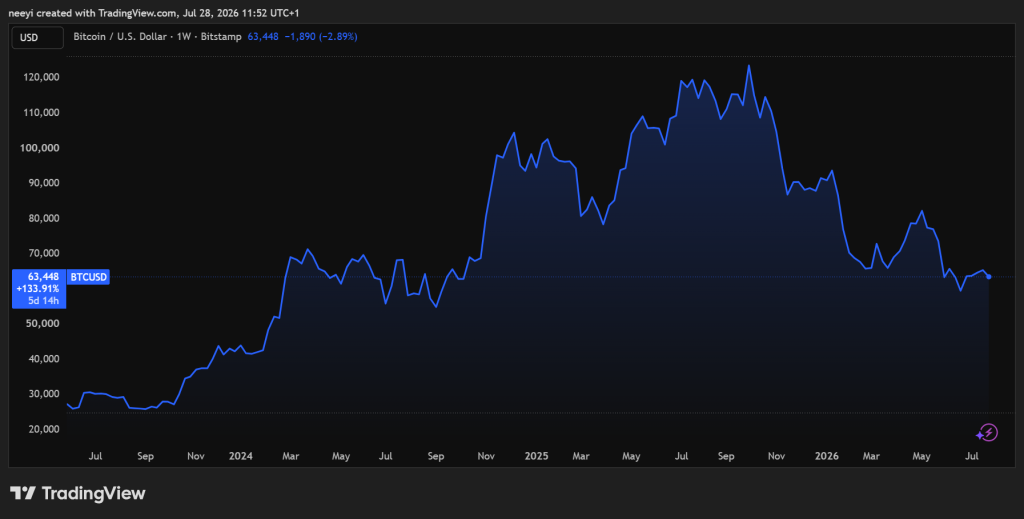
Bitcoin reached its record high in October 2025, when its market capitalization climbed to an estimated $2.52 trillion. Strong spot ETF inflows and favorable economic conditions supported BTC price during that period.
Heavy profit taking followed the October peak. Bitcoin ended December near $87,000 before its decline continued throughout the first half of 2026.
Higher bond yields, tighter financial conditions, and weaker demand for risky assets placed more pressure on Bitcoin price. June became the weakest month of the cycle as leveraged liquidations pushed BTC toward $60,000.
US spot crypto ETFs recorded billions in net outflows during the decline. Fresh institutional inflows have fallen close to zero, removing an important source of market demand.
Bitcoin now trades mainly between $61,000 and $66,000. Its current market capitalization stands near $1.304 trillion, and Bitcoin dominance remains around 58.5%.
Read Also: XRP’s Next Price Wave Could Be Violent as Clarity Act Faces August Break
Kaspa Price Usually Produces Larger Moves Than Bitcoin Price
Kaspa usually maintains a positive correlation with Bitcoin. The correlation coefficient often ranges between 0.65 and 0.85, although that relationship changes across different market conditions.
Both networks use Proof of Work consensus and fixed supply models. Kaspa has much lower liquidity and a smaller market capitalization, which makes KAS price more volatile than Bitcoin price.
Historical patterns show KAS producing returns around 1.5 times to 2.5 times larger than Bitcoin during favorable market periods. A 35% to 40% Bitcoin increase could therefore support a 70% to 80% Kaspa recovery under suitable conditions.
The same relationship creates greater downside risk. Bitcoin declined roughly 49% from its record high during the stated cycle period. Kaspa lost approximately 86.5%, which was nearly twice Bitcoin’s percentage decline.
Correlation alone cannot guarantee an equal recovery. Bitcoin could reach $100,000 without sending KAS back toward its record high.
A rapid BTC rally could push Bitcoin dominance above its current 58.5% level. Capital could leave smaller assets such as Kaspa and move into Bitcoin, which would limit the KAS price response.
Kaspa may perform better after Bitcoin completes its main advance and enters a stable range. Stable BTC price conditions often give altcoin liquidity more room to improve.
Mining conditions deserve consideration as well. Kaspa remains a prominent ASIC mineable cryptocurrency. Changes in mining profitability can affect network security, operating costs, hash rate allocation, and miner selling pressure.
Network Developments Could Influence Kaspa Price Beyond Bitcoin
The Toccata hard fork launched on June 30, 2026. It introduced native Layer 1 programmability, covenant style smart contracts, and basic tools for decentralized applications.
Kaspa now aims to expand beyond peer to peer payments. Future KAS demand may depend on developers who create useful DeFi protocols, stablecoins, and applications through the Silverscript language.
The Crescendo upgrade established a mainnet speed of 10 blocks per second. Developers plan to test an environment capable of processing 100 blocks per second during the second half of 2026.
Successful tests could reduce transaction delays to milliseconds. Technical speed alone cannot support Kaspa price unless applications and users adopt the network.
Other important Kaspa price factors include:
- More than 95% of Kaspa’s maximum 28.7 billion token supply has already entered circulation.
- The Chromatic Halving Model reduces KAS emissions gradually every month throughout 2026.
- Stroem Finance atomic swaps could connect Kaspa applications with Ethereum’s larger liquidity pool.
- Entity X reportedly holds about 1.47 billion KAS worth approximately $42.9 million.
- Coinbase and Binance have not introduced native KAS spot trading under the information provided.
Read Also: Ethereum Price Prediction: Here’s What ETH Could Be Worth by 2029
Lower emissions could reduce the available KAS supply if demand improves. However, Entity X creates concentration risk because any large sale could produce sudden Kaspa price volatility.
Major exchange listings could improve market access and liquidity. Kaspa’s BlockDAG design requires custom technical infrastructure, which makes native exchange integration more complicated. Wider access would still offer no guarantee of a lasting KAS price increase.
Kaspa Price Could Reach These Levels if Bitcoin Returns to $100K
Bitcoin would need to rise approximately 52% to 64% from its current range to reach $100,000. Applying Kaspa’s historical relationship with Bitcoin produces 3 possible KAS price scenarios.
| Scenario | Possible KAS Price | Main Condition |
|---|---|---|
| Limited Response | $0.040 to $0.045 | Bitcoin dominance rises and altcoin liquidity remains weak |
| Moderate Recovery | $0.052 to $0.058 | KAS records a larger percentage increase than Bitcoin |
| Strong Recovery | $0.067 to $0.073 | Bitcoin stabilizes and capital returns to smaller altcoins |
The limited scenario assumes that Bitcoin absorbs most available market liquidity. KAS price could still recover toward $0.040 or $0.045, but rising Bitcoin dominance could prevent a larger advance.
The moderate scenario places Kaspa price between $0.052 and $0.058. A move toward $0.056 would represent a 100% increase from $0.028, which remains consistent with KAS producing a larger percentage return than Bitcoin.
The strong scenario places KAS price between $0.067 and $0.073. This outcome would require Bitcoin to stabilize near $100,000 before more capital returns to altcoins. Kaspa would also need better money flow, useful applications, deeper liquidity, and successful network development.
FAQs
Subscribe to our YouTube channel for daily crypto updates, market insights, and expert analysis.