Kaspa (KAS) and Ripple’s XRP are 2 tokens that have enjoyed strong communities over the years. Although data shows that XRP has a much larger community, that makes sense because XRP has been around much longer than Kaspa.
XRP is backed by a 13-year-old network and years of institutional adoption. Kaspa, on the other hand, is a rapidly growing Proof of Work community that only launched in late 2021.
Both communities have played an important role in supporting their respective ecosystems. Community sentiment has often influenced price action, especially during periods of strong market optimism or fear.
Early investors in both projects have also enjoyed remarkable returns. Kaspa recorded an all-time low of $0.0001699 in June 2022 before reaching an all-time high of $0.2075 in July 2024. That represents a gain of more than 122,000%.
XRP tells a similar story. The token reached an all-time low of $0.002802 in July 2014 before climbing to its all-time high of $3.84 in January 2018. That move delivered gains of nearly 137,000%.
Those numbers explain why investors continue comparing KAS and XRP when discussing potential opportunities between now and 2027.
What you'll learn 👉
Kaspa And XRP Solve Completely Different Problems
Kaspa was created to solve one of blockchain’s biggest challenges, often called the blockchain trilemma. The goal is to achieve decentralization, security, and speed without sacrificing one for another.
Traditional Proof of Work networks such as Bitcoin are highly secure and decentralized. However, they process blocks one after another. That design limits throughput and can lead to slower transactions and higher fees during periods of heavy network activity.
Kaspa addresses this problem through its BlockDAG architecture. Instead of processing a single block at a time, the network can process multiple blocks simultaneously. This allows Kaspa to maintain Proof of Work security while delivering much faster confirmations.
The project mainly appeals to users who value decentralization, mining, and fast digital cash transactions.
XRP was built with a different objective. The XRP Ledger focuses on improving global money transfers. Traditional international payments often depend on multiple intermediary banks, require pre-funded accounts across different countries, and can take several days to settle.
XRP acts as a bridge asset that enables value to move quickly between currencies. Financial institutions can convert funds into XRP, transfer them across borders, and settle them into another currency within seconds.
Large banks, payment providers, corporations, and financial institutions represent the primary target audience for XRP.
Several Major Factors Could Influence Kaspa Price Through 2027
Kaspa is moving through an important stage of development. The Toccata Hard Fork scheduled for 2026 introduces native Layer 1 programmability, covenants, and KRC20 token support. Successful implementation could transform Kaspa from a digital cash network into a platform capable of supporting decentralized applications and broader ecosystem growth.
Another important milestone is the DAGKnight consensus upgrade. This upgrade aims to improve efficiency and transaction finality by adapting dynamically to network conditions.
The roadmap also targets 100 blocks per second by 2027. Achieving that objective without sacrificing decentralization would strengthen Kaspa’s position among high-performance blockchain networks.
Exchange accessibility remains another important factor. Kaspa still lacks listings on several major global exchanges. Additional listings could increase liquidity and expand access to new investors.
Several Catalysts Could Influence XRP Price Through 2027
XRP responds to a different set of drivers. Spot XRP ETFs could become one of the most important factors affecting XRP price over the next 2 years. Institutional inflows often create sustained demand because large asset managers typically operate on longer investment time horizons.
Ripple’s On-Demand Liquidity infrastructure also remains critical. Increased usage across payment corridors would strengthen XRP’s utility as a bridge asset.
RLUSD stablecoin growth could further improve liquidity across the XRP Ledger ecosystem. Greater stablecoin activity often attracts developers, tokenization projects, and financial applications.
Broader monetary policy also plays a major role. Interest rates, liquidity conditions, and global risk appetite often influence XRP more than smaller altcoins because of its connection to institutional finance.
Kaspa Price Outlook And Trajectory
Kaspa entered a prolonged correction after reaching its all-time high of $0.2075 in July 2024.
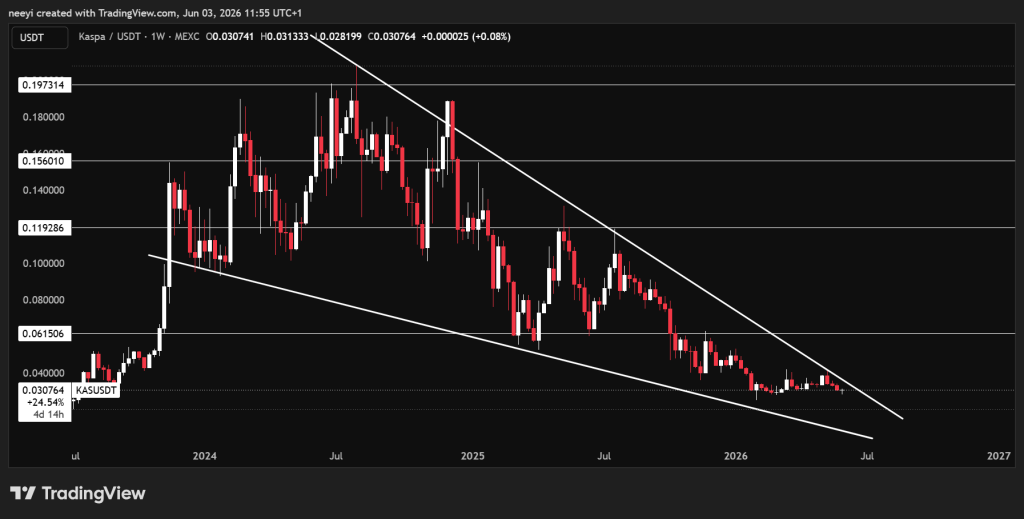
The token has declined by more than 80% from that peak and has spent much of the past 2 years trading inside a descending wedge structure. Price action since February 2026 suggests KAS has entered an accumulation zone around the $0.03 area.
A look at the KAS chart shows buyers repeatedly defending this region despite persistent selling pressure.
How High Can KAS Price Go If The Descending Wedge Breaks Out?
Scenario 1: KAS Price Could Reach $0.06
The first major upside target sits near $0.06.
A breakout from the long-term descending wedge would likely signal the end of Kaspa’s extended correction phase. Successful implementation of Toccata, improving market sentiment, and growing developer participation could support such a move.
This scenario would roughly double the current KAS price.
Scenario 2: KAS Price Could Reach $0.12 To $0.15
Breaking above $0.06 would place Kaspa in a stronger recovery phase.
This scenario would likely require successful rollout of both Toccata and DAGKnight, increasing KRC20 activity, stronger ecosystem growth, and expanding exchange support.
Market conditions would also need to improve substantially across the broader crypto sector.
Scenario 3: KAS Price Could Reach $0.19 To $0.21
The most optimistic scenario involves a return to Kaspa’s previous all-time high zone.
This outcome would likely require successful scaling toward 100 blocks per second, meaningful ecosystem adoption, major exchange integrations, and a strong crypto market cycle.
If those factors align, KAS could revisit the $0.19 to $0.21 region and potentially challenge its previous record high.
XRP Price Outlook And Trajectory
XRP remains well below its all-time high despite years of development and institutional adoption.
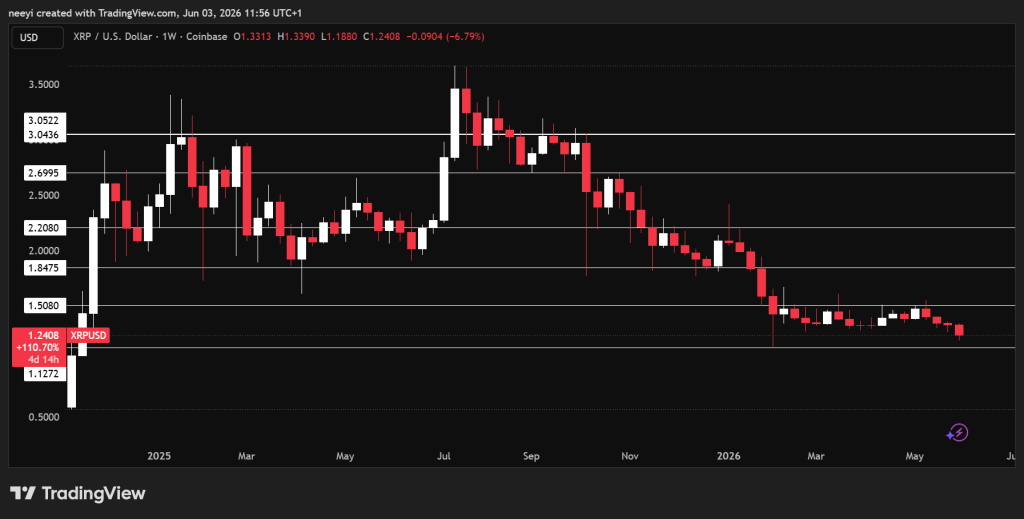
The token reached $3.84 in January 2018 and currently trades around $1.24. XRP experienced a strong recovery during 2025 before entering another correction phase.
Price action throughout 2026 has largely remained inside a broad accumulation range. Recent weakness has placed pressure on that structure, creating uncertainty about the short-term direction.
How High Can XRP Price Go Between 2026 And 2027?
Scenario 1: XRP Price Could Reach $1.84
The first major upside target sits near $1.84.
This scenario would likely require XRP to reclaim resistance levels around $1.50 while benefiting from improving ETF demand, stronger ODL activity, and expanding RLUSD adoption.
Bitcoin would also need to stabilize or move higher.
Scenario 2: XRP Price Could Reach $2.20 To $2.60
The next upside phase would require stronger institutional participation.
Spot XRP ETF inflows, rising transaction volume across Ripple’s settlement infrastructure, growing tokenization activity, and favorable liquidity conditions could support a move into the $2.20 to $2.60 range.
This would represent one of XRP’s strongest advances since the previous cycle.
Related Article: Grok AI Predicts Kaspa (KAS) Price If Bitcoin Hits $1 Million by 2030
Scenario 3: XRP Price Could Reach $2.69 To $3
The most optimistic XRP scenario requires several major catalysts to align.
Strong ETF demand, expanding enterprise adoption, greater RLUSD usage, favorable monetary conditions, and a healthy crypto market could help XRP approach the $3 level.
Even under this scenario, XRP would remain below its historic peak of $3.84.
How Much Would A $1,000 Investment Be Worth By 2027?
| Scenario | Kaspa (KAS) Target | $1,000 Value | XRP Target | $1,000 Value |
|---|---|---|---|---|
| Current Price | $0.03 | $1,000 | $1.24 | $1,000 |
| Scenario 1 | $0.06 | $2,000 | $1.84 | $1,484 |
| Scenario 2 | $0.12 | $4,000 | $2.60 | $2,097 |
| Scenario 3 | $0.21 | $7,000 | $3.00 | $2,419 |
Why Kaspa Could Make A $1,000 Portfolio Bigger Than XRP
The biggest argument in favor of Kaspa comes down to size. Kaspa’s market capitalization remains much smaller than XRP’s. Smaller assets generally require less capital to generate larger percentage gains.
Kaspa also remains unavailable on several major exchanges. New listings could expand access to millions of additional investors.
The project is still relatively young compared to XRP. That creates more room for growth if the roadmap continues delivering meaningful progress.
A successful transition into a broader smart contract ecosystem could significantly increase demand for KAS over the next several years.
Related Article: XRP Whales Suddenly Stop Selling – Ripple Analyst Shares Reasons XRP Price Could Reach $300
Why XRP May Offer More Stability Than Kaspa
XRP benefits from several advantages that Kaspa currently lacks. The network has existed for more than a decade. It maintains a much larger community, stronger liquidity, and deeper institutional relationships.
Spot ETF products provide another advantage because they create a direct channel for traditional capital to enter the market.
Ripple’s focus on payments and financial settlement also provides a clearer real-world utility story compared to many blockchain projects.
Those strengths may not produce the same percentage returns as Kaspa, but they can provide greater stability during uncertain market conditions.
Kaspa and XRP represent 2 very different investment opportunities.
Kaspa offers a younger ecosystem, a smaller market capitalization, and greater upside potential if its technology roadmap succeeds. XRP offers a more mature ecosystem, stronger institutional connections, and deeper liquidity.
Looking strictly at potential percentage gains, Kaspa appears capable of making a $1,000 investment grow more dramatically by 2027. Looking at stability, adoption, and institutional relevance, XRP continues to hold important advantages.
FAQs
Subscribe to our YouTube channel for daily crypto updates, market insights, and expert analysis.