Kaspa (KAS) would need a dramatic change in its market position to reach $10. The token currently trades near $0.029, yet a $10 valuation would place the project among the largest cryptocurrencies in the world. That gap makes the target more interesting than a simple technical price prediction.
We asked 3 AI models, Grok, Claude, and Gemini, to examine the possibility from different angles. The models looked at Kaspa’s market capitalization, supply schedule, technology, competition, adoption potential, and possible future market conditions.
Their answers do not point to $10 as a normal target. The more interesting part is where each model sees KAS going under more realistic bullish and bearish conditions.
What you'll learn 👉
Kaspa Would Need A $276.6 Billion Valuation To Reach $10
The first calculation is straightforward. Kaspa has approximately 27.66 billion KAS in circulation from a maximum supply of about 28.7 billion tokens.
A $10 KAS price would therefore produce a market capitalization of approximately $276.6 billion.
That would represent an enormous increase from Kaspa’s current valuation of less than $1 billion.
| KAS Price | Approximate Market Cap | Increase From $0.029 |
|---|---|---|
| $0.05 | $1.38 billion | 1.7x |
| $0.10 | $2.77 billion | 3.4x |
| $0.20 | $5.53 billion | 6.9x |
| $0.50 | $13.83 billion | 17.2x |
| $1 | $27.66 billion | 34.5x |
| $3 | $82.98 billion | 103x |
| $3.50 | $96.81 billion | 121x |
| $5 | $138.3 billion | 172x |
| $10 | $276.6 billion | 345x |
The table makes the main issue clear. Kaspa does not simply need to recover its previous high before reaching $10. The network would need to become a much larger cryptocurrency by market value.
That is where the 3 AI models took their analysis.
Grok Places $10 KAS Deep Into The Extreme Bull Case
Grok’s answer was the most direct about the $10 target. The model described $10 as mathematically possible but extremely unlikely under foreseeable market conditions.
Grok calculated the same $276.6 billion market capitalization and compared that figure with Bitcoin and Ethereum. Such a valuation would place Kaspa among the top 3 to 5 cryptocurrencies globally.
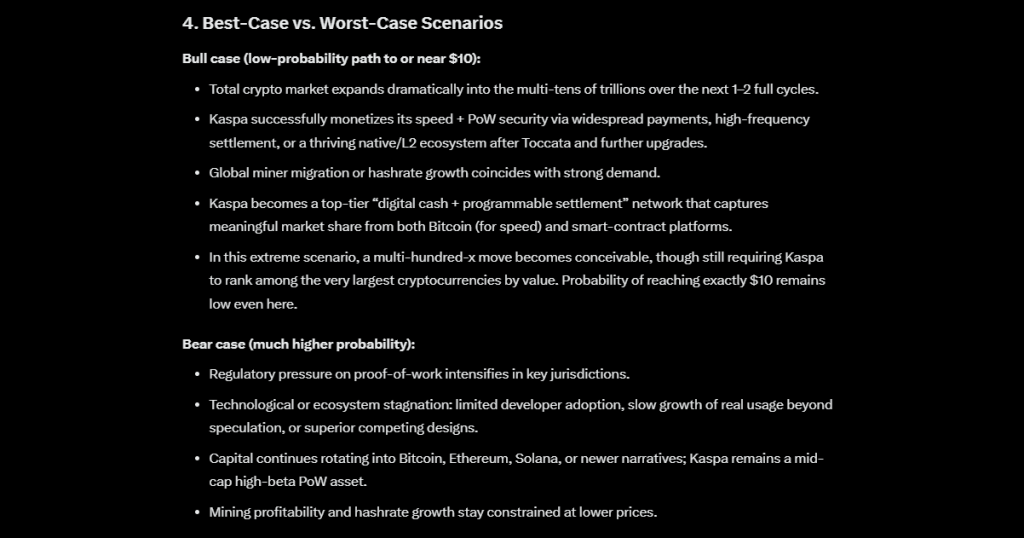
The model did not provide a conventional single price target for KAS. Instead, its analysis pointed toward a much more modest range under stronger but more realistic conditions.
Grok’s bear or base case leaves KAS below $1 for an extended period. A strong market recovery could potentially take the token back toward its previous $0.20 range without requiring the enormous ecosystem expansion needed for $10.
The model’s key view can be summarized this way:
| Scenario | Grok’s View |
|---|---|
| Bear/Base Case | KAS could remain below $1 |
| Strong Bull Market | Recovery toward or above the $0.20 area becomes possible |
| Extreme Bull Case | Much higher valuations become possible |
| $10 Target | Mathematically possible but extremely unlikely |
Grok also argued that Kaspa would need far more than a favorable crypto cycle. The project would need substantial growth in payments, settlement, decentralized applications, institutional access, and overall network usage.
A cryptocurrency with a $276.6 billion valuation would need to justify that valuation through a much larger economic footprint.
Claude Sees Higher KAS Prices As Possible But Rejects $10 As A Normal Target
Claude reached a similar conclusion, although its analysis focused more heavily on Kaspa’s competition with Ethereum and Solana.
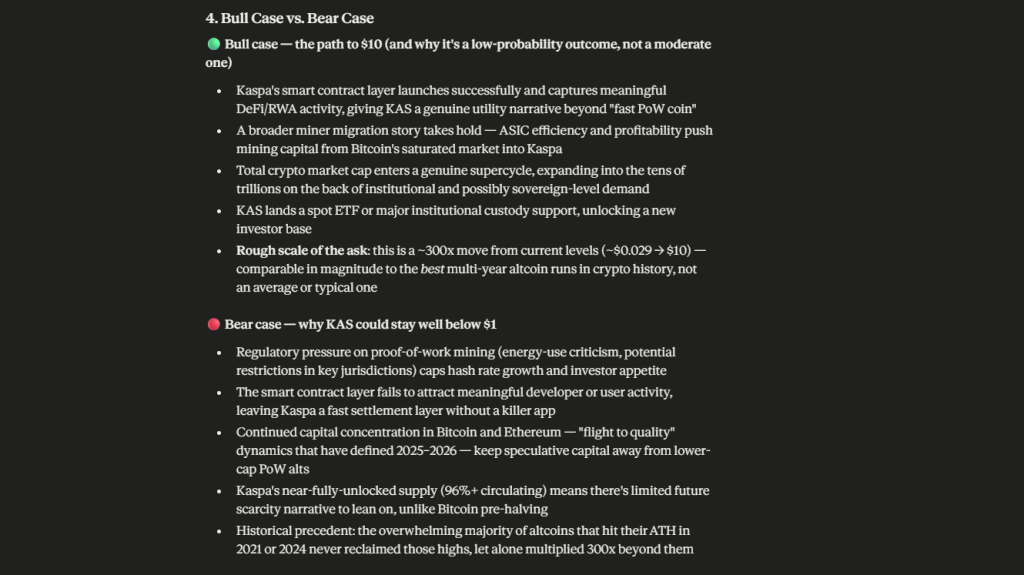
The model did not assign KAS a specific $1, $3, or $10 price target. Instead, Claude described a more modest ceiling as the realistic outcome under current fundamentals.
Claude’s analysis places particular importance on the difference between Kaspa’s technology and its ecosystem.
Kaspa has a BlockDAG architecture and a Proof of Work consensus model. Those characteristics give it a different position from Ethereum and Solana.
Ethereum has a much larger smart contract economy, with DeFi applications, stablecoins, Layer 2 networks, and institutional infrastructure. Solana also has a large application ecosystem with established activity across several areas of crypto.
Kaspa would need to close that ecosystem gap before a $276.6 billion valuation could become easier to justify.
| Claude Scenario | Expected KAS Direction |
|---|---|
| Bear Case | KAS could remain well below $1 |
| Base Case | Modest recovery from current levels |
| Strong Bull Case | Major multi bagger potential |
| $10 Case | Extreme outcome requiring several major developments |
Claude’s analysis therefore treats $10 as technically conceivable but far outside the normal range of outcomes.
The model also points out that Kaspa’s supply schedule changes the discussion. Most of the maximum KAS supply already exists, so future price growth would need to come mainly from demand.
Gemini Gives The Clearest Bull And Bear Price Ranges
Gemini provided the clearest numerical ranges of the 3 models.
Its bull case places KAS around $1 to $3.50 or higher. That would give Kaspa a market capitalization between approximately $27.66 billion and $96.81 billion.
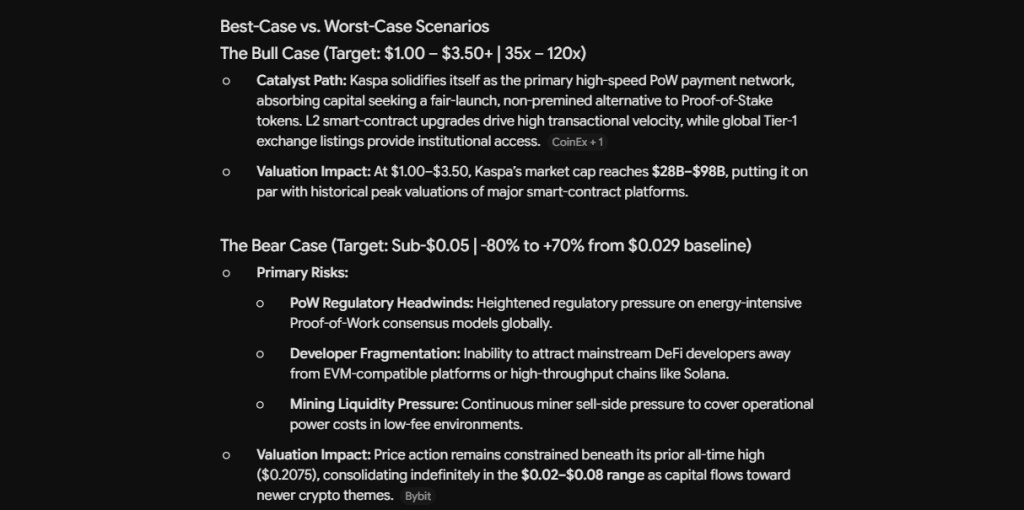
Gemini’s bear case places KAS below $0.05. At that price, Kaspa would have a market capitalization of approximately $1.38 billion based on the current circulating supply.
The model’s scenarios therefore create a much wider range than the current price alone might indicate.
| Gemini Scenario | KAS Price Range | Approximate Market Cap |
|---|---|---|
| Bear Case | Below $0.05 | Below $1.38 billion |
| Current Reference | $0.029 | About $803 million |
| Bull Case | $1 to $3.50+ | $27.66 billion to $96.81 billion+ |
| Extreme Target | $10 | $276.6 billion |
Gemini’s bull case requires Kaspa to establish itself as a major high speed Proof of Work network. The model also expects stronger smart contract activity, greater exchange liquidity, institutional access, and a much larger cryptocurrency market.
The $3.50 level is therefore important. It does not come close to $10, but it would already represent a valuation approaching $100 billion.
The 3 AI Models Give Different Price Levels But Similar Warnings
The models do not agree on an exact future KAS price. Their analysis does, however, show where the main disagreement lies.
Grok focuses on the enormous market capitalization required for $10. Claude concentrates on the ecosystem gap between Kaspa and larger Layer 1 networks. Gemini provides the clearest numerical bull and bear ranges.
| AI Model | Bear View | Bull View | $10 Assessment |
|---|---|---|---|
| Grok | Below $1 possible | Recovery toward or beyond previous highs | Extremely unlikely |
| Claude | Well below $1 possible | Major multi bagger potential | Long shot |
| Gemini | Below $0.05 | $1 to $3.50+ | Extreme scenario |
This comparison gives a more useful picture than simply asking whether KAS can reach $10.
The models broadly agree that a return toward $0.20 would be much easier to justify than a move toward $10. Gemini’s $1 to $3.50 bull range also shows what a much larger Kaspa ecosystem could mean for valuation.
A $1 KAS would already require a market capitalization of approximately $27.66 billion. A $3.50 price would push that figure above $96 billion.
Kaspa’s Supply Schedule Leaves Demand As The Main Price Driver
Kaspa’s maximum supply is approximately 28.7 billion KAS, and about 27.66 billion tokens are already circulating based on the figures used in the AI analysis.
That means roughly 96% of the maximum supply is already available.
Kaspa uses a gradual emission reduction system that lowers block rewards each month. The schedule differs from Bitcoin’s traditional halving system because the reductions happen progressively.
The remaining supply therefore becomes less important as a source of future inflation.
The bigger question becomes how much demand the network can create.
A move from $0.029 to $1 would require Kaspa to reach a valuation of about $27.66 billion. A move from $0.029 to $10 would require roughly $276.6 billion.
That difference is why the ecosystem matters so much.
Kaspa Would Need Major Ecosystem Growth To Justify A $10 Valuation
Kaspa’s BlockDAG architecture gives the project a clear technological identity, but a large cryptocurrency valuation requires more than technical specifications.
Ethereum and Solana already have extensive developer communities, applications, liquidity, and users. Kaspa would need to develop comparable economic activity before it could reasonably compete for hundreds of billions of dollars in market value.
Several developments would make the $10 scenario more plausible:
- Kaspa would need substantial growth in smart contract activity and decentralized applications.
- DeFi and stablecoin usage would need to become much larger across the network.
- Institutional custody and investment products would provide access to a broader pool of capital.
- Major exchanges would need to provide deep spot and derivatives liquidity.
- Kaspa would need sustained user and developer growth across several market cycles.
- The total cryptocurrency market would need to expand considerably beyond current levels.
Those developments would not automatically produce a $10 KAS price. They would create the type of economic foundation that a $276.6 billion valuation would require.
What Would Need To Happen Before $10 KAS Becomes A Serious Target?
The 3 AI analyses point toward several milestones that would need to appear before the $10 discussion becomes more realistic.
| Milestone | Why It Matters |
|---|---|
| KAS Reclaims $0.20 | Kaspa would recover its previous major price peak |
| KAS Reaches $1 | Market capitalization would approach $28 billion |
| KAS Reaches $3.50 | Valuation would approach $97 billion |
| Strong DeFi Growth | Creates additional demand for KAS |
| Larger Developer Base | Expands Kaspa’s network utility |
| Institutional Access | Opens the market to larger capital pools |
| Major Global Adoption | Creates demand beyond speculation |
| Multi Trillion Dollar Crypto Market | Provides greater capital for large valuations |
These milestones do not guarantee a specific price. They provide a framework for judging whether Kaspa is actually moving toward the type of market position required for $10.
Read Also: Zcash Price Prediction: How High Can ZEC Go in 2026?
The combined picture is therefore much more nuanced than simply asking whether Kaspa can reach $10.
A recovery toward $0.20 would require Kaspa to reclaim its previous all-time high. A move to $1 would create a $27.66 billion network. A rise toward $3.50 would push the valuation close to $100 billion.
A $10 KAS price would take Kaspa much further. The project would need to become one of the world’s largest cryptocurrency networks, supported by a much larger ecosystem and a far bigger global crypto market.
FAQs
Subscribe to our YouTube channel for daily crypto updates, market insights, and expert analysis.