Oil got crushed this week. Brent dropped to $73–$76. WTI fell toward $72. The reason is that the US-Iran war cooled off. They reached a ceasefire, and Iran got a temporary waiver to keep exporting crude through mid-August. That took the supply scare off the table.
But the physical market doesn’t match the price drop. U.S. inventories are at multi-decade lows. Cushing storage is getting dangerously low. And shipping through Hormuz is still risky.
So you’ve got two things pulling in opposite directions: weakening demand pulling prices down, and tight supply pushing them back up. Something’s gotta give.
What you'll learn 👉
Why the Oil Market May Be Tighter Than It Looks
The real problem is in Cushing, Oklahoma, that’s where WTI crude gets delivered. Inventories there just dropped to 19 million barrels. That’s the lowest since 2014. Some analysts say we’re only days away from levels where pipelines start having trouble because there’s not enough pressure to keep them running.
Meanwhile, the U.S. Strategic Petroleum Reserve keeps shrinking too. Down to 331 million barrels, the lowest since 1983. So if something else goes wrong, there’s barely any cushion left.
Oil prices dropped on the ceasefire news, but the danger isn’t gone. The Hormuz Letter reported that Iran’s IRGC Navy is still blocking new transit permits through the Strait. Only a handful of approved vessels are getting through.
BREAKING: The EIA confirmed US Cushing crude oil inventories have crashed to 19 million barrels, the lowest level since 2014 and just 2 days from rock bottom where pipelines lose pressure and the strategic hub begins physical breakdown, with the US Strategic Petroleum Reserve…
— The Hormuz Letter (@HormuzLetter) June 24, 2026
Read Also: Here’s Why Gold and Silver Prices Are Getting Wrecked Right Now
That’s a big deal. About one-fifth of the world’s oil moves through that narrow stretch of water. Any additional restrictions could quickly change sentiment and force traders to reassess supply expectations.
Lukas Ekwueme pointed to another major factor weighing on the oil price: weaker Chinese demand. Chinese oil imports are reportedly down by 5 million barrels per day, marking an eight-year low and roughly 30% below levels seen before the Iran conflict.
Axios and Trump did a good job lowering oil prices, but China did the heavy lifting.
— Lukas Ekwueme (@ekwufinance) June 24, 2026
– China's oil imports are down 5mbpd
– That's an 8-year low and 30% lower than pre-Iran war levels
To put that into perspective, that's the equivalent of taking out India, the world's 3rd… pic.twitter.com/YfI06PAoyh
That decline represents one of the largest demand contractions in the global market. Reduced Chinese buying has helped offset concerns surrounding inventories and Middle East supply risks, preventing oil prices from moving higher despite tightening physical conditions.
Here’s What the Brent Crude Oil Chart Is Showing
We had a look at the chart, and the dominant trend remains bearish. After peaking near $120 earlier this year, Brent has produced a series of lower highs and lower lows, falling to roughly $73.60 at the time of writing.
Read Also: $5 Trillion Vanished: Why Bitcoin, Gold, Silver, and Stocks Are All Crashing at Once
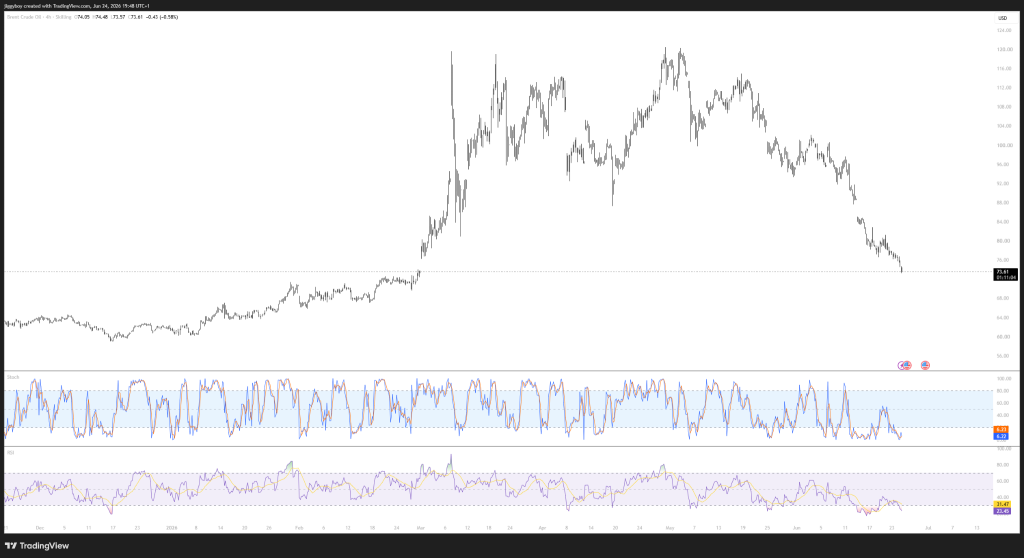
Momentum indicators are also weak. The Stochastic oscillator is buried near oversold territory, with readings around 6, showing persistent selling pressure. The RSI remains below 35, a level often associated with bearish market conditions.
The key point is that Brent is approaching an area where sellers may begin losing control. The Oil price has already fallen more than $45 from its yearly highs. Oversold readings do not guarantee a reversal, but they often appear when downside momentum starts fading.
Where Could Oil Price Go Next?
If things get worse
Brent could test $70–$72 if Chinese demand keeps sliding and the Middle East stays calm. Break that, and we’re looking at the high $60s, levels we haven’t seen since late 2025.
Most likely scenario
$72–$80 range. Two things pulling against each other: weak Chinese demand on one side, and super-tight U.S. inventories on the other. Neither one wins.
If things get better
Supply fears come back. Cushing near empty, SPR at 1983 lows, Hormuz still restricted. That could flip the market fast. Brent could climb back to $85 and maybe test $90 again.
Read Also: Why Is Crypto Market Down Today as Bitcoin Price Nears $60K
However, the oil price dropped on easing geopolitical fears and weak Chinese demand. But the supply side tells a different story.
U.S. storage hubs are at record lows. The Strait of Hormuz is still uncertain. Those two things alone mean supply is much tighter than the market is pricing it.
For now, oil is caught between soft demand and constrained supply. Which force wins that battle will likely determine the next major move in the oil price.
Frequently Asked Questions
Subscribe to our YouTube channel for daily crypto updates, market insights, and expert analysis.