Kaspa Price Prediction: What Could KAS Be Worth 1 Year After the 2028 Bitcoin Halving?

Kaspa price appears to be stabilizing after spending more than 2 years below its previous all time high. KAS currently trades around $0.04, giving the cryptocurrency a market capitalization slightly above $1 billion.
The recent recovery from approximately $0.025 has raised hopes that Kaspa may be leaving its prolonged downtrend. However, KAS remains more than 80% below its record near $0.21 and still faces several barriers before confirming a broader recovery.
Kaspa has never completed an entire Bitcoin halving cycle. Its limited history makes an exact 2029 prediction difficult, but the previous performances of Solana and Avalanche provide clues about how younger cryptocurrencies can behave after a halving.
What you'll learn 👉
Kaspa Price Shows Early Signs of Stabilizing
Kaspa reached its all time high near $0.207 in the second half of 2024. Interest in its BlockDAG technology, growing mining activity, fast confirmations, and fair launch helped KAS establish that record.
The rally eventually lost strength as early investors secured profits and miners continued selling newly created coins. Capital also moved toward other cryptocurrency sectors offering newer narratives and smaller market valuations.
KAS entered 2026 under renewed pressure. The price traded between approximately $0.05 and $0.12 early in the year before weakening as the wider cryptocurrency market cooled.
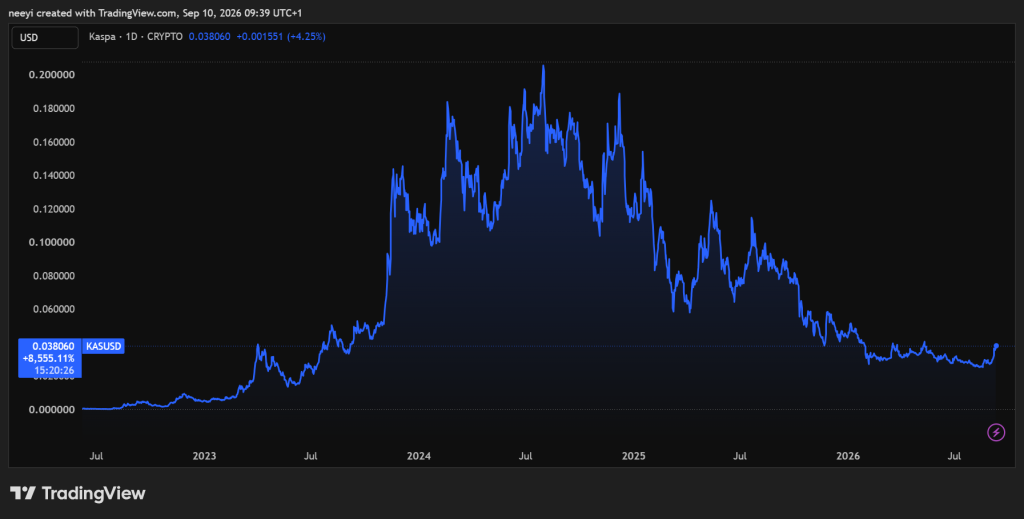
Bearish pressure eventually pushed Kaspa toward $0.026 in late summer. That area produced a strong reaction, with KAS climbing more than 30% over 1 week before returning to the middle of the $0.03 region.
The price is now attempting to establish support between $0.035 and $0.037. Buyers must protect that region before challenging the resistance levels standing above the current price.
Several areas could determine whether the recovery continues:
- The $0.04 region represents the immediate breakout level.
- The $0.05 area could provide the next major resistance.
- The $0.08 level marks an important former trading region.
- The $0.10 level could confirm a broader bullish recovery.
- The $0.20 region represents the previous all time high.
Toccata has also renewed interest in Kaspa’s technical capabilities. The upgrade activated on June 30, 2026, meaning the September bounce was not a direct reaction to a newly launched upgrade. However, growing awareness of what Toccata introduced may be supporting renewed interest.
Kaspa’s next direction still depends heavily on Bitcoin and wider market liquidity. Cautious economic conditions could keep KAS trading sideways before buyers attempt a more convincing breakout.
Kaspa Only Followed Bitcoin’s Halving Cycle Briefly
Bitcoin completed its latest halving in April 2024. KAS traded near $0.13 around that period before climbing toward its all time high near $0.21 several months later.
That move represented an increase of approximately 60% from its price around the halving. The timing indicates that wider market optimism may have helped Kaspa reach its record.
However, the relationship weakened after that peak. Bitcoin continued establishing new records in 2024 and 2025, eventually climbing above $126,000, but Kaspa entered a prolonged decline.
KAS therefore appeared partly decoupled from Bitcoin. Institutional demand and ETF inflows supported Bitcoin, although that liquidity did not spread evenly across the altcoin market.
This difference matters when estimating Kaspa’s possible price after the 2028 halving. A Bitcoin halving may improve overall market conditions, but KAS still needs adoption and independent demand to benefit fully.
Solana provides a useful comparison. The network launched in March 2020, approximately 2 months before Bitcoin completed its 2020 halving.
SOL traded below $1 in its early months before reaching approximately $260 in November 2021. That peak arrived around 18 months after the halving, with decentralized finance, NFTs, and developer activity helping Solana attract users and liquidity.
Avalanche offers another example. Its network launched in September 2020, several months after the same Bitcoin halving. AVAX initially traded near $5 before reaching approximately $146 in November 2021.
Neither cryptocurrency climbed solely because Bitcoin completed a halving. Both networks introduced applications, attracted developers, gained users, and benefited from expanding market liquidity.
Kaspa could produce a comparable move after 2028 if its technology generates real network growth. The halving may create favorable market conditions, but adoption must give investors a reason to purchase and use KAS.
Kaspa’s Supply Schedule Could Affect Its Next Cycle
Kaspa has a maximum supply of approximately 28.7 billion KAS. Around 96% of that supply has already been mined, leaving a relatively small number of coins for future distribution.
The network uses a distinctive emission schedule that reduces mining rewards every month. Those monthly reductions create an annual decrease similar to a halving and gradually lower the number of new coins reaching the market.
Lower emissions could reduce selling pressure from miners before 2029. Buyers would not need to absorb as many newly created coins as they did throughout Kaspa’s earlier years.
The supply structure could become favorable if network demand increases. However, reduced supply growth cannot create a lasting price recovery without buyers.
Existing holders and miners can still sell previously mined KAS. Weak user growth could also prevent lower emissions from producing any noticeable price effect.
Kaspa’s maximum supply makes it possible to estimate the valuations required for different targets.
| KAS Price | Approximate Future Valuation |
|---|---|
| $0.10 | $2.87 billion |
| $0.20 | $5.74 billion |
| $0.50 | $14.35 billion |
| $1 | $28.7 billion |
| $2 | $57.4 billion |
A return to $0.20 would restore Kaspa’s previous valuation. The $0.50 target would require greater adoption, deeper liquidity, and a considerably larger ecosystem.
Reaching $1 would place Kaspa’s valuation near $29 billion. That target is possible within a powerful market cycle, although Kaspa would need to become one of the industry’s leading blockchain networks.
Read Also: Dogecoin Price Prediction: Here’s When DOGE Could Return to Its 2021 All-Time High
Network Development Must Create Demand for KAS
Kaspa has continued improving its technology despite the extended price decline. The Crescendo hard fork increased block production from 1 block per second to 10 blocks per second in May 2025.
Toccata introduced a different set of improvements in June 2026. The upgrade added native Layer 1 covenant programming and infrastructure for zero knowledge applications.
Those additions expanded Kaspa beyond its original position as a fast payment network. Developers can now explore advanced transactions and applications supported by zero knowledge technology.
KAS climbed before the Toccata activation as expectations around the upgrade increased. The price later declined as some holders secured profits, preventing the event from creating a lasting breakout.
That reaction showed the difference between technical progress and actual token demand. Developers must use Kaspa’s new tools to create applications that attract regular users and liquidity.
Several developments could strengthen demand before 2029:
- New applications could increase regular network activity.
- Token platforms could bring more projects into Kaspa.
- Payment integrations could create practical demand for KAS.
- Greater exchange access could improve liquidity and availability.
- Developer growth could expand Kaspa beyond simple transfers.
Competition remains one of Kaspa’s largest problems. Ethereum, Solana, Avalanche, and several newer networks already have established developers, stablecoins, applications, and decentralized finance liquidity.
Kaspa must prove that its combination of proof of work security, fast confirmations, and programmability provides enough value to compete against those ecosystems.
The network has already built much of the technical foundation. The period before 2029 should reveal whether adoption can catch up with Kaspa’s development.
Read Also: Dogecoin Price Prediction: Here’s When DOGE Could Return to Its 2021 All-Time High
KAS Could Trade Between $0.20 and $1 During 2029
Bitcoin’s next halving is expected in 2028. Previous cycles have created favorable conditions for many alternative cryptocurrencies approximately 12 to 18 months after the event.
That pattern makes 2029 an important potential year for Kaspa. However, several outcomes remain possible because the 2024 halving failed to produce a lasting KAS rally.
The bearish scenario places KAS between $0.05 and $0.10 in 2029. Limited application growth, weak liquidity, and stronger competition could keep Kaspa below its previous record.
The base scenario places KAS between $0.20 and $0.40. This outcome would require Kaspa to reclaim its previous high, attract more developers, and benefit from stronger market conditions.
The bullish scenario places KAS between $0.50 and $1. Such a move would require a powerful post halving market combined with measurable growth across Kaspa applications, users, and liquidity.
| Scenario | Possible 2029 Price | Required Conditions |
|---|---|---|
| Bearish | $0.05 to $0.10 | Weak adoption and limited market liquidity |
| Base case | $0.20 to $0.40 | Previous record reclaimed and network usage grows |
| Bullish | $0.50 to $1 | Strong market expansion and major ecosystem growth |
| Exceptional | Above $1 | Kaspa becomes a leading programmable network |
Kaspa’s reduced emissions and improving technology provide a credible foundation for another rally. However, its performance after the 2024 halving shows that Bitcoin cannot carry KAS indefinitely without independent demand.
The 2028 halving could provide Kaspa with another major opportunity. Whether KAS reaches $0.20, $0.50, or $1 in 2029 will probably depend on what developers and users build before that cycle arrives.
FAQs
Subscribe to our YouTube channel for daily crypto updates, market insights, and expert analysis.