Kaspa (KAS) Price May Be Entering the “Generational Buy Zone” After Brutal 87% Collapse, Data Suggests


The Kaspa price fell 1.72% in the past 24 hours to around $0.0333, even as the broader crypto market added 0.17% and Bitcoin climbed 0.22%. The weakness appears tied to capital rotating away from altcoins and back into Bitcoin as traders wait for key inflation data and monitor Bitcoin’s hold above $76,000.
Even with the selloff, Kaspa’s fundamentals continue improving. The network passed 2.1 billion cumulative transactions on May 9, showing steady activity across the ecosystem.
Also, 95.55% of Kaspa’s 28.7 billion supply has already been mined, reducing future emission pressure and tightening available supply over time.
What you'll learn 👉
KAS Price Enters Deep Drawdown Zone as Accumulation Narrative Returns
Crypto analysts are paying close attention to the KAS price after the asset dropped nearly 84% from its all-time high of $0.2075. Data shared by Kaspa Daily shows the deepest drawdown reached 87% before a small recovery followed.
Since the start of 2026, the coin has spent most of its time trading inside the -75% to -85% drawdown range, far below the milder correction periods seen through 2024.
KAS is currently 83.9% below its all-time high of $0.2075.
— Kaspa Daily (@DailyKaspa) May 25, 2026
The deepest the drawdown has reached is 87.0%, hit recently before a small bounce. Price has spent most of 2026 pinned in the -75% to -85% zone after sliding out of the milder drawdown range it held through 2024.
Worth… pic.twitter.com/H5xFPxU2AJ
That type of decline has created a conversation around whether the KAS price is entering what some traders call a “generational buy zone.” Deep corrections often become accumulation phases for long-term holders, especially in crypto cycles where strong projects lose most of their value during broader market weakness.
Traders watching Kaspa believe the asset may now be closer to a bottom than a top after months of heavy selling pressure.
Another metric adding to the discussion is dormant supply activity. Kaspa Daily reported that supply inactive for more than six months has climbed back to a new high after dropping toward 50% of circulating supply in February. Many of those coins moved during the March and April selloffs before aging back into long-term storage wallets.
KAS supply dormant for 6+ months has recovered to a new high after bottoming near 50% of circulating supply in February.
— Kaspa Daily (@DailyKaspa) May 25, 2026
The cohort moved/sold off during the March and April, then aged back into the long-dormant bucket as those coins sitting untouched. pic.twitter.com/n29vGmy48q
That trend matters because rising dormant supply can point to investors choosing to hold instead of sell. If more coins remain inactive and fewer tokens circulate on exchanges, the available liquid supply tightens. Combined with Kaspa’s declining emission schedule, some traders believe this creates conditions for stronger price reactions once demand improves again.
DeFi Expansion and Toccata Upgrade Could Change the KAS Price Trend
Kaspa’s ecosystem is also expanding beyond payments. Kaskad, a decentralized lending protocol built on the Igra Network Layer-2, launched its public mainnet on May 24. The protocol lets users lock KAS as collateral to borrow stablecoins such as USDT and opened with around $250,000 in total value locked. Its governance token, KSKD, also started trading on MEXC on May 25.
This matters for the KAS price because it introduces one of the first major DeFi use cases inside the ecosystem. Lending markets can increase token utility and attract fresh liquidity into the network. Until now, Kaspa has mainly been viewed as a fast proof-of-work payment chain. DeFi applications could expand that narrative.
Another major catalyst is the Toccata hardfork expected between June 5 and June 20, 2026. The upgrade will add native KRC-20 tokens, covenant programming through SilverScript, and zero-knowledge verification support. Developers are already conducting the final rehearsal on Testnet-10 before the mainnet activation window begins.
The upgrade could completely change how investors value the network. Smart contract functionality opens the door for DeFi, tokenization, and NFT activity directly on Kaspa’s base layer. At the same time, the network’s emission schedule is nearing completion, with block rewards down to only 2.75 KAS. That combination of expanding utility and falling new supply is one reason traders remain optimistic despite the steep correction.
Related Kaspa News: ChatGPT Predicts KAS Price if Kaspa Is Listed on Coinbase and Robinhood in 2026
Here’s What the Kaspa Chart Is Showing
We had a look at the chart, and price action still shows a broader downtrend after the strong rejection near $0.041 earlier this month.
Since that high, the KAS price has made lower peaks and weaker bounces. Every time it tries to come back up, sellers show up and push it down again.
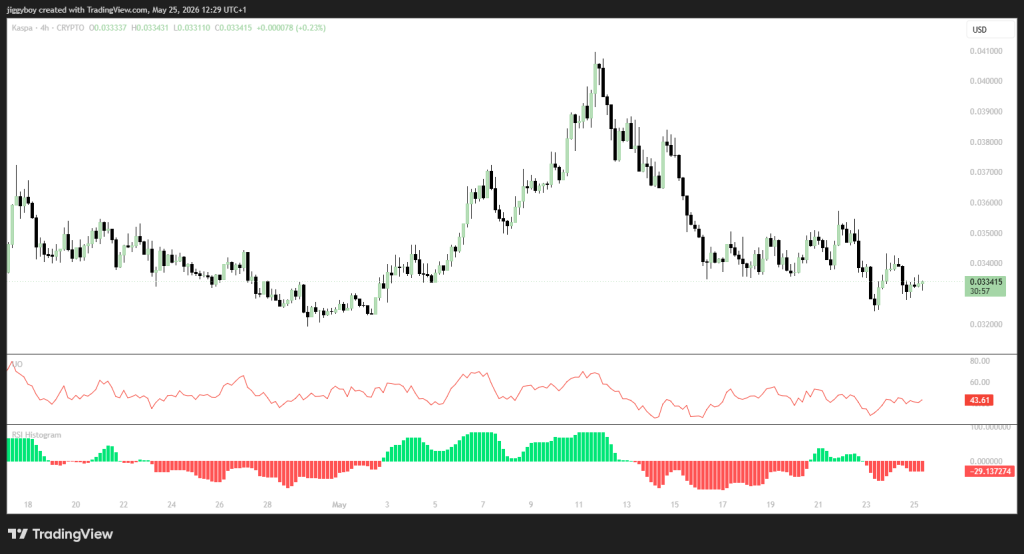
The chart does show some support around $0.032. Buyers have stepped in there several times over the last few days. The RSI is near 43. That means sellers still have the upper hand, but the price isn’t as oversold as it was. The histogram is still negative, but the bars are flattening out. Earlier in May, the drops were much steeper.
If buyers can hold that $0.032 line, the Kaspa price could try another move up to somewhere between $0.035 and $0.038. If it breaks above that, $0.04 could come back into view. If support fails, traders may start watching the psychological $0.03 level closely.
However, Kaspa remains under pressure in the short term, but the network’s on-chain growth, falling supply emissions, and upcoming protocol upgrades continue giving bulls reasons to stay interested. After an 87% collapse from its all-time high, many traders now see the KAS price trading inside one of its deepest historical discount zones.
Frequently Asked Questions
Subscribe to our YouTube channel for daily crypto updates, market insights, and expert analysis.