Cardano’s governance is alive and well, and one DRep just laid out exactly how he’s thinking through a major treasury request. Jaromir Tesar, who votes under the name Cardano YOD₳, has decided to say yes to the “IO: Cardano Upgrades” proposal.
But his support comes with some serious caveats, and he makes it clear that approval is not blind faith but a calculated, conditional decision based on strategic value.
Read Also: Here’s Where Cardano (ADA) Price Could Be Headed This New Week
What you'll learn 👉
What Excites Him About Cardano and What Makes Him Squint
Tesar sees real value in the three main pieces of this bundle. First up is CIP-159, which would improve account addresses to allow for micro-fees, lower batching costs, and better L2 reserve management. That sounds technical, but the takeaway is simple: cheaper and more flexible transactions for everyone.
Then there’s the multi-asset treasury idea. Right now, the treasury holds only ADA, which means its value goes up and down with one coin. Adding stablecoins or other native assets would make the treasury more resilient. Tesar likes the direction, though he notes this is just a CIP for now, not finished code.
Finally, Babel Fees. This is the user‑experience gem. Nobody should have to hunt down ADA just to try an app. Fee abstraction removes that friction. But Tesar points out the catch: the first version depends on a single provider. It’s a centralized prototype, not a decentralized system. He’s okay with that as a starting step, as long as everyone understands what it really is.
Where the Proposal Falls Short
Here’s where Tesar gets tough. The budget section, he says, is not detailed enough for a withdrawal this large. We see high‑level categories but no breakdown of how many engineers will work on what, what they get paid, or how time is split across the three work streams.
As a DRep, I have decided to vote YES on the proposal: IO: Cardano Upgrades.
— Cardano YOD₳ (@JaromirTesar) April 27, 2026
My rationale:
This is a strategically important proposal. Although it is a bundled proposal, the work streams are naturally connected around economic UX and treasury mechanics. In this case, I consider… pic.twitter.com/kUZ23fmEYP
He compares it to a much smaller proposal from Blink Labs for the Dingo node, which spelled out team size, cost per full‑time employee, duration, and contingencies. That transparency lets DReps judge whether the money makes sense.
Tesar’s point is simple: the same standards should apply to everyone, whether it’s a tiny team or IOG itself. If smaller groups can show their math, so can a core contributor.
ADA Price Outlook Today
ADA continues to consolidate around $0.2475, which implies indecision. Small candlesticks show that buyers and sellers aren’t able to gain the upper hand as the market waits for some catalysts to appear.
In addition, the price continues to hover around the $0.2487 level, which serves as solid resistance since ADA had already bounced off it several times before. As long as the ADA price fails to break above the 100 SMA, its short-term prospects remain cautiously bearish.
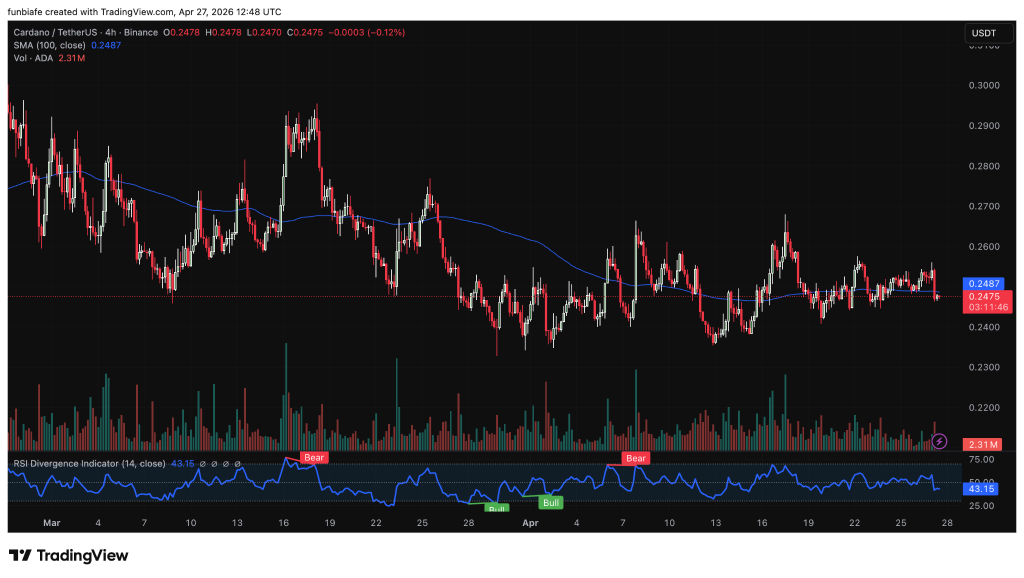
From the other side, the immediate support is located at $0.2470, while further downside targets can be seen near $0.2450 and $0.24. Nevertheless, at the moment, the selling pressure is quite light.
Overall, RSI near 43 and low volume suggest weak momentum and a quiet market. ADA is coiling tightly, the next move will likely come soon once either $0.2487 or $0.2470 gives way.
Why He’s Still Voting Yes
Even with those concerns, Tesar still votes yes. He recognizes the bigger picture. Core ecosystem players need to stay operational and keep delivering critical infrastructure.
At the same time, he warns that Cardano is moving toward multiple independent node implementations, and all of them will need funding. In his view, roughly half of the Net Change Limit, or less over time, should be enough to support every node implementation, not just IOG’s.
FAQs
Subscribe to our YouTube channel for daily crypto updates, market insights, and expert analysis.