Gold Price Implications: China Just Bought 10+ Tonnes in May – Largest Monthly Purchase Since January


Gold has spent the last several weeks under pressure, and the latest drop raises curiosity about whether the precious metal is entering a deeper correction. Despite all these, China has continued one of the longest gold buying campaigns seen in years.
At first glance, falling gold prices and aggressive central bank purchases may seem contradictory. A closer look reveals a much more complex story. China is quietly adding to its gold reserves at a time when prices are pulling back, and that combination could become important for the next phase of the gold market.
An update shared by analyst and market commentary platform The Kobeissi Letter revealed that China purchased more than 10 tonnes of gold during May. That marks the country’s largest monthly addition since January 2025.
The purchase follows another 8 tonnes added in April. Those two months extend China’s buying streak to 19 consecutive months. Official gold reserves have now climbed to a record 2,331 tonnes.
The attached chart from Correlation Economics and Azuria Capital helps illustrate the trend. China was an aggressive buyer throughout much of 2023 before purchases slowed during 2024. Activity picked up again late in 2024 and early in 2025.
Recent bars on the chart show purchases accelerating once more. May’s addition stands out as one of the strongest monthly increases seen during the current cycle. The highlighted section on the far right suggests expectations that buying activity could remain elevated in the months ahead.
BREAKING: China bought +10 tonnes of gold in May, the largest monthly addition since January 2025.
— The Kobeissi Letter (@KobeissiLetter) June 10, 2026
This follows +8 tonnes acquired in April, marking their 3rd consecutive monthly net purchase.
China has now bought gold for 19 consecutive months, the longest streak since at… pic.twitter.com/yAoCSvjpSC
Another detail stands out from the data. Gold now accounts for more than 9% of China’s foreign exchange reserves. That figure continues to rise as the country increases its exposure to physical bullion.
What you'll learn 👉
China’s Gold Accumulation Could Provide Support For Gold Price
One reason analysts pay close attention to central bank purchases is the sheer size of the demand involved.
China’s central bank effectively acts as a large and consistent buyer during periods of weakness. Every time gold price falls sharply, substantial official purchases can absorb part of the selling pressure entering the market.
That dynamic helps create what many analysts view as a price floor. Gold can still decline, but sustained central bank demand often limits how deep those declines become.
Another factor involves reserve diversification. China has steadily increased its gold holdings relative to traditional foreign exchange assets. Continued accumulation reduces dependence on dollar-denominated reserves and strengthens gold’s role within the global financial system.
The broader trend extends beyond China. Poland and Uzbekistan remain major buyers this year as well. Continued accumulation from multiple central banks creates additional demand for physical gold at a time when mine supply growth remains relatively limited.
Private demand could become another piece of the puzzle. Central bank purchases often draw attention to gold as a store of value. Strong official buying can encourage additional purchases from households and investors seeking exposure to physical gold.
Related Article: Gold Price Prediction: Dead Money or the Buy of the Decade? Bond Market Says Watch June 17
Several Factors Are Still Pressuring Gold Price Today
Despite China’s purchases, gold price remains under pressure. Western futures markets continue to exert a powerful influence on short term price action. Large institutional traders can push prices lower through futures activity even when physical demand remains strong.
Central banks can also slow purchases if prices rise too quickly. Temporary pauses sometimes occur when policymakers prefer to wait for more attractive entry levels.
Those factors help explain why gold can experience sharp corrections despite healthy long term demand trends. Current market action serves as a good example. China is buying gold at one of its fastest rates this year, but prices continue to slide.
Gold Price Remains Under Pressure After A 12% Decline
Gold has now recorded 5 consecutive weeks of losses. The metal has fallen from roughly $4,767 to around $4,190 at the time of writing. That represents a decline of approximately 12% in only 5 weeks.
A look at the current gold price structure shows an important support zone near $4,143. That level could determine what happens next.
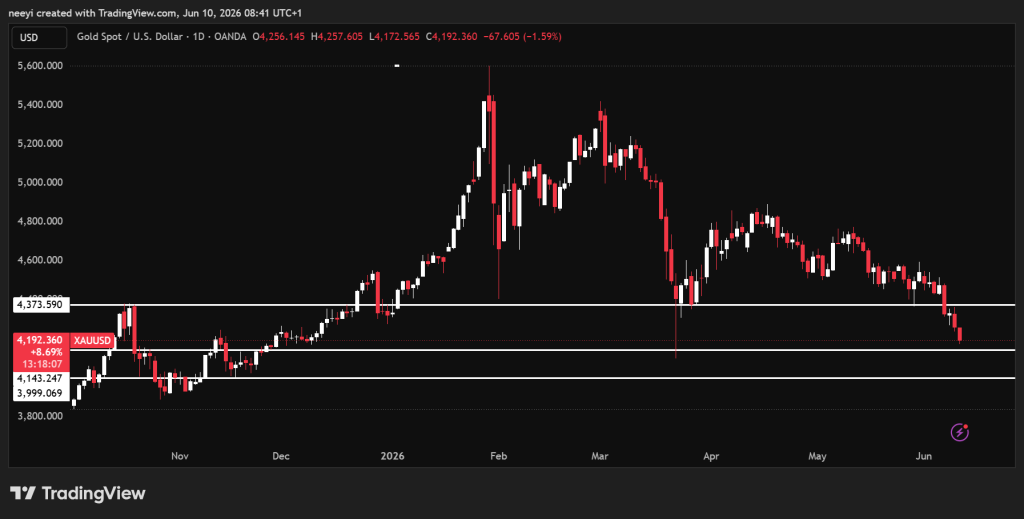
A decisive break below $4,143 would increase the probability of a deeper decline toward the psychological $4,000 area. Sellers have controlled the trend for several weeks, and the broader bias remains bearish until stronger evidence of stabilization appears.
Another possibility deserves attention. Gold could begin consolidating near current levels if buyers defend support successfully.
Read Also: Cardano Unusual Wallet Activity – Dormant ADA Suddenly Active, Something Has Changed
Price stabilization between $4,000 and $4,300 would not be unusual after a sharp multiweek decline. Markets often pause after extended selloffs as buyers and sellers reassess their positions.
Such a period would allow bearish pressure to cool and give the market time to establish a new base.
China’s continued gold purchases add an interesting backdrop to that scenario. Strong central bank demand has not stopped the correction so far, but it could become more important if prices continue approaching major support zones.
FAQs
Subscribe to our YouTube channel for daily crypto updates, market insights, and expert analysis.