
Gold price has spent months moving in the opposite direction of what many investors expected. After becoming one of the hottest assets in the world during the height of geopolitical tensions and economic uncertainty, gold has now entered a period where enthusiasm has faded considerably. That dramatic change in sentiment is exactly why some analysts believe the current setup deserves attention.
Gold was one of the most crowded trades during late 2025 and early 2026. Severe tariff disputes, global economic concerns, and escalating tensions between the United States and Iran pushed investors toward safe-haven assets. Demand exploded as investors searched for protection from uncertainty.
Gold price reached a historic milestone in January 2026 when it broke above $5,000 for the first time. The rally eventually carried gold to nearly $5,600 per ounce. That move represented one of the strongest advances the precious metal has ever experienced.
Several factors combined to create that explosive rally. Geopolitical tensions intensified sharply after military hostilities erupted between the United States and Iran. Reports of missile exchanges and the sinking of an Iranian warship created widespread concern across financial markets.
Investors quickly moved away from risk assets and sought safety in gold. Demand accelerated rapidly, pushing gold above $5,400 within a matter of days.
Another factor added fuel to the rally. Concerns over disruptions in the Strait of Hormuz sent crude oil above $100 per barrel. Markets feared that energy supplies could be interrupted, creating another source of uncertainty for the global economy.
The situation eventually changed. Higher oil prices increased concerns about inflation. Central banks, including the Federal Reserve, began emphasizing that interest rates could remain elevated for longer than previously expected.
That development created a challenge for gold. Since gold does not provide a yield or dividend, higher interest rates often make cash and income-producing assets more attractive. Profit taking followed. Capital also rotated into energy-related investments. Those factors helped push gold roughly 20% below its peak.
Related Article: Robert Kiyosaki Makes Shocking Silver and Gold Price Predictions for 2026
Retail participation also cooled significantly. Assets that once attracted intense attention suddenly became much less popular. Gold moved from being a must own asset to one that many investors barely discuss today.
What you'll learn 👉
Tavi Costa Says Gold Is Approaching A Contrarian Opportunity
That sharp change in sentiment caught the attention of macro analyst Otavio “Tavi” Costa.
Costa recently noted that gold is trading near its 200-day moving average. He acknowledged that the last visit to this area produced an excellent buying opportunity. However, Costa emphasized that technical levels alone are not the main reason he is paying attention.
Gold is sitting right at its 200-day moving average.
— Otavio (Tavi) Costa (@TaviCosta) June 3, 2026
Yes, the last time we were here turned out to be a great buying opportunity…. but I try not to get too fixated on technical levels alone.
What stands out to me is how dramatically sentiment has shifted.
Just a few months… pic.twitter.com/RyXzKxyrDm
The analyst believes sentiment is the more important factor.
Costa pointed out that gold was one of the market’s favorite trades only a few months ago. Today, enthusiasm has largely disappeared. Drawing inspiration from legendary investor Warren Buffett, Costa said he is beginning to get greedy while others are becoming fearful.
The comment stands out because Buffett’s famous investing principle focuses on finding opportunities when market sentiment becomes excessively negative. Costa appears to believe gold may be approaching a similar situation after months of weakness and declining interest.
Gold Price Continues To Hold A Critical Support Trend Line
A broader look at the gold price chart reveals an important technical development. Gold has been respecting an ascending trend line since August 2025. Every major pullback toward that support area has produced a notable recovery.
The first major bounce from this trend line helped launch the rally that eventually carried gold to its all-time high in January 2026.
Another test occurred after the sharp decline toward the $4,090 area. Buyers stepped in once again, and gold managed to recover from that support zone.
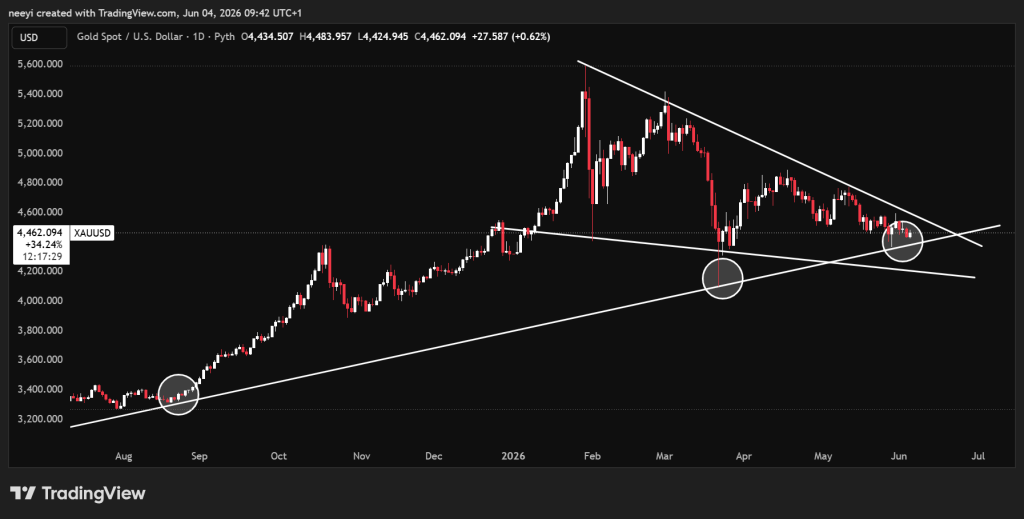
Gold has now returned to the same ascending trend line. That places the market at another important decision point.
The dominant trend remains bearish in the short term. Lower highs have continued to appear, and sellers still maintain control of the broader structure. Gold could move lower if support eventually breaks.
Historical price action shows that the ascending trend line has consistently acted as a strong foundation for the market. Bears likely need a decisive break below that level before a deeper decline becomes likely.
A Break Above Resistance Could Open The Door To Higher Gold Prices
Another technical feature deserves attention. Gold has been trading beneath a descending resistance line that has capped every recovery attempt during the correction phase. That resistance has prevented buyers from regaining full control of the market.
A successful breakout above that descending trend line would significantly improve the technical outlook.
Read Also: XRP Turned Early Buyers Into Millionaires Once: Why History Could Repeat in 6 Years
Such a move could allow gold price to revisit the $4,800 area. Stronger bullish conditions could open the door toward $5,300 and potentially even a retest of the previous all time high near $5,600.
Current conditions leave gold caught between two powerful technical forces. Support continues to hold underneath the market, yet resistance remains firmly overhead.
FAQs
Subscribe to our YouTube channel for daily crypto updates, market insights, and expert analysis.