
Bitcoin is opening the new week from a position of relative strength, with the BTC price trading around $80,000 after briefly reaching roughly $81,700 last week. Despite renewed uncertainty around U.S. monetary policy, Bitcoin has managed to hold most of its latest recovery rather than immediately giving those gains back.
There are now several important developments behind the market. U.S. spot Bitcoin ETFs just recorded nearly $1 billion in weekly net inflows, leverage has returned following one of Bitcoin’s biggest deleveraging periods since 2023, and Senator Cynthia Lummis has issued another major warning over the future of U.S. crypto regulation.
Together, these developments leave Bitcoin entering the week with improving institutional demand on one side and important regulatory and leverage risks on the other.
What you'll learn 👉
Bitcoin ETFs Pull In Nearly $1 Billion in One Week
One of the strongest developments for Bitcoin comes from the U.S. spot ETF market.
From August 31 through September 4, U.S. spot Bitcoin ETFs recorded approximately $986.9 million in net inflows, according to SoSoValue data reported by The Block. That extended their positive run to three consecutive weeks.
More importantly, the weekly number increased from approximately $924.5 million during the previous week.
BlackRock’s IBIT accounted for most of the latest demand, attracting approximately $691.5 million by itself.
The longer-term picture is also notable. Bitcoin ETFs brought in approximately $3.52 billion during August, their strongest monthly inflows since September 2025.
Bitcoin wasn’t the only cryptoasset attracting ETF capital.
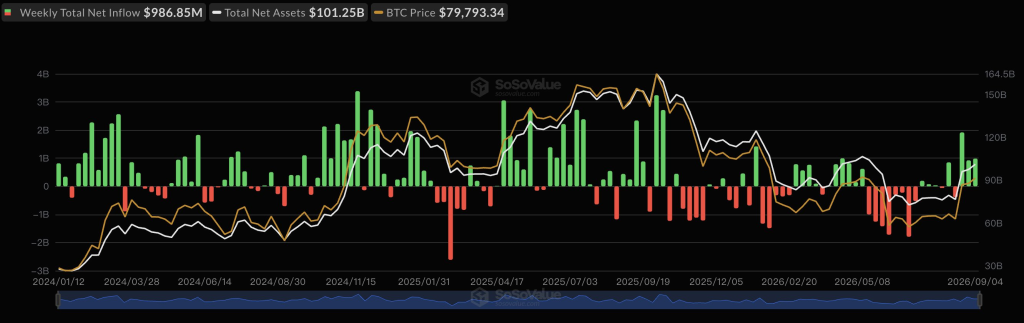
Ethereum spot ETFs recorded roughly $218.4 million of net inflows last week, also extending their positive run to three weeks. Solana products brought in approximately $6.2 million, while XRP and HYPE funds attracted about $19 million and $12.3 million, respectively.
However, Bitcoin clearly dominated the latest week.
That’s relevant to the current price action because ETF inflows represent spot-market demand rather than leveraged futures positioning. They don’t guarantee that Bitcoin will continue higher, but almost $1 billion entering the funds while BTC holds near $80,000 gives bulls something tangible to work with.
Senator Lummis Issues Major CLARITY Act Warning
At the same time, Washington is approaching another important moment for crypto.
Senator Cynthia Lummis has warned that failure to pass the CLARITY Act during the current Congress could leave lawmakers without another realistic opportunity to advance comprehensive digital-asset market structure legislation until 2030.
“If the Clarity Act doesn’t pass this Congress, the next real opportunity to bring market structure legislation back up is 2030,” Lummis wrote.
She argued that failing to complete the legislation now could mean years of lost investment, employment and tax revenue for the United States.
The legislation is intended to establish clearer rules for U.S. digital-asset markets, including the respective roles of the SEC and CFTC.
If the Clarity Act doesn’t pass this Congress, the next real opportunity to bring market structure legislation back up is 2030. That’s years of jobs, investment, and tax revenue we can avoid squandering if we finish this now.
— Senator Cynthia Lummis (@SenLummis) September 6, 2026
Importantly, 2030 isn’t a legal deadline written into the legislation. It is Lummis’ assessment of the political calendar and the difficulty of restarting a major market-structure effort if Congress fails to complete the current process.
The bill has already made substantial progress. The House passed its version in July 2025, while Senate lawmakers have continued negotiating their own framework. A procedural cloture vote would require 60 votes to advance debate, meaning bipartisan support remains necessary.
For Bitcoin, the immediate price impact has so far been limited. BTC remains around $80,000 rather than reacting dramatically to the latest political developments.
Still, the bigger issue is institutional certainty. Clearer federal rules could make it easier for exchanges, custodians, asset managers and other financial institutions to operate in the U.S. crypto market. Failure to pass legislation wouldn’t suddenly make Bitcoin unusable, but it could prolong regulatory uncertainty across the wider industry.
Read also: ChatGPT Predicts Bitcoin Price by Christmas 2027
Bitcoin Just Went Through Its Biggest Deleveraging Since 2023
There is another important development beneath Bitcoin’s recovery.
CryptoQuant contributor Darkfost reports that Bitcoin recently went through its most intense deleveraging period since 2023.
The chart makes that process particularly visible.
Red areas represent periods when Bitcoin was undergoing deleveraging, while the purple line tracks Binance Bitcoin open interest and the yellow line represents its 180-day moving average.
During the latest market correction, open interest fell rapidly and temporarily moved below that long-term average. This indicates that a considerable amount of leveraged positioning was removed as traders either closed positions voluntarily or were liquidated.
That can actually be constructive after a heavily leveraged market becomes unstable. Removing excessive positions can reduce some of the pressure that fuels cascading liquidations.
But the latest part of the chart adds an important complication.
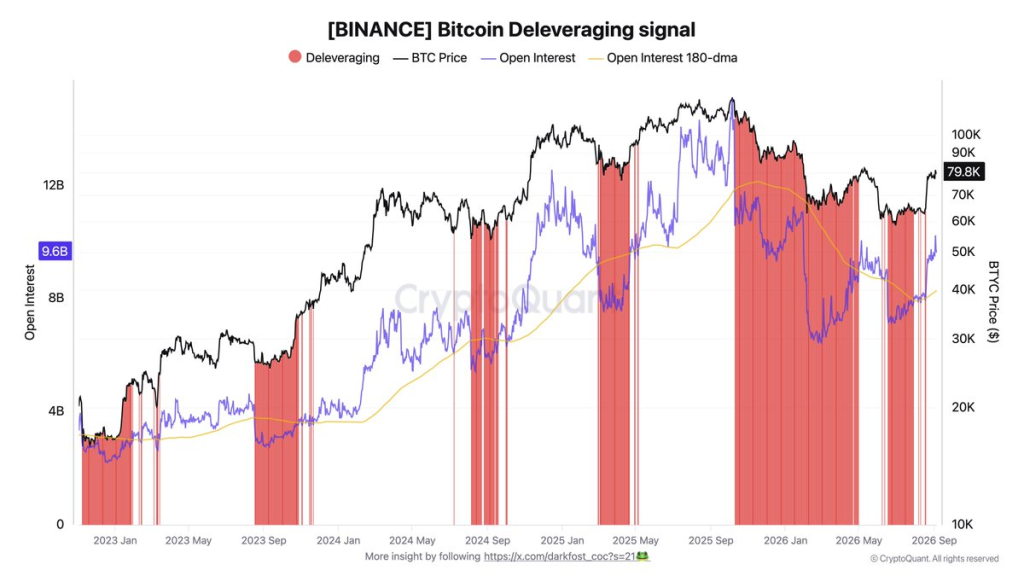
Binance Bitcoin open interest has already recovered to approximately $9.6 billion, compared with its 180-day average of roughly $8.3 billion. According to Darkfost, Binance currently represents approximately 37% of total Bitcoin open interest.
In other words, traders have come back quickly.
The chart shows open interest accelerating higher alongside Bitcoin’s rebound toward $80,000. That provides additional fuel if BTC continues rising, but it also means leverage is rebuilding relatively soon after the market finished flushing out previous positions.
This creates an interesting contrast with the ETF data.
On one side, Bitcoin has genuine spot demand, with nearly $1 billion flowing into U.S. ETFs last week. On the other, leveraged traders are returning to futures markets.
The healthiest bullish scenario would be one in which spot demand continues while leverage remains controlled. If open interest begins rising much faster than Bitcoin itself, the market could again become vulnerable to liquidations.
What Comes Next for Bitcoin Price?
Bitcoin holding around $80,000 after its recent rebound is constructive, but this week could provide a much clearer indication of whether buyers can extend the recovery.
The first obvious upside area is around $82,000–$85,000. Bitcoin already reached approximately $81,700 last week, putting that region within reach if buyers return.
A convincing move through that area would strengthen the case for another leg higher and bring the upper-$80,000 region back into focus.
The bullish case currently has several supporting factors: three consecutive weeks of Bitcoin ETF inflows, nearly $1 billion entering those products last week, and BTC holding close to $80,000 despite recent macro uncertainty.
But Darkfost’s data provides the reason for caution.
Bitcoin has only recently completed its largest deleveraging episode since 2023, yet Binance open interest is already back above its 180-day average. If leverage continues climbing aggressively without comparable spot buying, another liquidation event becomes a meaningful risk.
The CLARITY Act adds another variable. Passing comprehensive market-structure legislation could remove some regulatory uncertainty hanging over the U.S. crypto industry, while failure would keep that uncertainty alive. Lummis believes another serious opportunity may not arrive until 2030.
For now, however, Bitcoin isn’t behaving like a market particularly worried about Washington.
BTC is starting the week around $80,000, institutional money continues flowing into spot ETFs, and traders have returned after a major leverage reset. If Bitcoin can convert that combination into a break above the recent highs, the next battle could quickly move toward $82,000–$85,000.
The risk is that traders become too aggressive too quickly. The same leverage helping fuel the rebound today could become the source of the next selloff if Bitcoin fails to keep moving higher.
For more crypto news and price predictions, click here.
Subscribe to our YouTube channel for daily crypto updates, market insights, and expert analysis.