
The CLARITY Act was supposed to give the U.S. crypto market a clearer rulebook. Its failure to advance in the Senate has left a different question hanging over Bitcoin: if that rulebook never arrives, how much could BTC price depend on the Fed, ETF demand and its own market cycle?
Claude AI offers 3 possible paths for Bitcoin price in 2027. They range from another difficult year to a move beyond the 2025 high. The gap between those outcomes is wide, and the conditions behind each one matter more than any single target.
What you'll learn 👉
Why the CLARITY Act Vote Matters for Bitcoin Price
The Digital Asset Market Clarity Act aims to settle a question that has followed the U.S. crypto industry for years: which digital assets fall under the SEC, and which fall under the CFTC? A law could give firms a more durable answer than agency guidance, which can change under a future administration.
That answer did not come on September 15. A Senate procedural vote to advance the bill failed by 49 votes to 50, short of the 60 votes required. The Senate did not take a final vote on whether to pass the bill. The Senate’s roll call records the failed vote on the motion to proceed.
The dispute centered partly on ethics provisions concerning public officials and crypto interests. Republicans had revised the bill shortly before the vote, but Democrats argued that the restrictions still left gaps. Senator Cynthia Lummis said Republicans had accepted more than 120 negotiated Democratic demands. The disagreement remained unresolved when senators voted.
Crypto prices fell after the result, but the bill’s future is less certain than the immediate reaction might imply. Senator Thom Tillis made a procedural move that leaves room for reconsideration. That does not guarantee another vote, particularly with the Senate’s October work period and campaign season ahead.
The SEC and CFTC can continue their regulatory work without the CLARITY Act. For crypto firms, the remaining concern is whether guidance from those agencies will provide enough certainty to support plans that take years to carry out.
What Could Drive Bitcoin Price in 2027 Without the CLARITY Act?
Bitcoin price has reached new highs before without a comprehensive U.S. crypto law. That history does not make the Senate vote irrelevant. It does show why Claude’s 2027 scenarios depend on several forces beyond legislation.
Federal Reserve policy is the biggest variable in Claude’s framework. If inflation eases and the Fed cuts rates, conditions could become more favorable for assets such as Bitcoin. If rates remain high, BTC may have a harder time sustaining a recovery, even if other developments briefly lift the price.
Seasonality could also matter, though it needs careful handling. Crypto markets often refer to October as “Uptober” because of Bitcoin’s historical performance during that part of the year. A strong final quarter of 2026 could help Bitcoin enter 2027 on firmer ground. A rally based mainly on seasonal expectations could fade if broader financial conditions remain difficult.
Blockchain data may offer another clue. Large amounts of stablecoins moving onto exchanges can indicate that funds are available for potential purchases, though those deposits do not prove anyone will buy BTC. Bitcoin leaving exchanges for private wallets can point toward accumulation. Neither signal gives a complete picture on its own, but both could help test whether buyers remain active after the CLARITY Act setback.
Clearer rules outside the U.S. could influence where crypto businesses and capital go next. The EU’s MiCA framework, along with rules in places such as Hong Kong and the UAE, gives firms other jurisdictions to consider. That would not automatically lift Bitcoin price. It does mean U.S. legislative delays need not stop crypto activity elsewhere.
Major company or government Bitcoin purchases form the final catalyst in Claude’s framework. Such announcements could increase demand and change market expectations quickly. Their effect would still depend on the size of the purchases and whether demand continues afterward.
Claude AI Predicts Bitcoin Price in 2027 Across 3 Scenarios
Claude AI gives ranges rather than one Bitcoin price target for 2027. Each range depends on a different combination of regulation, Fed policy and demand. These are conditional scenarios, not prices that Claude can know in advance.
| Scenario | Bitcoin Price Range in 2027 | Conditions Behind the Range |
|---|---|---|
| Bearish | $45,000 to $62,000 | High rates persist, demand weakens and regulatory uncertainty continues |
| Base | $85,000 to $130,000 | The Fed eases gradually and institutional demand continues |
| Bullish | $150,000 to $210,000 or higher | Easier financial conditions combine with strong accumulation and major adoption |
The bearish case assumes the CLARITY Act remains stalled and the Fed keeps rates high to address persistent inflation. Bitcoin could struggle if a late 2026 rally fades and large holders begin moving more BTC onto exchanges. Under those conditions, Claude places Bitcoin between $45,000 and $62,000 during 2027.
A weaker U.S. regulatory outlook could also cause more crypto businesses to expand in jurisdictions with clearer rules. That would be a concern for the American industry, though it would not mean Bitcoin use or trading elsewhere had stopped.
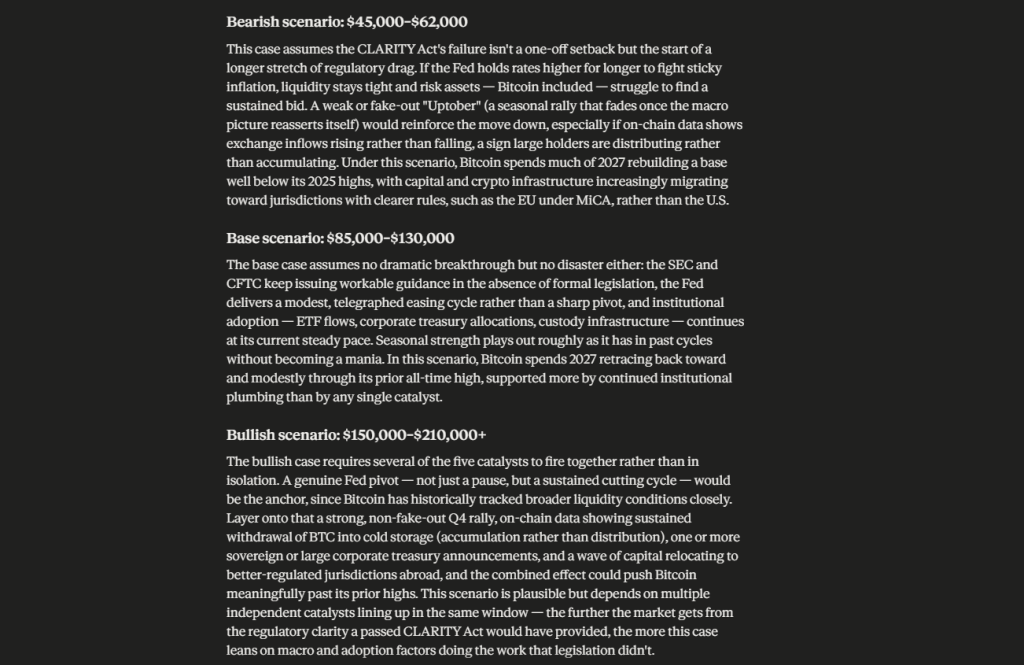
The base case assumes regulators continue to provide workable guidance without a new law. Fed rate cuts arrive gradually, and demand through Bitcoin ETFs, corporate holdings and custody services continues without a dramatic jump. Claude’s $85,000 to $130,000 range would put Bitcoin back near its previous high at the upper end. This case relies on several sources of demand continuing, rather than one event changing everything.
The bullish case asks more of the market. Claude puts Bitcoin at $150,000 to $210,000 or higher if a sustained Fed easing cycle coincides with strong demand, continued movement of BTC into private wallets and major corporate or sovereign purchases. Crypto activity outside the U.S. could contribute as well.
Those conditions would need to support one another. A company purchase could move the market for a short period, but a lasting move toward the upper end of Claude’s range would likely require broader demand and favorable financial conditions.
The CLARITY Act’s failure makes regulation part of every case. Fed policy, however, does more work in separating them. Seasonal strength or a burst of buying could help Bitcoin recover, but a rally may prove difficult to maintain if liquidity remains tight.
Could Bitcoin Still Reach $150,000 Without the CLARITY Act?
Bitcoin could reach $150,000 without the CLARITY Act passing. Its earlier rallies and new highs came before the U.S. had the comprehensive federal framework the bill seeks to create. The 2025 peak provides another example of Bitcoin reaching a new high without that legislation in place.
That does not mean the bill has no value for BTC price. Clearer rules could make it easier for some firms to commit funds and develop crypto services. The absence of those rules leaves uncertainty that may slow decisions, even if it does not prevent Bitcoin from trading or reaching higher prices.
Read Also: Cardano News: Leios Hits 1,000 TPS in Testing With ADA Price at $0.20
Bitcoin ETFs are also part of the picture. They provide an established route for investors to gain exposure to BTC. Continued ETF demand could support the market without a new act of Congress, although flows can weaken or reverse. Corporate purchases, Fed decisions and the wider appetite for risk would still affect the outcome.
The familiar 4 year Bitcoin cycle offers another reason to keep the $150,000 possibility open. Bitcoin has followed a broad pattern of major advances and declines across past cycles. That pattern is useful context, but it is not a timetable that can guarantee a new high in 2027.
Claude’s bullish range is therefore possible under its stated conditions. It is also the scenario that requires the most things to go right at the same time.
Our Bitcoin Price Outlook for 2027 Favors a Slower Recovery
Our reading of Bitcoin’s long term ascending channel points to a more cautious 2027 than Claude’s bullish case. BTC moved toward the top of that channel in 2020 and 2021. It later traded near the lower part during 2023 and 2024, before returning toward the top and setting a new high in 2025.
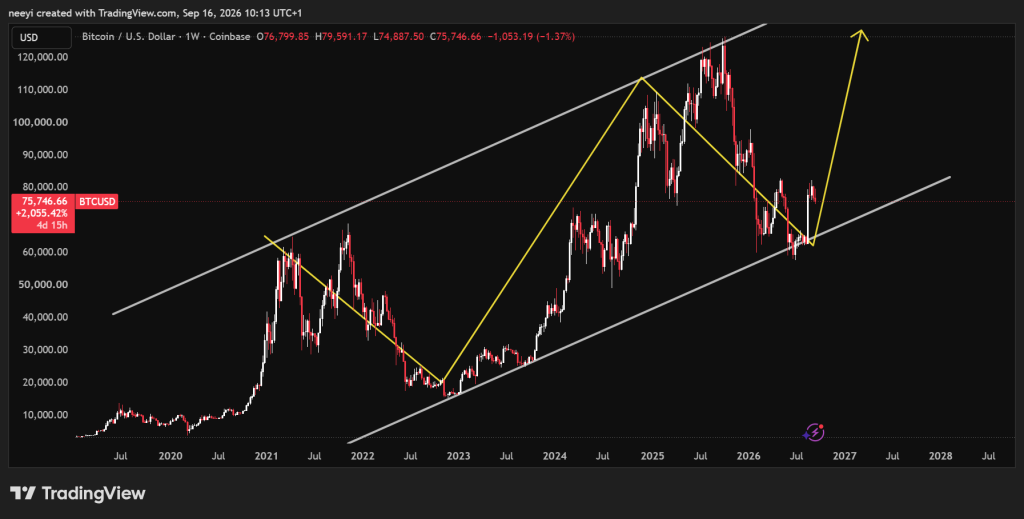
The pullback in 2026 brings the lower part of the channel back into focus. If the pattern holds, Bitcoin could test an area in the $60,000s to $70,000s again, possibly during 2027. Holding that area would leave room for another recovery inside the channel. A move below it would call that reading into question.
The timing of another all time high is harder to pin down. The channel’s previous moves leave open a period of several years between major peaks. That makes a new record in 2027 possible, but it is not our strongest case based on the pattern described here.
Read Also: CLARITY Act Isn’t Dead Yet: XRP and Crypto Will Get Another Chance
Our central outlook is for Bitcoin price to spend much of 2027 below $100,000, with room for a stronger recovery if it moves back above $83,000 and holds that level. Under more favorable conditions, BTC could travel toward its previous high near $126,000 to $128,000. A move beyond that area would strengthen the case for a new record, although it would require clearer evidence of sustained demand.
FAQs
Subscribe to our YouTube channel for daily crypto updates, market insights, and expert analysis.