Kaspa has spent the past few months trying to recover from its brutal correction phase, yet another major threat may now stand in front of the network. This time, the problem has little to do with mining, scalability, or BlockDAG technology. Regulatory uncertainty in the United States could become the bigger issue.
The CLARITY Act originally entered discussions as a possible turning point for the crypto industry. Many investors hoped the bill would finally separate commodities from securities and reduce years of confusion around digital assets. Recent developments around the legislation now paint a far more complicated picture, especially for altcoins like Kaspa (KAS).
ChatGPT’s analysis points to one uncomfortable reality. Kaspa may have one of the cleanest structures in crypto, yet a failed CLARITY Act could still slow adoption, weaken liquidity, and delay major price expansion for years.
What you'll learn 👉
The CLARITY Act Could Leave the Crypto Industry in a Worse Position
The original purpose of the CLARITY Act is for lawmakers to create clearer rules for crypto assets and a more defined split between SEC oversight and CFTC oversight. Recent amendments changed much of that expectation.
The SEC now appears positioned to gain more control than many industry participants originally expected. Early stage token projects may face compliance standards designed for traditional corporations. Smaller crypto developers could struggle to survive those requirements.
Another major concern comes from the removal of protections for non-custodial developers. Open source developers who never directly hold customer funds may still face Bank Secrecy Act and AML obligations. That creates serious pressure for decentralized development inside the United States.
Section 404 added another controversial issue. The bipartisan compromise introduced a ban on yield or rewards tied to stablecoins. Large firms such as Coinbase openly criticized that provision because offshore competitors would likely gain an advantage if US regulated stablecoins lose utility.
The CFTC also faces its own challenge. The bill gives the agency much broader authority over digital commodity markets, yet staffing and funding remain limited. Exchange approvals and oversight processes could become painfully slow if resources fail to expand alongside responsibilities.
Critical technical definitions still remain unresolved too. Questions around decentralization standards and capital buffer requirements would move into future rulemaking discussions. Legal battles could drag on for years even if the bill passes in weakened form.
Another problem now hangs over the entire process. Senate delays could collapse the compromise entirely. A complete legislative failure may leave the crypto industry trapped under aggressive enforcement conditions until close to 2030.
How CLARITY Act Failure Could Hurt Kaspa Despite Its Fair Launch Structure
Kaspa differs from many crypto projects because it launched without venture capital dominance, insider allocations, or a pre mine. Its Proof of Work structure also makes comparisons to Bitcoin much easier than comparisons to heavily centralized token ecosystems.
That clean profile still may not protect KAS if regulatory clarity disappears.
Institutional capital remains one of the biggest missing ingredients for Kaspa today. Asset managers still hesitate to enter regulatory grey zones beyond Bitcoin and Ethereum. A failed CLARITY Act would likely keep KAS outside institutional portfolios for much longer.
Major US exchange expansion may slow as well. Coinbase and Kraken typically avoid unnecessary legal exposure. Regulatory uncertainty could continue delaying broader KAS access across the United States retail market.
Kaspa’s growing KRC 20 ecosystem introduces another layer of risk. Native KAS itself looks structurally decentralized, yet many applications and ecosystem tokens built around the network may face greater regulatory vulnerability. Developer hesitation could eventually reduce ecosystem growth and weaken overall network utility.
Fear driven market conditions also tend to ignore nuance. Crypto correlations remain extremely high during major sell offs. Regulatory panic rarely separates decentralized projects from speculative tokens once liquidations begin across the broader market.
Kaspa Price Faces Multiple Resistance Levels After Recent Recovery Attempt
A look at the Kaspa chart shows KAS attempting to climb steadily from its long term ascending trendline support near the February lows. Price action has respected that rising structure for several months, which reveals that buyers still defend lower levels aggressively.
The current problem appears near overhead resistance.
Kaspa recently pushed toward the $0.041 region again, yet several major resistance zones remain above current price action. The yellow resistance levels on the chart near $0.041, $0.052, $0.063, and $0.073 could become difficult barriers unless stronger catalysts enter the market.
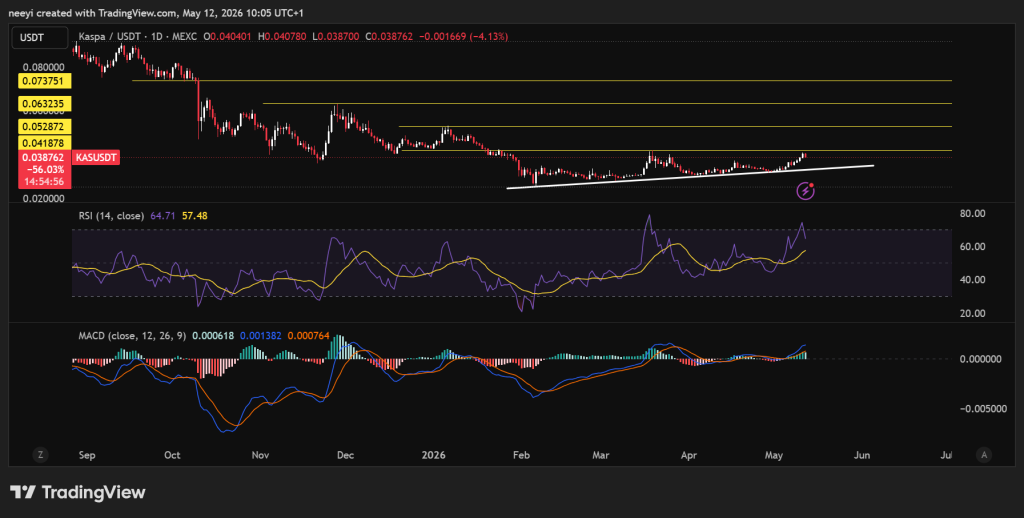
Those resistance zones matter because previous rallies struggled heavily around those same levels during earlier recovery attempts. KAS may need a major liquidity event or positive regulatory development before a larger breakout becomes realistic.
The RSI currently trades close to 57. That reading shows improving bullish strength without entering overheated territory yet. Buyers still maintain some control, although momentum remains far from extreme.
MACD data also leans mildly bullish. The MACD line stays above the signal line and histogram bars remain positive. That setup usually supports gradual upside continuation if broader market conditions remain stable.
Momentum still looks fragile overall. Regulatory pressure from a failed CLARITY Act could easily interrupt the recovery structure now developing on the chart.
Related Article: How High Can Kaspa (KAS) Price Go This New Week?
ChatGPT Predicts Several Possible Outcomes for Kaspa if CLARITY Act Fails
Kaspa currently trades near $0.038 with a market cap slightly above $1 billion. Smaller market cap assets often react more aggressively to regulatory shocks because liquidity remains thinner compared to Bitcoin or Ethereum.
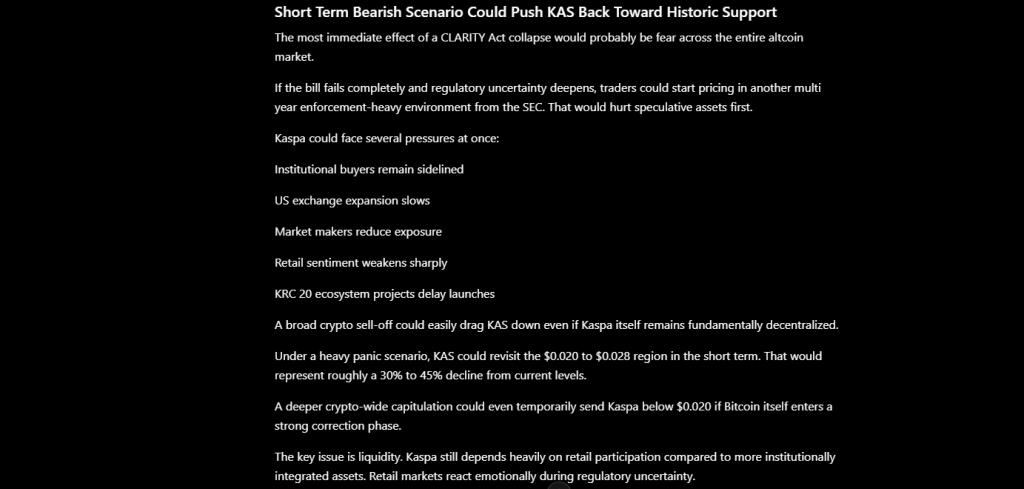
ChatGPT’s Bearish Scenario Focuses on Immediate Panic Across the Altcoin Market.
A complete CLARITY Act collapse could deepen SEC enforcement fears across the industry. Institutional buyers may remain sidelined. US exchange expansion could slow further. Retail sentiment may weaken sharply across speculative assets.
Under that scenario, KAS could revisit the $0.020 to $0.028 region during a heavy market correction. A broader Bitcoin sell off could temporarily push Kaspa below $0.020 if liquidity conditions deteriorate aggressively.
The neutral scenario assumes endless delays instead of outright collapse.
Senate negotiations, agency disputes, and legal uncertainty could leave Kaspa trapped in a slower growth environment for years. KAS might continue trading between $0.030 and $0.080 without reaching the explosive breakout many investors expect.
Related Article: Grok AI Predicts Kaspa (KAS) Price if the Fastest Proof-of-Work Chain Goes Mainstream
The long term concern centers around time. Regulatory uncertainty delays institutional custody expansion, ETF discussions, fintech integrations, and broader exchange adoption. Those delays could keep Kaspa below $0.10 much longer than supporters anticipated.
ChatGPT Still Sees One Strong Counterargument Working in Kaspa’s Favor.
Kaspa’s fair launch structure resembles Bitcoin far more closely than many modern token projects. No premine or nsider allocations existed. Also, venture capital firms never controlled the network.
That structure may eventually help Kaspa survive future regulatory reviews better than many competing altcoins.
If regulation stabilizes later in the decade and Kaspa continues expanding its ecosystem successfully, much larger valuations may still become possible over time.
- A $10 billion market cap would place KAS near $0.38 based on current supply assumptions.
- A $25 billion valuation during a strong crypto cycle could theoretically push KAS close to $0.95.
| Scenario | Estimated KAS Price Range | Main Driver |
|---|---|---|
| Heavy Bearish Panic | $0.020 to $0.028 | Regulatory fear and market sell off |
| Deep Capitulation | Below $0.020 | Strong Bitcoin correction and liquidity collapse |
| Neutral Slow Growth | $0.030 to $0.080 | Delayed regulation and limited institutional access |
| Long Term Recovery | Around $0.38 | $10 billion market cap expansion |
| Strong Bull Cycle | Around $0.95 | $25 billion market cap and broader adoption |
Kaspa still holds one of the cleaner narratives in the crypto market today, but regulation may decide whether that technology reaches mainstream capital anytime soon.
FAQs
Subscribe to our YouTube channel for daily crypto updates, market insights, and expert analysis.