
Cardano founder Charles Hoskinson made a bold long-term Bitcoin price prediction. He said the total cryptocurrency market cap can grow from roughly $2.5 trillion today to $100 trillion within 12 years. That is a 40x increase.
Crypto Patel, a well-known analyst, took the statement and did the math for Bitcoin. The results are eye-catching: Bitcoin would trade at either $1.5 million or $3 million per coin, depending on how much dominance BTC retains as the market expands. Let’s break down the tweet and the attached chart, then give an honest opinion on whether this is realistic.
What you'll learn 👉
Hoskinson’s Prediction and Crypto Patel’s Math
Crypto Patel tweeted that Charles Hoskinson believes crypto can reach a $100 trillion market capitalization within 12 years. Currently, the total crypto market cap is approximately $2.5 trillion. That would require a 40-fold increase.
Patel then applies two scenarios for Bitcoin. Right now, Bitcoin’s market cap is about $1.5 trillion, representing roughly 60% dominance of the crypto market, with Bitcoin trading around $73,000 per coin.
In the first scenario, if Bitcoin maintains its 60% dominance in a $100 trillion crypto market, then Bitcoin’s market cap would be $60 trillion. Dividing that by 20 million coins gives a price of approximately $3,000,000 per Bitcoin.
In the second scenario, if altcoins grow faster and Bitcoin’s dominance drops to 30%, then Bitcoin’s market cap would be $30 trillion. That yields a price of roughly $1,500,000 per coin.
Patel’s conclusion: “Either way Bitcoin in the millions.” He argues that the question is not whether Bitcoin will reach million-dollar territory, but how much dominance it will retain as billions of new users enter the space.
Read more Bitcoin news: Why the Crypto Market Is Crashing Now as Bitcoin Dips Below $73K
Chart Analysis – Crypto Patel’s Long-Term Market Cap Projection
The attached chart from Crypto Patel shows the total cryptocurrency market cap on a logarithmic scale from 2015 to 2032. Key observations:
Historical growth: The market cap rose from under $10 billion in 2015 to a peak near $3.5 trillion in late 2025. The current level is around $2.46 trillion.
Patel’s projection: He draws a long-term upward channel, with the upper boundary reaching approximately $100 trillion by 2032 (the chart shows a label “100T” near the top right, with an arrow pointing to the 2032 timeframe). The lower boundary suggests support around $1.95 trillion in 2026, with a potential dip to $1.15 trillion in a worst-case scenario.
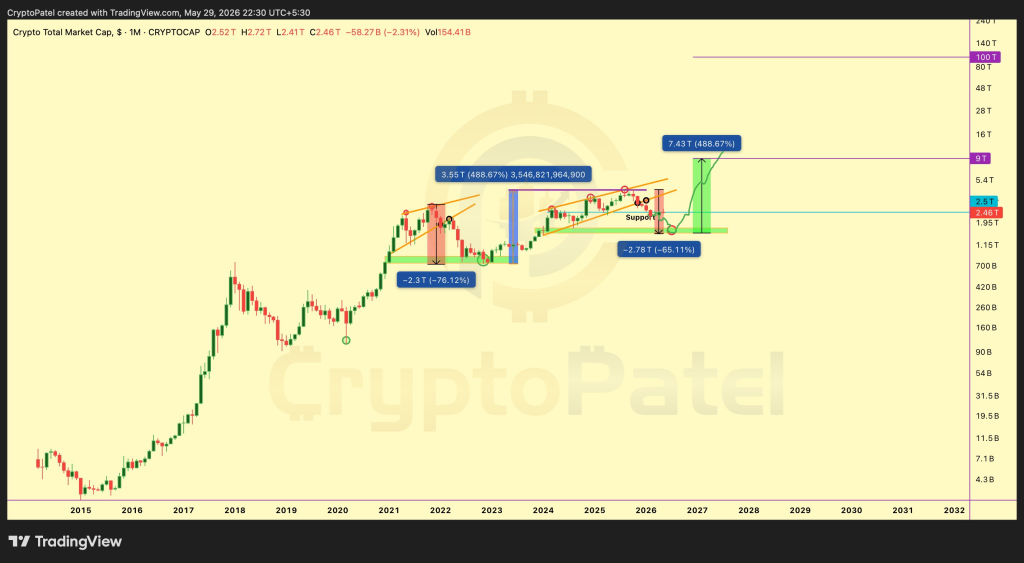
Fibonacci extension levels: The chart includes Fibonacci extension levels, with the 488.67% extension at roughly $3.55 trillion (already exceeded in 2025) and another extension near $7.43 trillion, which would be a near-term target. The ultimate target is $100 trillion.
The chart is highly speculative. It draws a straight line from past growth and extends it forward without accounting for regulatory, economic, or technological disruptions. However, it visually represents the same optimistic trajectory that Hoskinson described.
Our Honest and Unbiased Opinion
Charles Hoskinson’s $100 trillion crypto market prediction is optimistic but not impossible over a 12-year horizon. Consider that the global stock market is roughly $120 trillion, and the bond market is even larger. A $100 trillion crypto market would mean crypto absorbing a significant share of global financial assets. With tokenization of real-world assets, central bank digital currencies, and the growth of decentralized finance, that level of adoption is conceivable by the late 2030s.
However, the math relies on several heroic assumptions. First, the $100 trillion figure assumes continuous exponential growth without major multi-year bear markets. Crypto has historically experienced 70–90% drawdowns, and future cycles could push the $100 trillion target much further out. Second, Bitcoin’s supply is not fixed at 20 million forever; it will approach 21 million by 2140, but currently the circulating supply is around 19.8 million. This is a minor adjustment.
More importantly, the $1.5–3 million Bitcoin price assumes that BTC’s market cap grows proportionally with the total market. That may not hold. As the crypto market matures, altcoins, especially those with real utility (Ethereum, Solana, XRP, etc.), could capture a larger share. Bitcoin’s dominance has already fallen from over 90% in the past, and if that trend continues, Bitcoin may command a smaller share of a future $100 trillion market. In that case, even with a $100 trillion total market, Bitcoin’s price might only reach $1–2 million.
Another factor: institutional adoption through ETFs and corporate treasuries could drive Bitcoin’s price much higher than the proportional math suggests. Bitcoin is the only crypto with a clear “digital gold” narrative. Pension funds allocating even 1% to Bitcoin would create massive demand.
Overall, Hoskinson’s prediction is a long-term vision, not a short-term forecast. The math is correct on paper. The real question is whether crypto can overcome regulatory hurdles, scalability issues, and competition from traditional finance to achieve that scale. For Bitcoin specifically, $1.5–3 million per coin by 2038 is not a certainty, but it is within the realm of possibility if adoption continues at historical growth rates. Investors should treat it as a hopeful scenario.
FAQs
Subscribe to our YouTube channel for daily crypto updates, market insights, and expert analysis.