
The Bitcoin price is pulling back after its latest rally ran into resistance around $82,000, giving bears another opportunity to argue that the 2026 market bottom may not be complete. At the same time, Washington has delivered potentially constructive news for crypto, with the CLARITY Act losing another source of organized opposition ahead of its crucial September 15 Senate vote.
Bitcoin’s rejection around $82,000 is particularly important because that region has emerged as one of the market’s biggest technical barriers. Reuters recently identified roughly $82,793 as major resistance, with several longer-term technical levels converging nearby.
CryptoCon, an analyst we regularly follow, isn’t convinced that August’s powerful Bitcoin rally marked the beginning of a new bull market.
His latest Fisher Transform chart indicates that Bitcoin still hasn’t produced the technical breakout he wants to see. In fact, the analyst remains convinced that the bear market has unfinished business, despite BTC’s impressive recovery from its 2026 lows.
What you'll learn 👉
Bitcoin Price Rejected After Rallying Toward $82K
Bitcoin entered September with bulls firmly back in control after gaining roughly 25% during August.
The rally erased a significant portion of the losses from earlier this year and carried BTC back toward the $81,000–$83,000 area.
But breaking through that region has proven difficult.
CryptoCon described bullish confidence as reaching a crescendo as Bitcoin approached $82,000, only for the cryptocurrency to be “smacked down” from resistance.
That rejection matters because price isn’t the only part of his analysis running into resistance.
His Fisher Transform indicator is doing the same thing.
CryptoCon Says Bitcoin Hasn’t Confirmed a Bull Market
CryptoCon’s chart tracks the Fisher Transform across multiple Bitcoin market cycles going back to 2010.
Rather than focusing exclusively on Bitcoin’s dollar price, the analyst uses the indicator to identify major changes in longer-term market conditions.
The most interesting feature is the recurring descending structure that develops during bear markets.
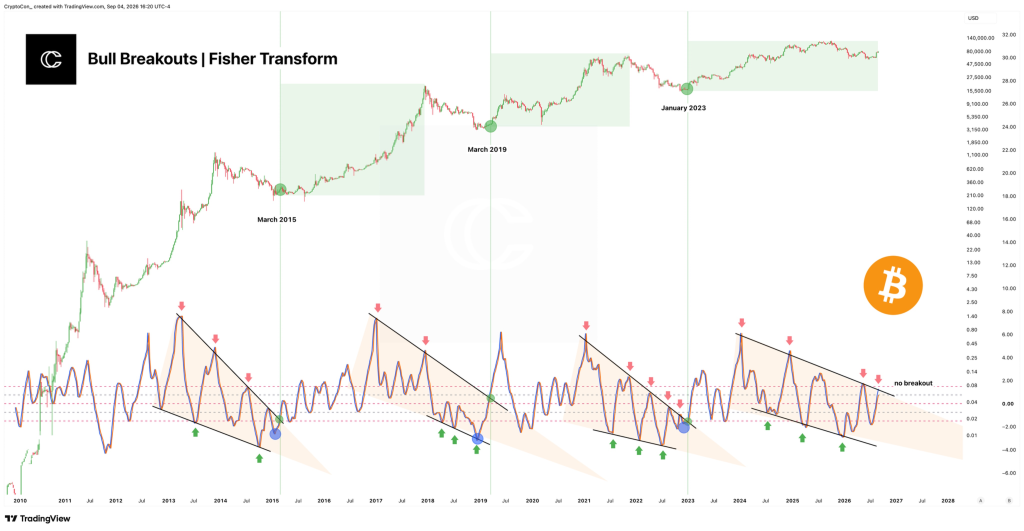
CryptoCon draws downward-sloping resistance across successive Fisher Transform peaks. Eventually, the indicator breaks through that resistance, and historically those breakouts have appeared close to the beginning of major bullish periods.
The chart identifies previous important turns around March 2015, March 2019 and January 2023.
Each came near the end of a major Bitcoin bear market.
According to CryptoCon, the current cycle hasn’t produced the equivalent confirmation.
The Fisher Transform has rebounded considerably, but it is now testing the upper boundary of another descending structure. CryptoCon explicitly marks the latest attempt as “no breakout.”
That’s why he isn’t ready to call Bitcoin’s recent move the beginning of a new bull market.
The Fisher Transform Is at a Critical Level
The current setup creates a fairly straightforward test.
If the Fisher Transform decisively breaks above its descending resistance, CryptoCon would finally have one of the signals that appeared near the early stages of previous Bitcoin bull markets.
Until that happens, he considers the existing structure part of the bear market.
The chart also shows why the recent $82,000 rejection caught his attention. Bitcoin has staged a major recovery, but the indicator underneath that recovery has reached almost exactly the area where confirmation is required.
This doesn’t prove another Bitcoin crash is coming.
Technical indicators can fail, and Bitcoin’s market structure today is very different from previous cycles. Spot ETFs, institutional ownership and corporate Bitcoin holdings have all changed the composition of demand.
Still, CryptoCon believes the historical pattern remains relevant until the market definitively breaks it.
Read also: ChatGPT Predicts If $1,000 in Bitcoin Can Become $10,000
CryptoCon Still Expects the Bitcoin Bottom Later This Year
This isn’t the first piece of data leading CryptoCon to the same conclusion.
The analyst has repeatedly argued that Bitcoin’s normal cycle timing places the final bear-market bottom somewhere around November 2026 to January 2027.
His previous cycle analysis found that Bitcoin’s last three completed bear markets lasted approximately 417, 372 and 384 days, respectively. The average is around 391 days. His model recently put the current bear market around 84% through that historical average.
CryptoCon has acknowledged that there are legitimate reasons to believe the bottom could already be in. Several indicators have entered historical bottoming territory, Bitcoin has developed bullish divergences, and the strength of the August rally is difficult to dismiss.
But he hasn’t changed his base case.
He still believes another low is possible before the bear market is complete.
In his latest comments, CryptoCon pointed to three factors behind that conviction: regular cycle timing, longer-term cycle-bottom data that he believes hasn’t fully completed, and market psychology.
The Fisher Transform now adds another piece to that argument.
Washington Just Delivered Better News for Crypto
While Bitcoin’s technical picture remains contested, the regulatory picture in Washington has improved.
The National Sheriffs’ Association (NSA) has moved from opposing the CLARITY Act to taking a neutral position, removing another source of resistance ahead of the expected September 15 Senate vote.
That doesn’t mean the organization now supports the bill.
The distinction is important.
In a July 31 letter, the NSA had been highly critical of the legislation, raising concerns about law enforcement, illicit finance and protections for noncustodial software developers.
Its new position is considerably less confrontational.
The National Sheriffs’ Association was the last of the major police organizations opposing the Clarity Act to change its position, moving from opposition to neutral. But that shift is notable.
— Eleanor Terrett (@EleanorTerrett) September 4, 2026
Compare the language in this letter with the one the group sent July 31, when it… pic.twitter.com/BJMNDa1t3a
The organization said that, given the legislation’s complexity and outstanding details, it would step back and allow the legislative process to continue.
For the crypto industry, moving a major law-enforcement organization from active opposition to neutrality removes one obstacle—even if it doesn’t add a guaranteed Senate vote.
Why Law Enforcement Has Been Fighting Parts of the CLARITY Act
One of the biggest disagreements revolves around protections for developers of noncustodial crypto software.
Law-enforcement critics have argued that the proposed protections could make it harder to pursue developers whose software is knowingly used to move illicit funds.
The crypto industry takes a very different position.
Its argument is essentially that developers who create decentralized software but never take custody of users’ assets shouldn’t automatically be regulated or prosecuted as money transmitters.
That disagreement remains unresolved.
The National District Attorneys Association and National Association of Assistant U.S. Attorneys are still expected to oppose the current approach unless those protections are narrowed.
According to the information surrounding the negotiations, however, the White House, Treasury, congressional supporters and crypto industry representatives have resisted those requested changes.
Sen. Catherine Cortez Masto has also previously aligned herself with prosecutors’ concerns and has not publicly reversed that position.
So the CLARITY Act still has political hurdles ahead.
Read also: White House Crypto Summit: Trump Drops Major Bitcoin and CLARITY Act Statements
September 15 Could Be a Major Date for Crypto
The National Sheriffs’ Association development matters largely because of timing.
A Senate procedural vote is expected on September 15, and advancing the legislation requires 60 votes. Republicans hold 53 Senate seats, meaning Democratic support will be required.
The NSA moving to neutral potentially removes one argument that undecided senators could use against advancing the legislation.
But it doesn’t guarantee passage.
Other disagreements remain, including questions surrounding crypto-related conflicts of interest involving government officials. Semafor reports that those issues remain unresolved.
The next ten days could therefore become important for determining whether lawmakers can assemble the coalition needed to move the legislation forward.
Is the Bitcoin Price Crash Really Not Over?
Our view is that CryptoCon’s chart deserves attention, but it isn’t confirmation that Bitcoin must make another low.
The historical Fisher Transform pattern is compelling. Similar breakouts appeared around previous major market turns, and the current indicator simply hasn’t delivered the same signal yet.
But the absence of confirmation is different from confirmation of another crash.
Bitcoin bulls have a relatively clear way to challenge the bearish thesis: BTC needs to break through the major $82,000–$83,000 resistance region and maintain the recovery while CryptoCon’s Fisher Transform escapes its descending structure.
Until then, his bear-market scenario remains alive.
That makes September unusually interesting.
Subscribe to our YouTube channel for daily crypto updates, market insights, and expert analysis.