Bitcoin (BTC) Price News: Bitcoin Faces Its Biggest Test Yet as Analysts Watch the $61K Support Level


Bitcoin has managed to bounce back from its week of weakness and is now trading near $62,700, after rising from $57,000. While the move has boosted sentiment, the traders are not too happy with this move. There is one resistance level which can determine how far Bitcoin will rise.
Crypto analyst Ardi believes the answer depends less on the latest rally and more on what happens during the next correction. A look at Bitcoin’s daily and 4-hour charts shows why the $61,000 level has become the most important area for traders.
What you'll learn 👉
Why the $61K Price Level Matters Most for The BTC Price
We had a look at the charts Ardi shared, and the daily timeframe continues to show a bearish market structure. Ever since the fall from above $70,000, Bitcoin has been creating a series of lower highs and lower lows.
In this case, the current rally has pushed the BTC price from $57,000 to more than $62,000, although the price is still below the previous daily lower high of around $66,000 to $67,000.
Ardi argues that the next pullback is the real test. If the BTC price revisits the $61,000 area and buyers defend it, the market would produce a higher low above the previous swing low near $58,000. That would mark the first interruption in the existing bearish sequence and improve the short term outlook.
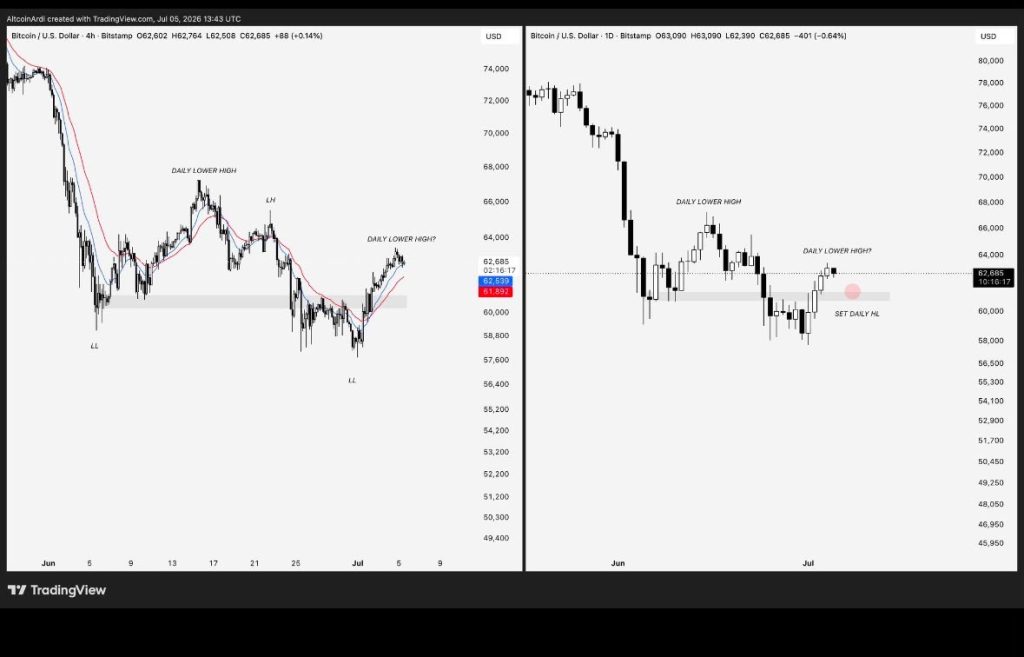
The 4-hour chart presents a more constructive picture. BTC is back on track above its short-term moving averages and creating new higher highs and higher lows from a rebound from around $57,000 levels. Despite the fact that the rise faces resistance at the $63,000 to $64,000 level, the daily bias remains neutral.
From the buyer’s point of view, the aim is quite clear. First of all, the cryptocurrency should trade above the $61,000 during the next pullback and stay above the $58,000 pivot level. In such a case, a new higher low will be created and allow an attempt towards the $66,000 to $67,000 resistance level. A daily close above $67,000 would invalidate the existing lower high pattern and provide stronger confirmation that bullish momentum has returned.
Read Also: Cardano Price Recovers as 14,783 New ADA Holders Flock Back After the Bottom
Michael Saylor Says Bitcoin’s Strength Comes From Consensus
The technical setup isn’t the only thing traders are paying attention to. Michael Saylor also shared his thoughts this week on what makes Bitcoin different from most other blockchain networks. In a post on X shared by Micheal Saylor, the Strategy chairman described Bitcoin’s consensus model as the network’s “immune system.”
Hard consensus is Bitcoin’s immune system. Fees price block space. Nodes set policy. Miners build blocks. Holders allocate capital. Protocol changes must earn overwhelming alignment, so bad ideas fail before becoming iatrogenic protocol changes. $BTC
— Michael Saylor (@saylor) July 5, 2026
As he noted, transaction fees define block space pricing, the nodes enforce the rules of the network, the miners create blocks, while the holders of Bitcoin determine the allocation of funds. Any innovation in the protocol, according to him, should gain widespread consensus from within the system for it to become a part of Bitcoin.
Indeed, it is a confirmation that Bitcoin was never meant to be modified easily. In contrast to other blockchain platforms with their constant changes and upgrades, Bitcoin was always very conservative in its development process.
A $1 Million Bitcoin Might Not Be the Good News Everyone Expects
Another conversation that caught attention this week came from Ledger co-founder Éric Larchevêque. Crypto Patel shared Larchevêque’s view that a $1 million Bitcoin would not automatically mean the global economy is thriving.
Instead, it could happen because of deeper economic problems, including weakening fiat currencies, rising government debt, and growing geopolitical uncertainty.
A $1M $BTC Isn't Always a Bullish Sign.
— Crypto Patel (@CryptoPatel) July 5, 2026
According to Ledger's co-founder, it could mean the world is facing major economic problems like failing fiat currencies, rising debt, and growing geopolitical uncertainty, not a stronger global economy. pic.twitter.com/5gUCh9FjSg
It’s an interesting perspective because Bitcoin often attracts investors during periods of financial stress. A much higher BTC price doesn’t always mean economic conditions have improved. In some cases, it simply means more investors are looking for alternatives to traditional financial assets.
Institutions Are Still Betting on Bitcoin
ARK Invest has acquired approximately $77 million of cryptocurrency-related stock investments during the month of June, with a bulk of this amount coming from $44 million Coinbase purchases.
These acquisitions occurred in one of the most challenging times in history for the crypto-equity sector. Regulation also remains part of the bigger picture. The proposed American Reserve Modernization Act (ARMA) would establish a Strategic Bitcoin Reserve for the United States.
The proposal includes long-term government custody, quarterly Proof-of-Reserves audits, and restrictions that would prevent large Bitcoin sales for 20 years. The bill has not been approved, but it continues fueling discussion around sovereign Bitcoin adoption.
Not everyone is convinced the market has turned the corner. According to analysts from Seeking Alpha, the technical setup, monetary tightening, and macroeconomic headwinds could force the BTC price to test lower levels of support before seeing any recovery.
What Happens if the Bitcoin Price Loses Support?
The bearish case remains valid if Bitcoin fails to defend the $61,000 support zone. A break below that level would increase the probability of another test of the $58,000 low. Losing both support levels would extend the existing pattern of lower highs and lower lows, keeping the broader downtrend intact.
For now, the Bitcoin price remains between confirmation and rejection. The latest recovery has improved short term conditions, but the next pullback will determine whether buyers have enough strength to change the daily market structure or whether the broader bearish sequence continues.
FAQs
Subscribe to our YouTube channel for daily crypto updates, market insights, and expert analysis.