
Government debt across major economies has reached levels that would have looked extreme only a decade ago.
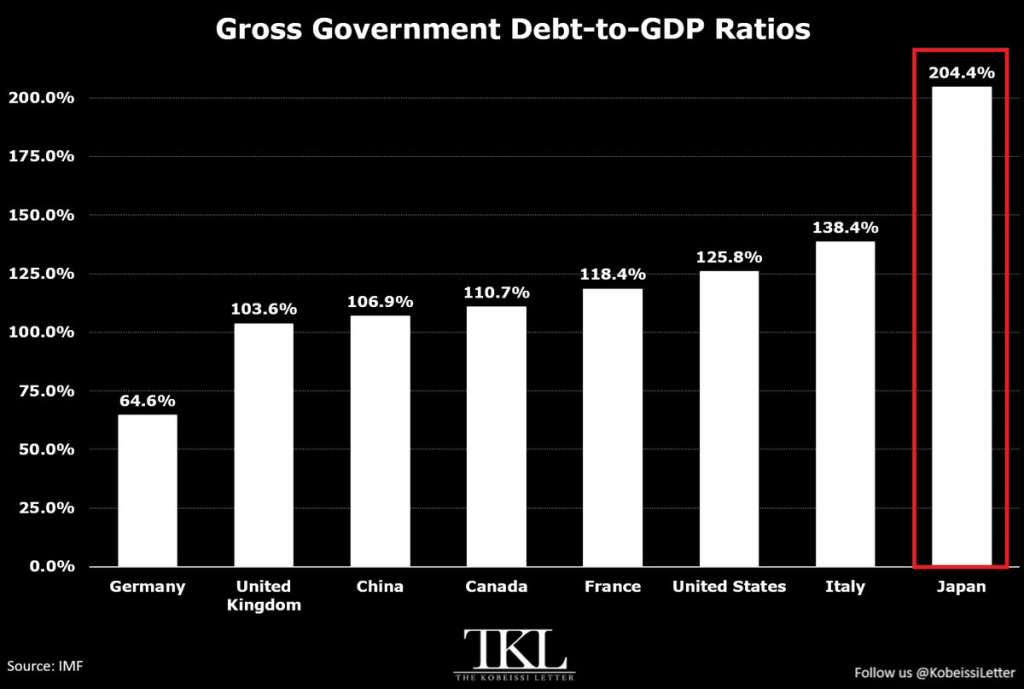
The Kobeissi Letter shared IMF data showing Japan with gross government debt near 204.4% of GDP, Italy around 138.4%, the U.S. at 125.8%, France near 118.4%, Canada around 110.7%, China 106.9% and the UK 103.6%. Germany remains much lower at roughly 64.6%.
I would like to explain how all of this could affect Bitcoin going forward, but before that, let me explain the broad point (since it’s tricky to dispute).
Developed economies are carrying very large debt burdens at the same time borrowing costs are rising.
The IMF independently lists U.S. general government gross debt at 125.8% of GDP for 2026 and expects that figure to continue rising in coming years.
Japan remains the clearest outlier. The IMF recently described its public debt as roughly 207% of GDP, still the highest among advanced economies.
What you'll learn 👉
Why High Debt Is Becoming More Difficult to Manage
Debt by itself is not automatically a crisis.
The real problem appears when governments must refinance huge debt loads at much higher interest rates.
That is increasingly relevant now.
Global bond yields have risen as central banks deal with persistent inflation, large government borrowing needs and heavy capital demand from infrastructure, defense and AI investment. Reuters recently noted that benchmark 10-year yields across the largest developed economies have increased materially this year, making sovereign financing more expensive.
The U.S. is a good example.
Federal debt reached roughly $40 trillion in 2026, with annual interest costs hitting about $1.36 trillion. Persistent deficits mean the government must continue issuing large amounts of debt even as borrowing costs remain elevated.
France is dealing with similar pressure. Its government debt is around 118.5% of GDP, and French 10-year yields recently moved close to 24-year highs.
That combination is what turns high debt from an accounting number into a market issue.
How Could This Affect Bitcoin?
Bitcoin has a very different monetary structure.
Its supply is capped at 21 million coins, and issuance follows a predetermined schedule rather than government fiscal needs.
That is why long-term Bitcoin bulls often view rising sovereign debt as supportive for BTC.
If governments continue running large deficits, investors may become more concerned about currency debasement, financial repression or central banks eventually having to tolerate higher inflation to keep debt servicing manageable.
In that environment, scarce assets such as Bitcoin and gold can become more attractive.
But I would not call rising debt automatically bullish for Bitcoin.
In the short term, high government borrowing can actually hurt BTC.
More debt issuance can push Treasury yields higher. Higher yields tighten financial conditions and make risk-free assets more attractive relative to speculative investments.
We have already seen Bitcoin react negatively this year when U.S. yields moved toward the 5% area.
So there are two competing effects:
| Time horizon | Possible impact on Bitcoin |
|---|---|
| Short term | Higher debt issuance can push yields higher and pressure BTC |
| Medium term | Fiscal stress can increase volatility and weaken risk appetite |
| Long term | Currency dilution and debt sustainability concerns can strengthen Bitcoin’s scarcity narrative |
That tension is important.
Bitcoin can fall during a debt-driven bond selloff and still benefit from the same debt problem over a longer period.
Read also: What Happens to Bitcoin if the Stock Market Crashes Again?
What It Means for the Broader Crypto Market
Bitcoin is the cleanest crypto asset for this thesis because its monetary policy is simple and capped.
The argument is weaker for most altcoins.
Many crypto projects have inflationary token schedules, concentrated ownership or governance systems that can alter supply dynamics. Rising sovereign debt therefore does not automatically create the same monetary narrative for ETH, XRP, SOL or smaller tokens.
The broader crypto market may still benefit if debt stress eventually leads to easier monetary policy or renewed liquidity.
But if governments keep borrowing heavily and central banks respond with higher rates, altcoins could struggle badly before that liquidity returns.
That is why I see global debt as structurally positive for Bitcoin but potentially negative in the short term.
The world’s debt problem strengthens BTC’s long-term argument as a scarce, non-sovereign asset.
The problem is timing.
Before high debt leads to easier money, it can first produce higher yields, tighter liquidity and exactly the type of environment that Bitcoin has historically found difficult.
For more crypto news and price predictions, click here.
Subscribe to our YouTube channel for daily crypto updates, market insights, and expert analysis.