The Kaspa price has dropped 3.40% over the past 24 hours to trade around $0.0289, moving almost in lockstep with the wider crypto market as investors reduced exposure to risk assets. The broader crypto market lost 2.91%, and Bitcoin fell 3.35%, showing KAS remains highly sensitive to macro conditions.
Data also shows the crypto market maintained a 0.946 correlation with the S&P 500 and a 0.781 correlation with gold, pointing to a liquidity-driven sell-off instead of a project-specific decline.
Even so, trading activity moved in the opposite direction, with Kaspa’s volume climbing 20% over the same period. That combination of higher volume and falling prices has drawn attention to on-chain data, which points to conditions that have historically appeared near market bottoms.
What you'll learn 👉
Kaspa’s On-Chain Data Points to a Potential Market Bottom
One of the strongest on-chain signals comes from Kaspa’s realized price. Data shared by Kaspa Daily places the realized price near $0.07, more than double the market price of about $0.03. Since realized price represents the average acquisition cost across the network, most holders remain underwater after months of trading below that level.
Kaspa realized price sits around $0.07, while market price trades near $0.03, less than half of it.
— Kaspa Daily (@DailyKaspa) July 8, 2026
Realized price is the network's average cost basis, roughly what the typical holder paid. With market well below it, the average holder is underwater — coins changing hands for… pic.twitter.com/7g9GBdMq8F
The gap between realized price and market price has persisted throughout the year, with the KAS price moving between $0.027 and $0.040 without closing the difference.
Historically, assets trading well below their realized price have often entered the later stages of bear markets, where selling pressure begins to fade as fewer investors remain willing to sell at a loss.
Large holders also continue accumulating. Wallet 17 added 1.01 million KAS in four transfers from Gate.io and MEXC, increasing its balance to roughly 130.3 million KAS, valued at about $3.83 million. Whale buying during weak market conditions often indicates confidence beyond short-term price action.
Wallet 17 added roughly 1.01M KAS over the last 24 hours, four inbound transfers between 172K and 369K, all from Gate .io and MEXC. Balance now sits at about 130.3M KAS (~$3.83M). pic.twitter.com/7KB16UYGqv
— Kaspa Daily (@DailyKaspa) July 7, 2026
Kaspa Network Activity Remains Strong After the Hard Fork
Network activity has remained stable following Kaspa’s hard fork. Numbers from Renksi show the network is humming along. Over the last two days, it’s been processing 27,000 to 31,000 accepted transactions every hour.
That’s steady traffic. No hiccups. The upgrade seems to have gone smoothly, and users are sticking around.
$KAS accepted transactions are looking steady
— Renksi (@renksieth) July 8, 2026
around 27k to 31k txs every hour over the last 48h
and this is after the hard fork went live
thats what you want to see
network keeps producing blocks, transactions keep flowing
kaspa is doing the boring part right
upgrade the… pic.twitter.com/jGnqVr3KBV
The network has also continued producing blocks normally, showing the upgrade did not interrupt operations. Maintaining steady transaction flow immediately after a hard fork is often viewed as a positive sign for blockchain reliability and developer execution.
Holder distribution also paints an interesting picture. Kaspa’s distribution tells a clear story. Over 250,000 addresses hold between 1 and 100 KAS. Another 100,000 wallets own 1,000 to 10,000 KAS. And about 67,000 addresses have between 10,000 and 100,000 KAS.
$KAS holder distribution is getting interesting
— Renksi (@renksieth) July 5, 2026
250k+ addresses hold 1 to 100 KAS
100k+ addresses hold 1k to 10k KAS
67k+ addresses hold 10k to 100k KAS
and only 191 addresses hold 10M to 100M KAS
this is the kind of chart that shows how early the holder base still is
a lot… pic.twitter.com/dQsW7h1jlm
On the other end, only 191 wallets control 10 million to 100 million KAS. So you’ve got a large crowd of small and mid-sized holders, with just a handful of giants at the top. That’s broad participation, not just a few whales running the show.
Related Kaspa News: Where Will Kaspa (KAS) Price Go This Week?
Kaspa Price Prediction: Can KAS Recover From Here?
We pulled up the KAS chart. Sellers are still in charge. Price slipped from $0.031 down to about $0.029.
The RSI is at 34.88, getting close to oversold but not quite there. The Ultimate Oscillator is at 42.73. Momentum is weak, but it hasn’t hit panic levels yet.
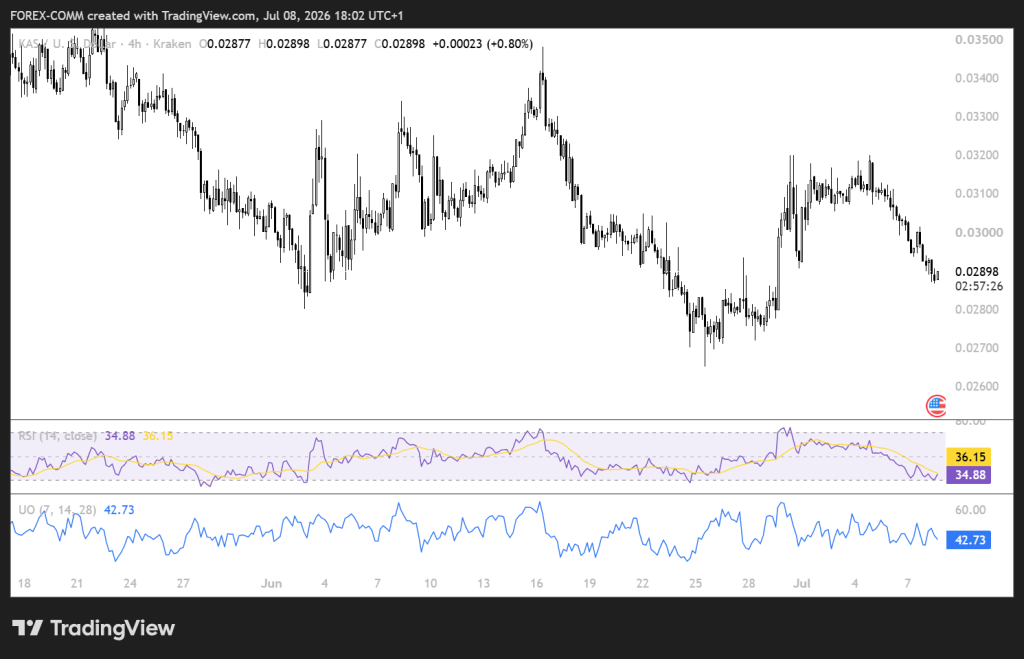
Immediate support is around $0.028. If that breaks, $0.027 is the next floor, buyers defended that area back in late June. On the upside, $0.031 is the first wall to crack. After that, $0.0325–$0.0335.
The best case could happen if whales keep stacking, the network keeps growing, and market sentiment improves. the KAS price pushes back above $0.031 and runs toward $0.033–$0.034.
The middle ground could have the price bounce between $0.027 and $0.031. Everyone waits for Bitcoin to give a clearer direction.
In the worst case, another macro sell-off hits. The KAS price drops below $0.027, even if the network itself is doing fine.
However, Kaspa’s price remains under pressure, but on-chain metrics, whale accumulation, and healthy network activity point to improving fundamentals beneath the surface. The next major move will likely depend on whether broader crypto market sentiment improves enough for those fundamentals to translate into higher prices.
Frequently Asked Questions
Subscribe to our YouTube channel for daily crypto updates, market insights, and expert analysis.