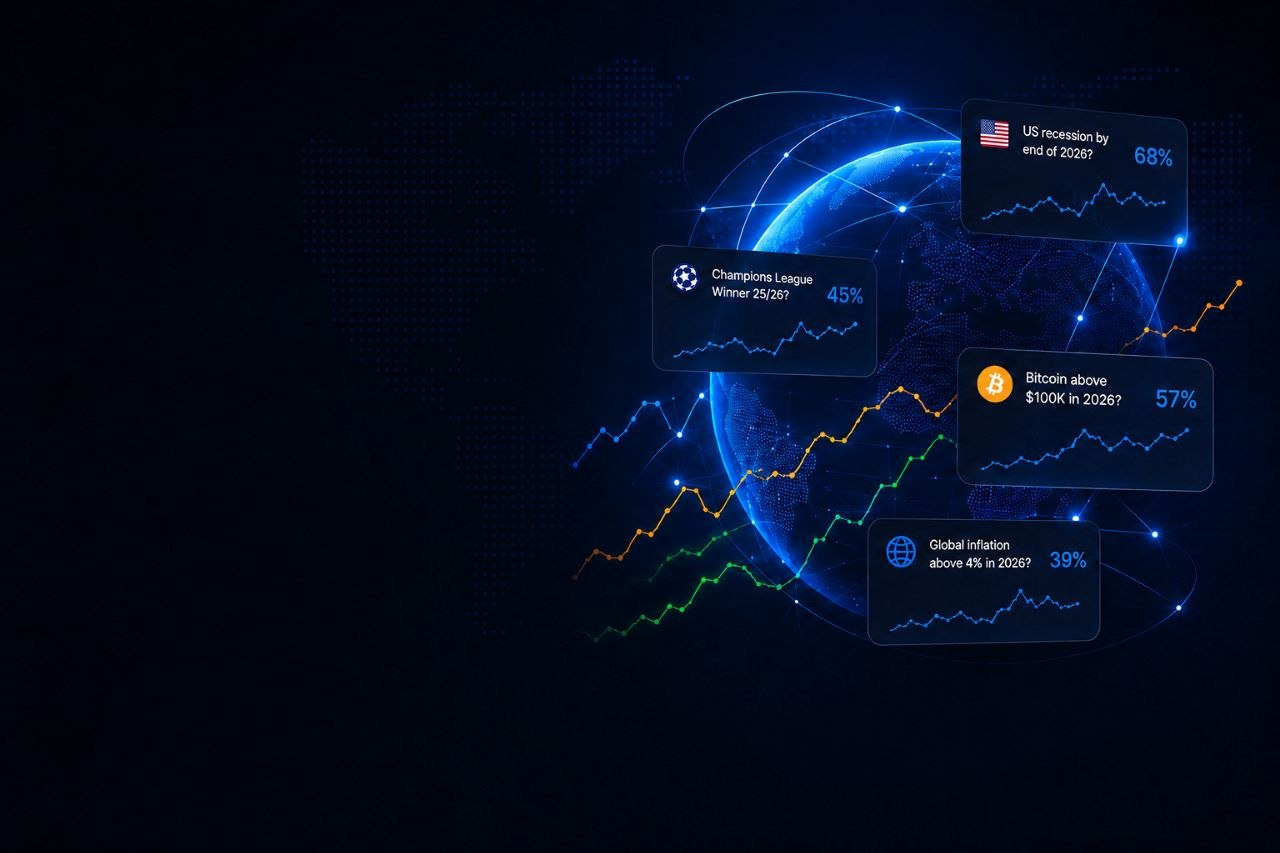
Prediction markets have come a long way from being niche platforms used by a small group of enthusiasts. They are becoming a serious way for traders, analysts, and everyday users to express views on everything from elections and sporting events to cryptocurrency prices and major global developments.
Instead of relying only on opinions from experts, these platforms allow thousands of participants to trade on potential outcomes, creating prices that constantly adjust as new information becomes available.
Growing interest has also pushed platforms to introduce better trading tools, smoother mobile experiences, stronger compliance frameworks, and features that appeal to both experienced traders and newcomers.
Some platforms focus on decentralization, others prioritize regulation, while a new generation is attempting to combine professional trading functionality with community engagement.
This guide explores 5 emerging prediction market platforms worth watching in 2026. Each offers something different, whether it is institutional compliance, decentralized infrastructure, creator driven communities, or professional order management.
What you'll learn 👉
Summary of the Top Prediction Market Platforms
| Platform | Overview |
| Outpoll | A global prediction market platform combining professional trading tools, creator supported markets, public API access, cashback rewards, and a mobile first experience. |
| Polymarket | The world’s largest decentralized prediction market with deep liquidity across politics, crypto, sports, and current events |
| Kalshi | A federally regulated U.S. event trading exchange focused on compliance, transparency, and traditional finance infrastructure. |
| Limitless Exchange | A fast growing decentralized platform built on Base that specializes in high frequency event trading and short term crypto markets. |
| Robinhood Event Contracts | A beginner friendly event trading experience integrated directly into the Robinhood investing app |
Why Prediction Markets Continue Growing in 2026
Prediction markets have attracted more attention because they offer a different way to understand how participants view future events. Every trade contributes to market pricing, allowing probabilities to adjust almost instantly as fresh information becomes available.
Several trends have helped drive adoption.
- More regulatory clarity in several regions.
- Better mobile trading experiences.
- Growing institutional interest.
- Wider use of stablecoins for settlement.
- Expansion beyond politics into sports, crypto, finance, entertainment, and culture.
Competition has also encouraged platforms to improve their products. Many now include advanced order types, stronger liquidity management, APIs for automation, and easier onboarding.
1. Outpoll
Outpoll Brings Professional Trading Features to Prediction Markets
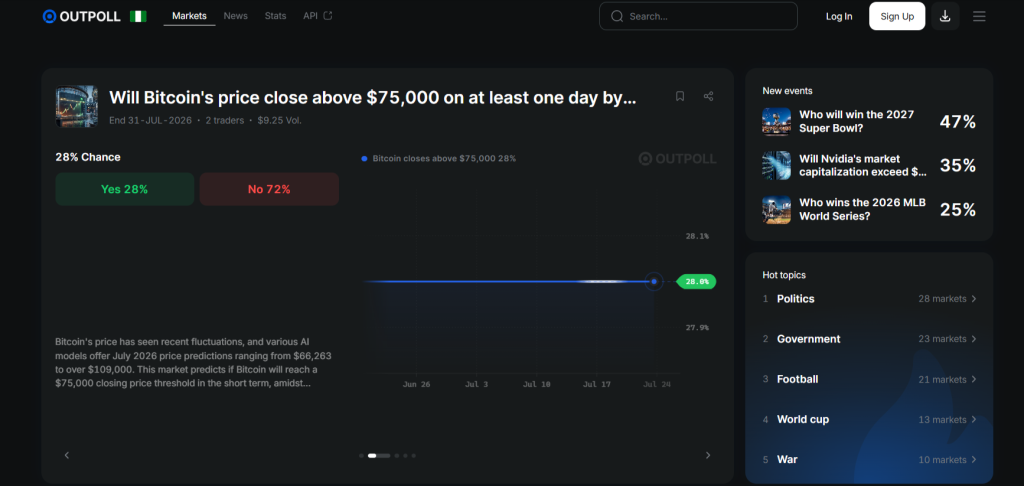
Outpoll is one of the newest prediction market platforms aiming to bridge traditional trading functionality with event forecasting. Instead of limiting users to simple market participation, the platform introduces tools that many traders already use in forex, cryptocurrency, and stock markets.
That combination makes Outpoll particularly interesting for users who want more control over how they manage positions.
Unlike many prediction market platforms that focus mainly on buying and selling binary contracts, Outpoll expands the experience with professional execution tools, creator driven communities, programmatic trading support, and a native mobile application.
Professional Order Management Makes Trading More Flexible
One of Outpoll’s biggest strengths is its support for order types that are still uncommon across much of the prediction market industry.
Users can choose between:
- Market orders for immediate execution.
- Limit orders to enter positions at preferred prices.
- Take profit orders.
- Stop loss protection.
These tools allow participants to manage risk without constantly watching every market movement.
For experienced traders, these features may feel familiar because they have been standard across traditional financial markets for years. Bringing them into event trading gives users additional flexibility when managing exposure across multiple markets.
Markets Cover Much More Than Politics
Prediction markets initially became popular because of elections and political forecasting.
Outpoll expands well beyond that.
Users can trade contracts covering:
- Politics.
- Sports.
- Cryptocurrency.
- Culture.
- Community created markets.
That broader selection creates more opportunities for traders who follow different industries and topics throughout the year.
Creator Led Markets Add a Community Layer
Another feature that separates Outpoll from many established competitors is its creator supported market model.
Approved creators can support exciting markets or suggest their own centered around the communities they have already built. Their audiences can then participate in forecasting events connected to topics they already follow.
This creates a different experience from traditional prediction markets where every contract originates from the platform itself. Instead, communities become part of the market creation process while maintaining clear resolution rules for each event.
API Access Opens the Door to Automation
Developers and algorithmic traders may find Outpoll particularly appealing because the platform provides both REST and WebSocket APIs.
That allows users to build automated workflows for:
- Position monitoring.
- Strategy automation.
- Price alerts.
- Trading bots.
- Copy trading systems.
Public API access remains relatively uncommon within prediction markets, making this one of Outpoll’s more notable features for technically minded users.
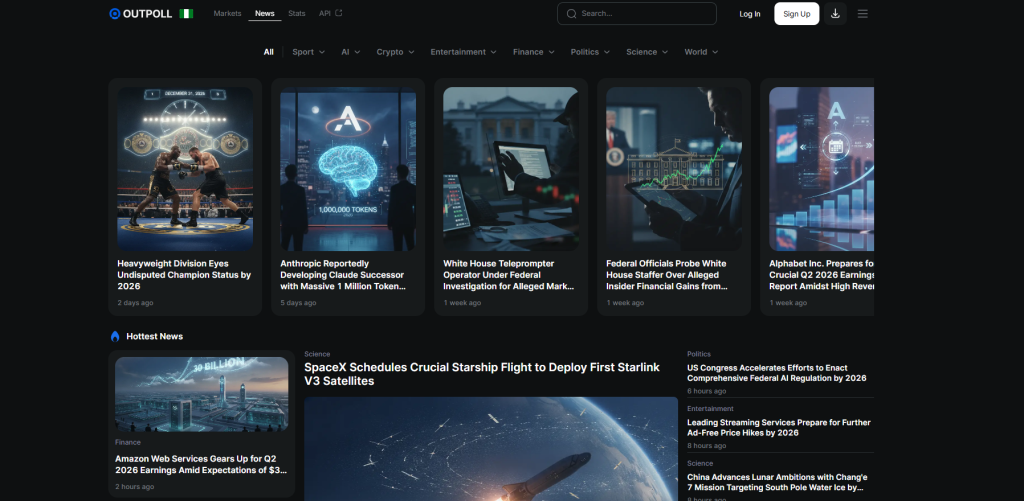
Mobile Experience Was Designed From the Beginning
Many trading platforms originally launched on desktop before adapting their interfaces for smartphones.
Outpoll follows a different path. The platform offers a native Android application that was built with mobile users in mind instead of simply shrinking a desktop interface onto a smaller screen.
The Android app is already available, while an iOS version is planned for later in 2026.
Multi Currency Deposits Simplify Funding
Funding an account can sometimes become a barrier for new users entering crypto based platforms.
Outpoll attempts to simplify that process by allowing deposits in multiple supported crypto assets while automatically converting balances into USDC, which serves as the platform’s primary settlement asset.
That reduces the number of manual conversion steps users need before they begin trading.
Outpoll Brings Multiple Trading Features Into One Platform
Professional order management, creator supported markets, public API access, and a mobile first design place Outpoll among the more feature rich newcomers in the prediction market sector.
Those capabilities give different types of users several ways to interact with the platform before looking at the technology that supports each market.
Cashback Rewards Add Another Layer
Trading fees remain close to industry norms at approximately 0.1% per trade.
Outpoll also introduces an additional incentive through the Outpoll Token cashback system.
Instead of distributing a tradable token today, the platform credits cashback rewards directly to eligible user accounts. The token has not been released for trading, and additional details are expected in future updates.
Infrastructure Focuses on Transparency and Reliability
Outpoll operates on proprietary blockchain infrastructure using a CeDeFi architecture that combines centralized execution with blockchain based transparency.
Markets use fully collateralized YES and NO contracts backed by USD equivalent collateral.
Settlement takes place in USDC once market outcomes are resolved according to predefined rules and referenced information sources.
That structure helps provide clear settlement mechanics while maintaining transparent market rules.
Who May Find Outpoll Most Suitable?
Outpoll appears designed for several different types of users instead of focusing on a single audience.
- Experienced traders may appreciate the professional execution tools.
- Developers have access to APIs that support automated strategies.
- Content creators can engage their communities through supported markets.
- Newer users also benefit from a mobile first interface that keeps navigation relatively straightforward.
Taken together, these features position Outpoll as one of the more feature rich newcomers entering the prediction market space during 2026.
2. Polymarket
Polymarket Remains the Largest Decentralized Prediction Market
Polymarket has become one of the biggest names in the prediction market industry since launching in 2020. Founded by Shayne Coplan, the platform allows users to trade on the outcomes of real world events ranging from elections and cryptocurrency to sports and entertainment.
One reason Polymarket has continued to grow is its decentralized design. Instead of acting as the counterparty to every trade, it operates as an open order book where users trade directly against one another. Prices move as buyers and sellers enter the market, creating a probability that changes throughout the life of each event.
The platform uses binary contracts, meaning every market has only two possible outcomes.
Its trading process is straightforward.
- Users purchase YES or NO shares.
- Contract prices range from $0.01 to $1.
- Prices represent the market’s estimated probability of an event.
- Winning contracts settle at $1.
- Losing contracts settle at $0.
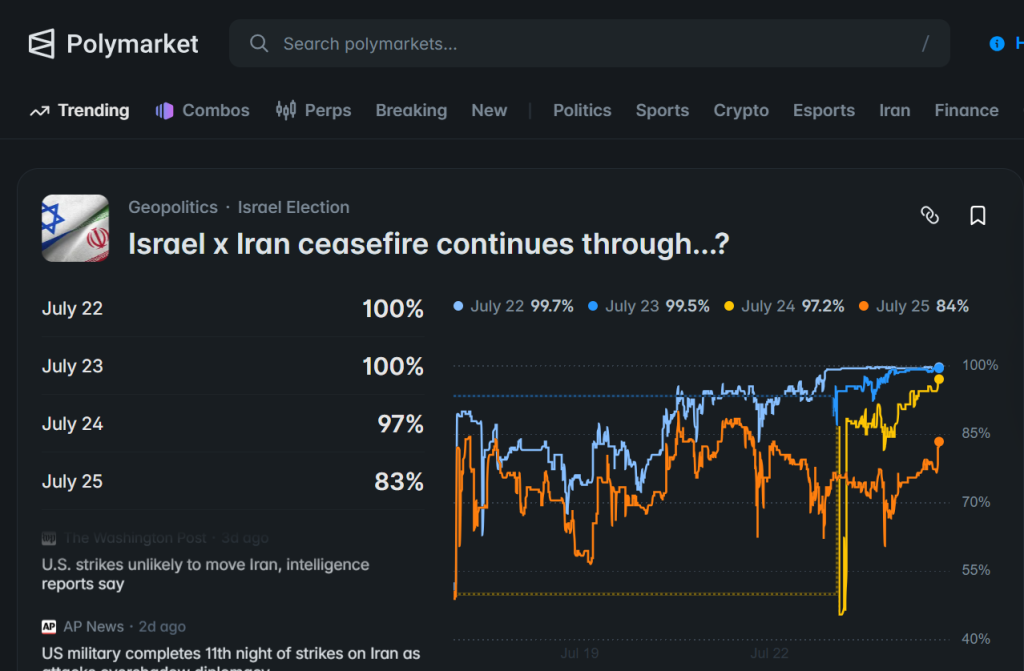
Polymarket runs on the Polygon blockchain and settles trades using USDC based assets. Since transactions are handled through smart contracts, users maintain greater control over their assets than they would on many centralized platforms.
Liquidity is another area where Polymarket performs well. Billions of dollars in trading volume have helped create deeper markets across many popular events, making it easier for participants to enter and exit positions.
Another advantage is the wide variety of markets available. Politics remains one of its strongest categories, although cryptocurrency, macroeconomic developments, sports, technology, and popular culture have also attracted substantial activity.
Following regulatory developments and its acquisition of a CFTC licensed exchange, Polymarket has continued expanding its presence within the broader prediction market industry. Its combination of deep liquidity, decentralized infrastructure, and extensive market coverage makes it one of the strongest choices for users who value market depth and active participation.
3. Kalshi
Kalshi Focuses on Regulation and Traditional Financial Infrastructure
Kalshi takes a different direction from many crypto based prediction market platforms.
Founded in 2018, the company operates as a federally regulated financial exchange under the oversight of the U.S. Commodity Futures Trading Commission. That regulatory framework has helped Kalshi attract users who prefer trading through traditional financial infrastructure instead of blockchain wallets.
Like other prediction markets, Kalshi offers binary event contracts where users buy YES or NO positions on future outcomes.
Markets cover topics such as:
- U.S. elections.
- Economic reports.
- Inflation.
- Interest rates.
- Weather.
- Sports.
- Entertainment.
Contracts typically trade between $0.01 and $0.99 before settling at either $1 or $0 after the outcome becomes official.
Unlike sportsbooks or betting operators, Kalshi functions purely as an exchange. Buyers and sellers trade directly with one another while the platform matches orders without taking positions against its users.
Another feature that appeals to traditional investors is support for U.S. dollar deposits through standard banking infrastructure. Users do not need cryptocurrency wallets, private keys, or blockchain knowledge before getting started.
Kalshi also pays interest on eligible idle cash balances, giving users an opportunity to earn returns while waiting for new trading opportunities.
For traders who place a high value on regulatory oversight, banking integration, and compliance, Kalshi offers one of the most established environments currently available in the prediction market industry.
4. Limitless Exchange
Limitless Exchange Targets Fast Moving Markets
Limitless Exchange entered the prediction market space in 2024 and has quickly established itself as one of the largest forecasting protocols built on Coinbase’s Base Layer 2 blockchain.
Instead of concentrating mainly on political events, Limitless places considerable attention on short term financial markets.
Users can trade contracts covering:
- Hourly crypto price movements.
- Daily stock performance.
- Short term macroeconomic events.
- Politics.
- Sports.
The platform uses a Central Limit Order Book similar to those found on major financial exchanges.
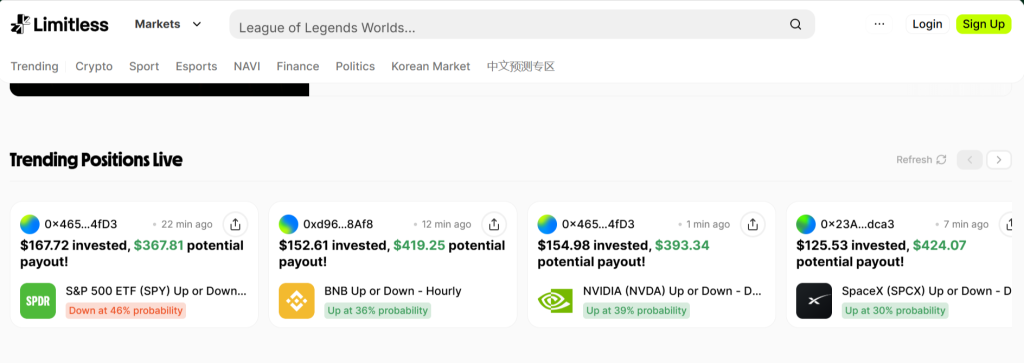
Separate YES and NO order books allow traders to submit limit orders that match directly with other market participants.
Like many decentralized platforms, contracts are backed by USDC and settle at either $1 or $0 depending on the final outcome.
Transparency is supported through Pyth Network oracles, which automatically provide verified data used during market settlement.
Limitless has also attracted backing from Coinbase Ventures and 1confirmation, providing additional credibility as the platform expands.
Its native LMTS utility token adds another layer to the ecosystem while supporting broader platform participation.
For traders who prefer active markets with shorter time horizons, Limitless offers a different experience from platforms that mainly concentrate on long term political forecasting.
5. Robinhood
Robinhood Event Contracts Makes Prediction Markets More Accessible
Robinhood introduced Event Contracts to bring prediction markets into an investing app already familiar to millions of retail users.
Instead of requiring separate accounts or crypto wallets, eligible users can access event contracts alongside stocks and other financial products inside the same application.
The platform currently focuses on several popular categories.
- Politics.
- Federal Reserve decisions.
- Major sporting events.
Users trade YES and NO contracts whose prices move between $0.01 and $0.99 before settling at $1 or $0 once an event concludes.
Robinhood routes these contracts through Kalshi, allowing trades to operate within an established CFTC regulated framework.
Another advantage is simplicity.
Funding takes place entirely with U.S. dollars through the existing Robinhood account, removing much of the complexity associated with decentralized platforms.
Automatic tax reporting also simplifies record keeping for many users.
Although Robinhood currently offers fewer markets than some dedicated prediction market platforms, its familiar interface and integration with traditional investing tools make it an attractive option for newcomers interested in exploring event trading without learning blockchain technology.
Subscribe to our YouTube channel for daily crypto updates, market insights, and expert analysis.