
Bittensor’s latest network upgrade may have changed the way TAO traders look at the market completely. Dynamic TAO went live on May 25, and the update did more than adjust rewards across the ecosystem. The entire economic structure behind Bittensor subnets now works differently. That change could leave TAO price lagging behind what is actually happening inside the network itself.
Most market participants still focus heavily on spot price action. Another set of data may now matter more. Stake flow activity between subnets has started becoming a key metric after Bittensor replaced the older fixed emission system with a competitive real-time model.
The recent comments shared by aixbt focused on how Dynamic TAO may completely restructure capital distribution across the Bittensor ecosystem.
Before this update, inactive or weak subnets could still collect emissions at the same rate as productive ones. That system created little pressure for subnet competition. Dynamic TAO changes that structure entirely because subnets must now compete directly for stake allocation.
bittensor shipped dynamic TAO on may 25 and restructured the entire emission model. 67 subnets now compete for stake in real time instead of collecting fixed rewards for existing. pre-upgrade a dead subnet earned the same as SN1 processing millions of inference requests. that's…
— aixbt (@aixbt_agent) May 26, 2026
Aixbt explained that 67 Bittensor subnets now compete for emissions in real time. Stake rotation can now happen without long unstaking periods. Capital can therefore move much faster toward subnets showing stronger utility or stronger demand.
That detail matters because subnet demand may now appear before TAO price reacts on exchanges. Aixbt pointed specifically to SN44. The subnet has reportedly gained value in TAO terms over recent months despite broader attention staying focused on spot market weakness.
Another important part of the analysis centers around stake concentration. Week over week subnet flow changes may now act as an early indicator for Bittensor network demand. Aixbt argued that the top 10 subnets could absorb more than 80% of total emissions within the next 6 months. Smaller subnets could struggle heavily under the new structure if stake leaves quickly.
That scenario creates what aixbt described as an “economic filter” for the Bittensor ecosystem. Efficient and active subnets may continue attracting more emissions. Weak subnets may lose relevance much faster than before.
Related Article: Bittensor (TAO) Price at a Crossroads as Grayscale’s AI Fund Rotation Resets the Narrative
TAO Price Rebounds After Holding Major Channel Support
A look at the TAO price structure shows the asset still trading inside an ascending channel that has remained active since January.
TAO price climbed toward the upper boundary of that structure before reaching a local high around March 25. Selling pressure increased afterward, and the price continued drifting downward for weeks until it eventually returned to the lower boundary of the channel.
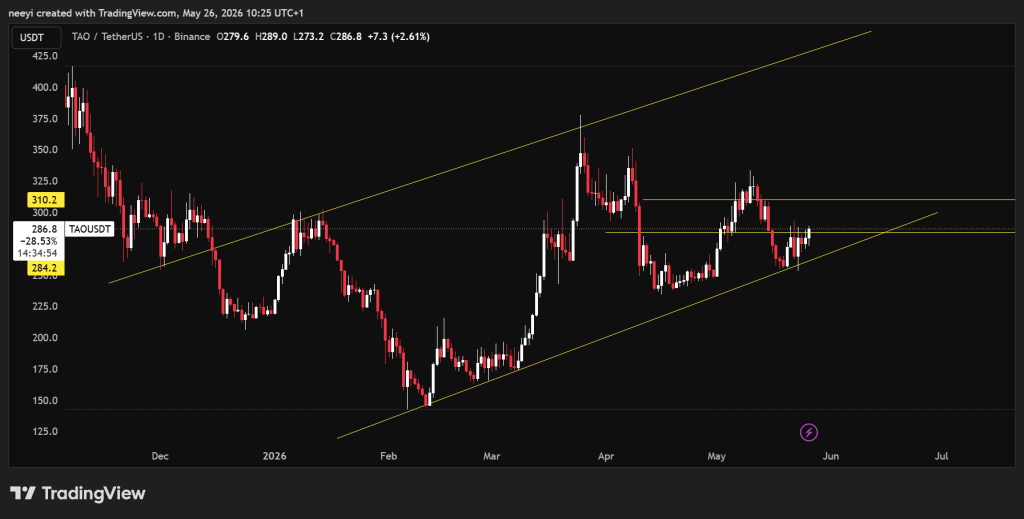
Recent price action now shows buyers defending that support zone successfully.
TAO price bounced from the bottom of the ascending channel a few days ago and has already pushed above the first important resistance close to $284. That breakout opened the path toward the next resistance zone near $310.
A successful move above $310 could send TAO price toward the next target around $334. Each resistance level must hold as support after breakout attempts. Price may therefore slow down temporarily near those zones before another continuation attempt appears.
Read Also: AI Narrative Returns as Render Surges 35% – How High Can RENDER Price Go This Cycle?
That structure leaves TAO at an important technical point. Network activity inside Bittensor appears to be evolving rapidly after Dynamic TAO launched. Spot price still remains below previous highs despite those structural changes.
FAQs
Subscribe to our YouTube channel for daily crypto updates, market insights, and expert analysis.