
Stellar is moving deeper into institutional finance as major players expand tokenized products onto blockchain rails. State Street Investment Management and Galaxy launched the SWEEP fund on May 5, targeting expansion to Stellar, while Figure introduced a regulated yield-bearing stablecoin directly on the network.
Also, DTCC confirmed a July 2026 rollout for tokenized assets involving over 50 institutions. These developments point to growing real-world use for Stellar’s infrastructure.
Despite that, the XLM price is up only 0.53% to $0.159 in 24 hours, closely tracking Bitcoin’s 1.74% gain, with trading volume down 16% to $113.1 million, showing limited independent demand so far.
What you'll learn 👉
State Street’s $5T Onchain Move: Why This Matters for XLM Price
The tweet lays out a clear development: State Street and Galaxy introduced the SWEEP fund as a tokenized liquidity vehicle for institutional investors. The structure allows stablecoins to be deployed into yield-generating strategies with continuous access, removing restrictions tied to traditional market hours. This is a direct upgrade to how large pools of capital manage short-term liquidity.
State Street’s scale is a key detail. The firm oversees more than $5 trillion in assets, making this one of the largest traditional finance players entering tokenized fund infrastructure. Galaxy provides the crypto-native rails, and Anchorage handles custody, forming a bridge between traditional finance and blockchain systems.
🧵 Stellar is becoming part of the institutional onchain cash-management stack.@StateStreetIM and Galaxy Asset Management have launched SWEEP, the State Street Galaxy Onchain Liquidity Sweep Fund.
— Marco Salzmann Ħ 🇩🇪🇻🇪 (@MarcoSalzmann80) May 5, 2026
The fund starts on @solana and is planned to expand to @ethereum and @StellarOrg… https://t.co/ZUzGmgAqZM pic.twitter.com/cCj7MGgzPQ
The expansion plan is just as important. SWEEP launched on Solana, with Ethereum and Stellar next in line. That places Stellar in direct competition with leading smart contract networks for institutional use cases, especially in areas like liquidity management and settlement.
The broader context strengthens the case. BlackRock’s BUIDL fund and Franklin Templeton’s tokenized products already demonstrated demand for onchain funds. With Figure launching a regulated yield-bearing stablecoin on Stellar, the network is building a stack that includes payments, tokenized assets, and yield products. This positions Stellar beyond simple transfers and into full financial infrastructure.
Here’s What the XLM Chart Is Showing
We had a look at the chart, and price action shows a range-bound structure over the past few months. The Stellar price peaked near $0.18 in late April before entering a steady decline toward the $0.155–$0.16 zone. That area has acted as support multiple times, preventing deeper downside.
The recent candles show tight consolidation around $0.159, with smaller bodies and reduced volatility. This aligns with the drop in trading volume to $113.1 million, pointing to weaker participation. There’s no strong breakout structure yet, despite the fundamental developments around the network.
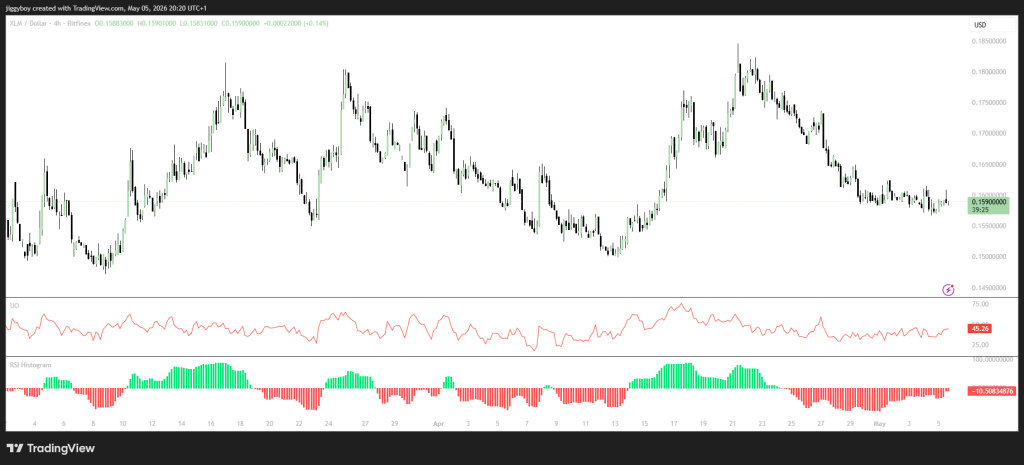
Momentum indicators also remain neutral.RSI is around 45. That is middle ground, not too hot, not too cold. The histogram is still a little negative, so there is some soft downward pressure, but nothing strong enough to call it a real trend.
Resistance shows up near $0.17 to $0.175. Price has hit that wall and bounced back more than once. To see a real breakout, the price needs to get past that zone. Until then, XLM stays stuck in a flat range, just waiting for more buyers to step in and push it up.
Read Also: ONDO vs. Bittensor (TAO): Which Is Better to Hold for the Next 6 Months?
Where is the Stellar Price Headed Next?
In a bullish case, a break above $0.17 backed by rising volume could open the path toward $0.18 and potentially $0.185. Institutional developments like SWEEP expansion and stablecoin growth would need to translate into on-chain activity and demand for this move to hold.
If things turn bad and XLM loses the floor near $0.155, then $0.15 or lower comes into view. Volume is dropping, and there aren’t enough buyers acting on their own. That makes a drop more likely if the rest of the market weakens.
The most likely thing is more of the same, trading between $0.155 and $0.17. The underlying picture is getting better, but the price still hasn’t seen strong buyers step in. This range allows time for institutional developments to convert into measurable network activity.
Stellar is moving further into the world of big finance. Tokenized funds, regulated stablecoins, and new infrastructure linked to major financial firms are all coming together. These are real things, not just ideas on paper.
Even with that, the XLM price is still stuck in a range, following the rest of the market. To see real strength, price needs to break above that resistance. Until then, consolidation remains the dominant structure.
Frequently Asked Questions
Subscribe to our YouTube channel for daily crypto updates, market insights, and expert analysis.