Silver enjoyed one of its strongest rallies in recent history before everything changed. After racing to a record high of $121.6 earlier this year, the metal has entered a sharp correction that has already erased nearly half of its value. That decline has brought back memories of another period that many precious metals investors would rather forget.
A market analyst known as Leni believes silver may be following a path that looks remarkably similar to the crash that unfolded between 2011 and 2013. That comparison has raised an uncomfortable question. Has silver already found a bottom, or could another major leg lower still lie ahead?
Leni argues that the sequence behind the current silver price decline closely matches what happened after silver peaked in 2011.
The comparison begins with a powerful rally fueled by inflation concerns, geopolitical uncertainty, and expectations of supply shortages. Silver climbed steadily for years before reaching a record high. Momentum eventually faded, and profit taking started to increase. That development marked the beginning of a lengthy decline during the previous cycle.
🚨SILVER IS REPEATING THE 2011-2013 CRASH SCENARIO
— Leni (@lenion) June 22, 2026
I've seen this before, and I don't like how it ends
Since January 2026, silver has dropped around 48% from its all-time high of $121.6/oz, making January and February some of the worst months since 2011
The scenario is… pic.twitter.com/xBJd45LbwJ
Another major factor comes from monetary policy. Leni points to expectations of tighter policy and a more hawkish stance from Kevin Warsh as a source of pressure on precious metals. Higher real yields and a stronger dollar often create a difficult environment for silver because investors can find more attractive returns elsewhere.
Silver also tends to struggle when confidence in the broader economy improves. Capital often rotates from commodities into stocks during those periods. Gold sometimes remains supported due to central bank demand, though silver does not benefit from the same level of institutional accumulation.
Safe haven demand has also weakened. Geopolitical tensions helped support silver during its rally. Easing concerns around conflicts in the Middle East could remove part of that support and reduce the premium that investors previously placed on defensive assets.
ETF flows present another concern. Leni notes that silver ETFs have recorded noticeable outflows during the recent correction. That trend often appears when investors reduce exposure and become less willing to hold risk assets.
What you'll learn 👉
Strong Silver Fundamentals May Not Prevent Further Downside
Despite the bearish comparison, Leni does not argue that silver’s fundamentals are weak.
Industrial demand remains far stronger than it was during the previous cycle. Supply deficits have become an important part of the silver market story, particularly as demand from manufacturing and technology sectors continues to expand.
That difference creates an interesting contrast. Fundamental conditions may be healthier today, yet the investment and speculative side of the market appears to be behaving similarly to the period that preceded the 2011 crash.
Based on that historical comparison, Leni believes silver could still face additional downside. The analyst outlined a possible move toward the $50 to $55 region if the correction continues. A more bearish scenario could eventually pull silver toward the $40 area before stronger demand dynamics begin supporting prices again.
Read Also: Robert Kiyosaki’s Gold and Silver Warning: Price Drop Doesn’t Change His Mind
Silver Price Faces A Critical Test Near The $61 Support Zone
Another analyst, Rashad Hajiyev, sees the current situation differently. Hajiyev believes silver may be approaching an important capitulation phase before a larger recovery begins. The analyst pointed to the March and June lows near $61 as a key area worth watching.
That level has already proven important several times. Silver bounced from the same zone roughly 3 weeks ago. Buyers also stepped in around that area during March and December 2025.
A look at the silver price structure shows why this level matters. Repeated rebounds from the same support zone often indicate that demand remains active there. Another successful defense could produce a short term recovery and stabilize the market after months of selling pressure.
The picture becomes more concerning if silver loses that support. A break below $61 could expose the metal to a decline toward $53. Price action below $53 would strengthen the bearish case substantially and could open the door to a move closer to $47 during the coming weeks.
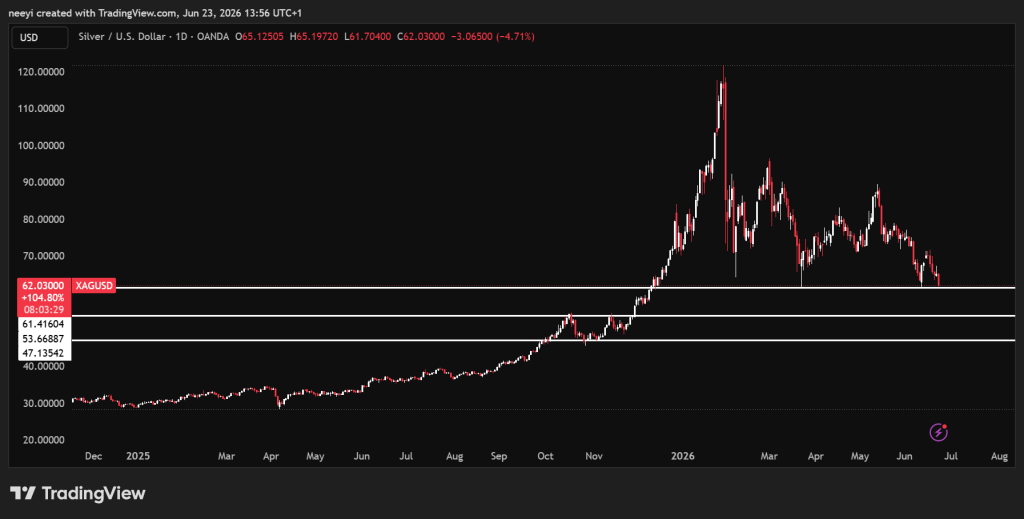
Current market conditions still favor the bears. Silver remains below several important resistance levels, and the broader trend continues pointing downward. Even if silver manages another bounce from $61, that rebound may struggle to generate enough strength to reverse the larger correction.
A wider view of the market also shows that silver may still be digesting the powerful rally that carried prices to record highs earlier this year. Markets rarely move in a straight line forever. Extended rallies are often followed by lengthy periods of consolidation and retracement before the next major move begins.
FAQs
Subscribe to our YouTube channel for daily crypto updates, market insights, and expert analysis.