The SEI price is down over 70% in the past year and slipped another 1.15% in the last 24 hours to around $0.0569, lagging behind a slightly positive Bitcoin. The weakness comes from a lack of strong coin-specific drivers during a broader altcoin slowdown.
Still, things are starting to change. On April 24, SEI broke above a descending resistance around $0.055 with rising volume.
Earlier in the month, Coinbase completed full EVM integration on April 14, opening the door for more developers. Then on April 27, the Giga upgrade was confirmed for Q2, targeting over 10,000 TPS. That puts SEI at a key moment where tech progress and price action are starting to meet.
What you'll learn 👉
SEI Price Action vs Explosive On-Chain Growth in Q1
Top analyst Dami-Defi shared on X that the SEI price fell hard in the first three months of the year. It went from $0.47 down to $0.17. A drop like that would normally push people away. But the numbers underneath say something else.
More people kept using the network even as the price fell. Daily active addresses grew to 311K, up 78% from the quarter before. Transactions averaged 639K, and at one point peaked near 917K. The number of people coming back to use Sei (SEI) again also went up, by 137%.
At the same time, more money flowed in. Total value locked hit $363 million, a 73.7% pump. Stablecoin supply on the network also hit a new high at $178 million. That shows real usage, not just speculation. The SEI price didn’t keep up, but the network itself kept growing.
SEI Institutional Backing, Catalysts, and Q2 Pressure Points
There’s also early institutional interest building in the background. Around $30 million has been committed toward real-world asset initiatives tied to the ecosystem, and large validators have joined the network. That adds credibility, even if it hasn’t fully translated into price strength yet.
Looking ahead, Q2 comes with both opportunity and pressure.The Giga upgrade is the main event, aiming to push performance far beyond current levels. It introduces “Autobahn” consensus and asynchronous execution, targeting over 200,000 transactions per second with sub-400ms finality.
$SEI Q1 Recap:$SEI saw a -56% dip, but its fundamentals remain solid
— Dami-Defi (@DamiDefi) April 30, 2026
1/ Price movement
– Moved from $0.47 to $0.17 in 2026 Q1
– On-chain metrics continue to surge despite the sharp drop in price
2/ Institutional Signal
– $30m committed for enterprise real-world assets (rwa)… pic.twitter.com/z7IiujgLK1
The goal is to bring Web2-level speed to DeFi, gaming, and AI use cases. If it delivers, SEI becomes more attractive to high-frequency applications. Delays or technical issues could slow confidence during rollout.
The upgrade also includes stronger MEV protection to reduce issues like sandwich attacks by limiting how transactions are reordered for profit. That’s important for DeFi users because it improves fairness and supports stronger liquidity conditions.
Alongside this, the EVM transition makes SEI easier for Ethereum developers to use, lowering barriers for app migration and expanding the ecosystem. Also, monthly token unlocks between 112 million and 132 million SEI could weigh on the price. That creates a push and pull dynamic between growth and sell pressure.
Here’s What the SEI Chart Is Showing
We had a look at the chart, and the structure tells a steady story. After a prolonged drop into early April, the price started forming a base around the $0.048–$0.050 zone. That level held multiple times, showing buyers were willing to step in.
From there, the SEI price began printing higher lows. Not aggressive moves, but enough to show accumulation. Each dip found support slightly above the previous one, which usually signals that sellers are losing control.
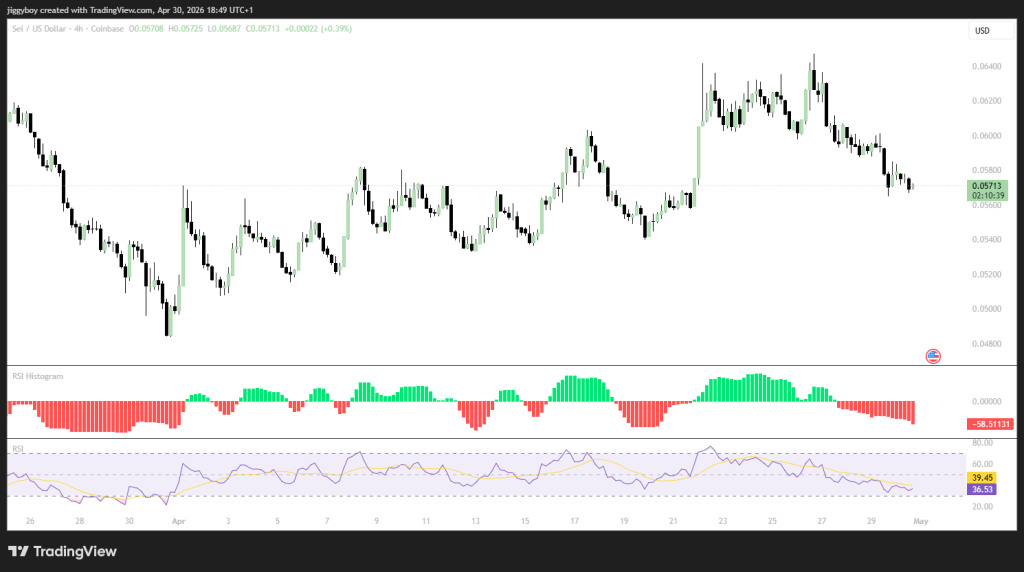
Then things broke loose. The price cut through a hard ceiling near $0.055 and ran straight up to the 0.062–$0.064 zone. You could see it in the candles and the rising numbers, traders who chase moves had jumped in.
Now it’s slowed down. The SEI price fell back to the $0.056–$0.057 area. The RSI cooled to around 39, so there’s room to go up again if buyers come back. The red bars on the histogram show selling pressure right now, but nothing’s fallen apart yet. As long as the price stays above $0.055, the whole setup is still fine.
Read Also: Ripple Expands in Dubai as XRP Sentiment Hits 2-Year High After Rakuten Integration
How High Can SEI Price Go in Q2?
Bullish case
If the Giga upgrade goes smoothly and people keep using the network, the SEI price could climb back to $0.065. From there,it might test the $0.075 to 0.080 zone. Break past that with force,and $0.10 becomes the next stop.
Realistic scenario
The SEI price may stay in a range between $0.052 and $0.065 as the market waits for confirmation from the upgrade and absorbs token unlocks.
Bearish case
If selling pressure builds or the upgrade faces delays, the price could drop back toward $0.050 and retest the $0.048 support zone.
The SEI price didn’t perform well in Q1, but the network moved in the opposite direction. Usage, liquidity, and developer access all improved. Now everything comes down to execution. If the upgrade delivers and demand holds, Q2 could look very different.
Frequently Asked Questions
Subscribe to our YouTube channel for daily crypto updates, market insights, and expert analysis.