Short answer: PUMPCHANGE hasn’t launched. There’s no trading history yet, no completed payout, and no track record to point to. Anything that claims otherwise right now isn’t being straight with you.
That’s a weaker opening than most platforms would give a skeptical reader. It’s also the accurate one. What follows is what can be checked about PUMPCHANGE today, what will be checkable once it’s live, and what should make a cautious reader cautious either way.
What you'll learn 👉
Is PUMPCHANGE Legit, or Is “Charity Meme Coin” Just Marketing?
There’s no complete answer to that before launch, and any piece that claims a complete answer is the thing to be skeptical of. PUMPCHANGE sits in a small but growing charity crypto category: projects that tie a donation directly to a token’s mechanics instead of running it as a separate campaign.
What’s verifiable is the framing PUMPCHANGE puts on itself. Meme tokens traded through the platform are for entertainment purposes and have no inherent value or utility. That’s not marketing copy: it’s stated directly in PUMPCHANGE’s terms of service, and it applies to every token launched there, not just the ones that look thin.
The platform is also non-custodial, meaning it never takes control of a user’s tokens or private keys (the codes that let a wallet’s owner access it). Non-custodial cuts both ways, though: it also means no safety net. Blockchain transactions can’t be reversed once confirmed, by PUMPCHANGE or anyone else. Send a token to the wrong address or approve a bad transaction, and there’s no support line that undoes it.
Both of those are structural facts about how the platform and the underlying blockchain work, not judgments about whether PUMPCHANGE specifically is trustworthy. They’re worth knowing before trading on any meme coin platform, this one included.
What Is PUMPCHANGE, Exactly?
PUMPCHANGE is a Solana launchpad and software interface to Raydium’s Solana protocol. It is not the company running the markets, and not a party to any individual trade.
The token creation and trading itself happens on Raydium, an open-source protocol; PUMPCHANGE provides the interface a creator or trader uses to reach it. Meme tokens on the platform will launch on a bonding curve, a pricing mechanism where a token’s price rises automatically as more of it gets bought, before it graduates to open trading on Raydium’s market maker.
The mechanic that makes PUMPCHANGE a “charity meme coin platform” sits inside that same flow: a creator chooses a charity and locks in 10% to 100% of their share of trading fees to it, in the same step where they name the token. That percentage is fixed before the token exists and applies to every trade after that. There’s no separate step where it gets remembered or forgotten.
A 1.25% fee applies to every buy and sell while a token is on the bonding curve. Half goes to the platform; the other half is the creator’s share, split between the creator and their chosen charity according to the percentage the creator locked in. A creator who locks in 50%, for example, sends the charity 0.3125% of every trade and keeps the same amount; a creator who locks in 100% keeps nothing and doubles the charity’s share. Both numbers will appear on the token’s page before anyone trades it.
Creators who want to lock in a charity when they launch can join the waitlist at pumpchange.fun/waitlist.
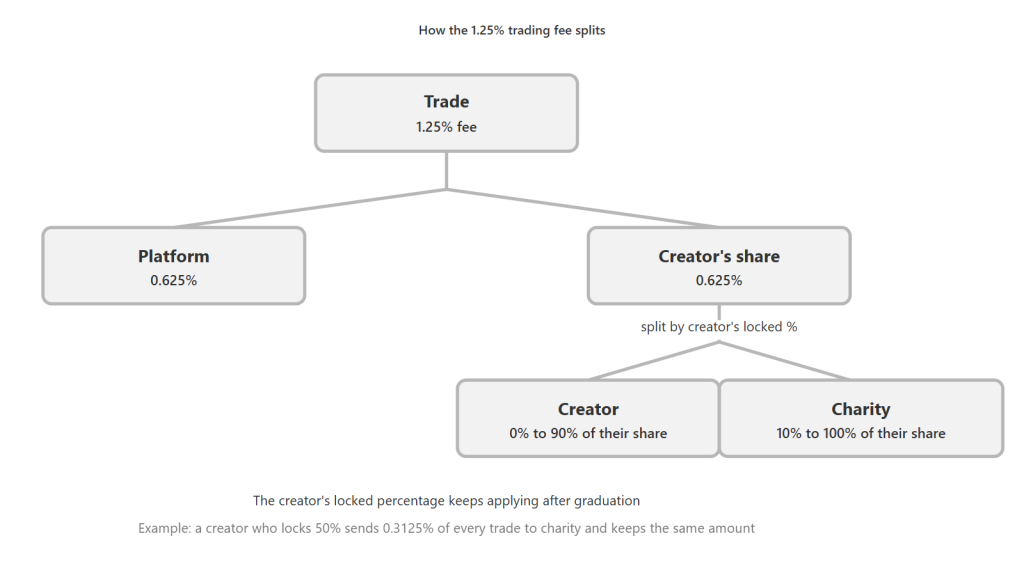
Alt text: Diagram of PUMPCHANGE’s 1.25% trading fee split between the platform, the token creator, and the creator’s chosen charity.
How Is a Token’s Donation Supposed to Reach the Charity?
The Giving Block sets up an individual Gemini account for every charity on the platform, and PUMPCHANGE will send SOL directly to that account when a payout runs. The Giving Block isn’t part of the money path itself: it provisions the account, and the transfer runs directly from PUMPCHANGE to the charity’s own account at Gemini, a regulated custodian.
The charity gets chosen at creation, from a category and then a specific organization, and the percentage gets locked before the token exists. Fees won’t be paid out per trade. They’ll accumulate and be claimed at intervals, and payout details, including the blockchain transaction hash, will be published on the token’s page once that happens. The donation percentage will continue to apply after a token graduates to open-market trading.
What the charity receives is SOL, the same cryptocurrency the trading fees were collected in, not the meme token that generated them. How often payouts run hasn’t been published yet.
Who’s Behind PUMPCHANGE, and Does That Matter?
PUMPCHANGE’s founder is anonymous, and that’s a real risk factor, not a detail to wave away.
An anonymous team means there’s no name, no history, and no reputation on the line in the way there would be with a public founder. Weigh that plainly, on its own terms.
What it doesn’t mean is that trust has to rest on the team at all. The contracts that move the tokens are Raydium’s: open source, reviewable by anyone, independent of PUMPCHANGE. A third-party security audit has also been completed, and the issues it raised were resolved. The platform is designed so that it never takes custody of a user’s tokens or keys. And the payout mechanism is built to publish a public record from the start, rather than depend on anyone’s word after the fact. The argument isn’t that the team should be trusted more. It’s that the design is meant to require less trust in the team to begin with. Take that on its own merits. It doesn’t substitute for the transparency an anonymous team doesn’t offer.
Can a Token’s Creator Hold Too Much Supply and Sell Into Buyers?
The creator’s allocation is tied to which launch tier they choose, and it isn’t the entire supply of a token.
What isn’t yet public: the total supply for a given token, and whether a creator’s allocation is locked or immediately sellable. Without both numbers, there’s no way to state what percentage of a token’s supply sits in the creator’s wallet, and this article isn’t going to guess.
That’s a fair question to keep asking, and one to confirm directly before trading any specific token, not something to take on faith either way. A platform still finalizing those details ahead of launch is normal. One that won’t answer a direct follow-up about supply and vesting once it’s live is a different matter.
What Can You Check About PUMPCHANGE Today, and What Will You Be Able to Check at Launch?
Right now, the list of things a reader can independently inspect is short. At launch, it gets longer.
| What you can check | How to check it |
| The terms of service | A real, dated document naming a governing jurisdiction and an arbitration process. It states plainly that meme tokens are for entertainment, with no inherent value |
| Raydium’s smart contracts | Open source, and reviewable independently of PUMPCHANGE |
| The Giving Block partnership | PUMPCHANGE has named The Giving Block, an established name in crypto philanthropy, as a partner |
| The security audit | A third-party security audit has been completed, and the issues it raised were resolved |
| What you’ll be able to check at launch | How to check it |
| Payout records | Each token page will show a payout history with blockchain transaction hashes, codes you’ll be able to look up on a block explorer, a public tool that shows every transaction recorded on a blockchain |
| Where the donation lands | Each payout will send SOL directly to the charity’s own Gemini account, so a transaction hash will resolve to a specific charity’s account rather than an anonymous wallet |
| The charity and its percentage | Will be displayed on a token’s page before anyone trades it |
| Custody | Tokens will stay in a user’s own wallet; every create, buy, or sell action will require that user’s own wallet signature to approve |
Getting started will involve connecting a wallet and registering with an email and username. That’s an identity record, not custody. The platform is still designed to never take control of a user’s tokens or keys.
How Do You Spot a Meme Coin Scam in General?
Most meme coin scams, and cryptocurrency scams more broadly, share the same handful of missing pieces, whether or not they mention charity.
Watch for:
- No public terms of service, or one that’s vague about jurisdiction and dispute process.
- A team that won’t name any verifiable partner or independent contract to inspect.
- Any claim that a token’s price is bound to rise, or messaging built to pressure a reader into acting before they’ve thought it through. Meme tokens, by design, carry no inherent value, and no legitimate platform should suggest otherwise.
- No independent security audit, or an audit claim with nothing to back it up.
- A platform that describes itself as holding user funds “safely” without saying, specifically, what it does and doesn’t have access to.
- An explanation of what happens to your tokens and wallet keys that doesn’t hold up against the platform’s own terms of service, not just its marketing page.
A mismatch between what a platform claims and what its own terms of service say is a bigger warning sign than any single missing feature.
None of those checks are unique to PUMPCHANGE. They’re the same questions to ask about any Solana launchpad, or similar platform on another chain, combining meme coin trading with a charitable claim, and worth asking again once PUMPCHANGE itself is live.
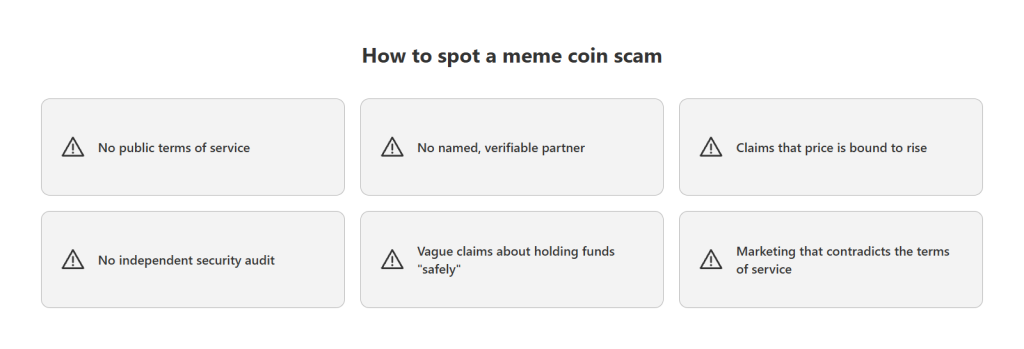
Alt text: Checklist for spotting a meme coin scam: missing terms of service, no verifiable partner, claims that price is bound to rise, and other warning signs.
Where Isn’t PUMPCHANGE Available?
PUMPCHANGE won’t be available to users in New York or California, and is restricted to users aged 18 and over.
That’s a platform-level restriction, not a comment on the product’s legitimacy elsewhere, and it’s worth stating plainly rather than burying it in a terms-of-service clause a reader has to go looking for.
What This Comes Down To
None of this adds up to a verdict, because there isn’t enough history yet to render one for PUMPCHANGE or for the charity crypto category more broadly. What exists today is a terms of service you can read yourself, a set of open-source contracts PUMPCHANGE doesn’t control, a completed security audit, and a named charity partner. What’s designed to exist at launch is a payout record built to be checked, not taken on faith, a donation that lands in the charity’s own named account, and a structure where the platform never holds a trader’s tokens or keys.
That’s a narrower claim than “trust us,” and it’s supposed to be. The waitlist is open at pumpchange.fun/waitlist for anyone who wants to be there when there’s something to check.