Crypto investors searching for strong altcoin opportunities in 2026 have started comparing two very different projects: Injective and Zcash. One focuses on institutional DeFi infrastructure. The other centers on privacy, scarcity, and encrypted transactions.
That comparison matters because both INJ price and ZEC price have moved through extreme volatility during the current market cycle. Recent consolidations across crypto markets pushed many investors to rethink whether they want exposure to fast-growing mid-cap ecosystems or larger, more established networks with institutional narratives.
Injective and Zcash now represent two completely different bets for 2026. One offers aggressive growth potential tied to DeFi expansion. The other offers a Bitcoin style scarcity model combined with advanced privacy technology.
What you'll learn 👉
Injective Infrastructure Gives Developers a Financial-Focused Blockchain
Injective operates as a Layer 1 blockchain built specifically for financial applications. Unlike many chains trying to support every type of application, Injective focuses heavily on decentralized finance infrastructure.
That distinction changes how developers interact with the network.
Injective includes native order books, derivatives infrastructure, and oracle systems directly at the blockchain level. Developers do not need to build those components from scratch. That setup reduces development complexity and allows projects to launch faster.
Another factor deserves attention. Injective supports multiple virtual machine environments simultaneously. Developers from Ethereum, Solana, and Cosmos ecosystems can deploy applications across EVM, SVM, and CosmWasm environments with far less friction than normal cross chain migrations.
The protocol also uses a Frequent Batch Auction system to reduce MEV exploitation and front running. Retail traders often lose value during unfair transaction ordering on traditional DeFi systems. Injective attempts to reduce that issue by batching transactions together.
Analysts following DeFi infrastructure have paid close attention to the network’s tokenomics after Governance Proposal IIP 617 redirected 100% of dApp fees into weekly buyback and burn auctions.
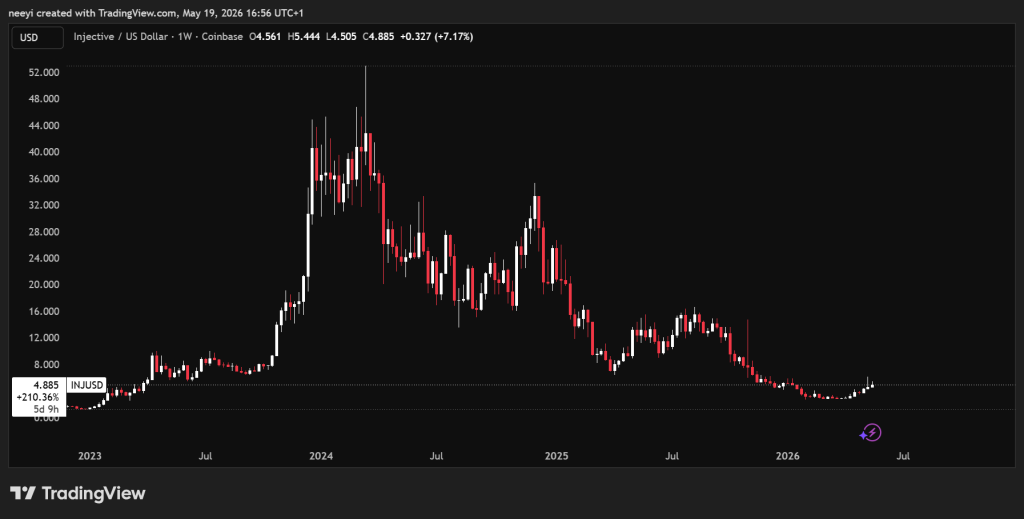
That mechanism matters because INJ trades near $4.8 with a market cap close to $450 million. A smaller market cap combined with aggressive token burns creates room for rapid price expansion if network activity increases again.
Zcash Continues Expanding Beyond The Traditional Privacy Coin Narrative
Zcash originally emerged as a privacy-focused fork of Bitcoin. The project kept Bitcoin’s 21 million supply cap but introduced shielded transactions powered by zero-knowledge cryptography.
Users can choose between transparent transactions or fully encrypted transfers. That optional privacy model separated Zcash from many competing cryptocurrencies years ago.
The project became widely known for pioneering zk SNARK technology. That innovation allowed transactions to be verified without exposing transaction details publicly.
Recent upgrades have expanded the Zcash ecosystem further. The Halo 2 upgrade removed the controversial trusted setup requirement that existed in earlier versions of the protocol. That upgrade improved scalability and removed one of the largest long-standing criticisms surrounding Zcash architecture.
Selective disclosure tools also make the network more compliant-friendly. Users can provide viewing keys to auditors or tax authorities when necessary without giving up permanent public visibility.
Another major catalyst revolves around the Zcash Shielded Assets framework. That infrastructure allows private stablecoins and private assets to operate directly within the network.
Related Article: Injective (INJ) or Hyperliquid (HYPE): Which Is Better for Millionaire Level Returns?
Analysts from firms following privacy infrastructure believe that feature could reposition Zcash from a simple payment network into a broader privacy focused financial ecosystem.
INJ Price And ZEC Price Show Completely Different Growth Profiles
Recent price action reveals how different these assets really are.
INJ price climbed as high as $37.49 during the previous market expansion before falling back into the $3 range during broader 2026 market weakness. Current valuations leave the project trading at $4.78, far below previous highs. That compression creates speculative upside if DeFi activity returns aggressively.
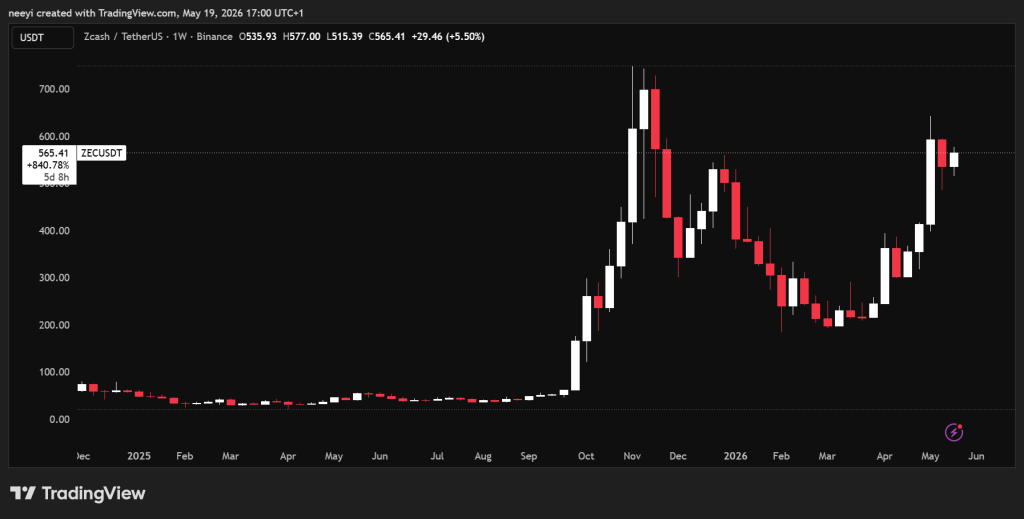
ZEC price followed a much different path. Zcash reached highs near $748 during its institutional expansion phase and currently maintains a market cap near $8.6 billion. It currently trades at around $565.
A look at the numbers shows the key difference clearly.
| Metric | Injective (INJ) | Zcash (ZEC) |
|---|---|---|
| Current Price | $4.78 | $565 |
| Market Cap | ~$450 million | ~$8.6 billion |
| 2025 to 2026 High | $37.49 | $748 |
| 2025 to 2026 Low | $2.90 to $3.03 | $159.41 to $220 |
| Main Narrative | DeFi infrastructure and token burns | Privacy, scarcity, and institutional accumulation |
| Key Catalyst | IIP 617 buyback and burn mechanism | ETF narrative and Shielded Assets expansion |
| Growth Profile | Higher upside potential with higher volatility | More stable large cap structure |
The market cap comparison explains why analysts see Injective as the higher risk but potentially higher reward asset for 2026.
For ZEC to produce a 10x return from current levels, the network would likely require tens of billions in fresh liquidity inflows. Injective would need far less capital to generate the same percentage move because of its much smaller valuation.
There is growing institutional interest surrounding tokenized real-world assets and interoperable DeFi infrastructure. Injective fits directly into that narrative because of its multi-VM architecture and financial infrastructure design.
Zcash continues attracting attention for different reasons. Institutional interest in privacy infrastructure, ETF discussions, and quantum-resistant wallet development have strengthened the long-term case for ZEC as a digital wealth preservation asset.
Injective May Offer Higher Upside Potential In 2026
Choosing between Injective and Zcash depends heavily on investment goals and risk tolerance.
Zcash appears stronger for investors searching for a large-cap asset tied closely to Bitcoin-style scarcity and privacy infrastructure. The network already has institutional attention, deep liquidity, and a mature market presence.
Injective offers a more aggressive growth profile. The combination of low market capitalization, buyback-driven token burns, interoperable infrastructure, and expanding DeFi utility gives INJ price more room for explosive movement if market conditions improve again.
Read Also: Grok AI Predicts Ripple’s XRP Price as RWA Growth Crushes Ethereum and Solana
That does not guarantee stronger performance. Smaller market cap assets also experience sharper volatility during market downturns.
Still, the current structure favors Injective for investors searching for asymmetric upside potential in 2026. Zcash may continue operating as a steadier macro aligned crypto asset. Injective could benefit far more aggressively if DeFi trading volume and institutional blockchain adoption accelerate again over the next market cycle.
FAQs
Subscribe to our YouTube channel for daily crypto updates, market insights, and expert analysis.