Tensions between the United States, Israel, and Iran have escalated into a full military campaign as of March 6, 2026. Operation Epic Fury has now entered its seventh day. Heavy airstrikes have hit Tehran and several strategic locations across Iran.
Forces from the United States and Israel have struck roughly 200 targets so far. Reports also confirm that more than 30 Iranian vessels have been destroyed. Casualty numbers inside Iran have climbed above 1,230 people.
Iran has responded with drone and missile attacks aimed at U.S. military bases across Kuwait, Iraq, and Qatar. Additional strikes have targeted locations in Israel, Bahrain, and the United Arab Emirates. The situation intensified further after Iran’s Revolutionary Guard Corps closed the Strait of Hormuz. That decision disrupted one of the most critical global shipping routes for oil and natural gas.
Humanitarian pressure is also rising rapidly. More than 330,000 people across the region now face displacement due to the conflict.
Diplomatic channels failed shortly before the military campaign began. Negotiations in Geneva collapsed despite mediation from Oman. President Donald Trump stated that negotiations arrived too late to prevent escalation. Regional actors such as Qatar, Turkey, and Saudi Arabia continue pushing for de escalation efforts.
Financial markets have reacted cautiously to the situation. Cryptocurrency prices have weakened during periods when geopolitical uncertainty rises. XRP and Solana both show signs of that pressure. A peace agreement between the United States and Iran could quickly reverse that environment.
What you'll learn 👉
A U.S. Iran Peace Deal Could Improve Global Risk Appetite And Help Crypto Markets
Data from Polymarket suggests that there is a 70% chance the war ends by the end of June. A peace agreement would remove one of the most serious geopolitical risks currently facing global markets. Oil supply stability would return quickly if the Strait of Hormuz reopened. Lower energy prices could reduce inflation pressure across major economies.
Financial markets often respond positively when geopolitical risks fade. Investors tend to rotate capital toward assets that offer higher growth potential. Cryptocurrency markets benefit during these periods because risk appetite expands again.
XRP and Solana both sit in the category of large capitalization altcoins that often respond strongly when sentiment improves. Lower oil prices also influence monetary policy expectations. Central banks may feel less pressure to maintain tight financial conditions if energy driven inflation declines.
Historical patterns offer useful perspective. The Russia-Ukraine conflict during 2022 caused an immediate drop in Bitcoin and many altcoins. Markets recovered once uncertainty stabilized and risk appetite returned.
A similar pattern appeared during the 2020 COVID market crash. Panic drove rapid selling across nearly all asset classes. Recovery followed once stimulus programs entered global economies. The banking turmoil of 2023 also created short term crypto weakness before prices rebounded.
Geopolitical calm often removes obstacles that hold risk assets back. XRP focuses on global payments infrastructure. Solana focuses on decentralized applications and high speed transaction processing. Improved macro conditions would allow investors to concentrate again on those narratives.
XRP Price History Shows Strong Reactions To Legal Developments And Adoption
XRP has experienced several major cycles during the past three years. Regulatory news played a significant role in shaping those moves.
The partial legal victory against the SEC in 2023 marked one of the largest turning points for XRP price. Markets interpreted that outcome as a reduction in regulatory risk. XRP rallied sharply after the decision.
Partnership announcements within the cross-border payments sector have also influenced price movements. Payment networks and financial institutions exploring Ripple’s technology created bursts of optimism at several periods.
The broader crypto cycle also influenced XRP’s trajectory during 2024. Bitcoin rallies often pulled XRP upward as liquidity flowed into the altcoin market. Periods of tightening financial conditions caused the token to remain range bound.
Price history during the past year illustrates that pattern clearly. XRP traded around $2.24 in mid March 2025 before climbing to roughly $3.28 by mid August of the same year. The how trades $1.43.
Geopolitical tension between the United States and Iran added caution during the most recent phase. Bitcoin held stronger because many investors view it as the most resilient crypto asset during uncertain periods. XRP often requires positive momentum from broader markets before sustained rallies appear.
Peace Deal Could Allow XRP Price To Recover Toward Higher Levels
A signed peace agreement could change market psychology quickly. War-related risk premiums would decline across financial markets. Investors could move capital back into altcoins once uncertainty fades.
Bitcoin typically leads such recovery phases. XRP tends to follow that movement once liquidity expands into the broader crypto ecosystem.
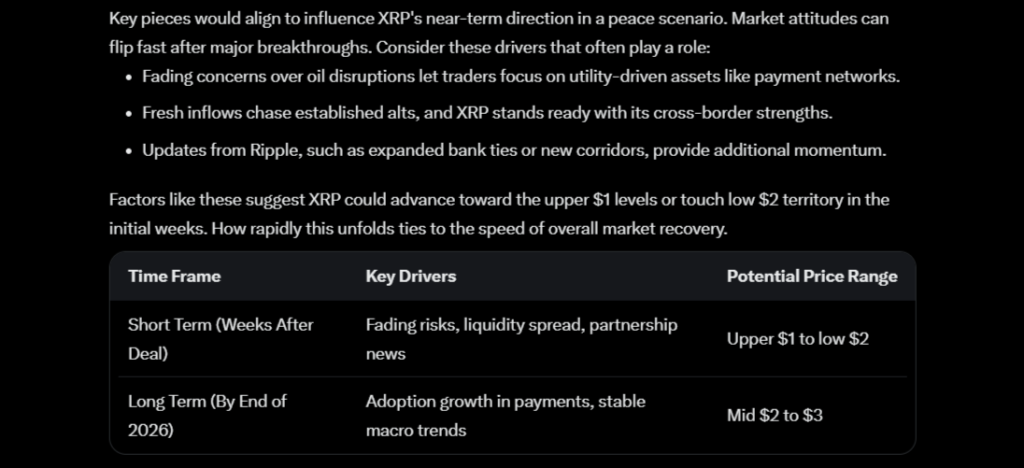
XRP currently trades near $1.43. Relief from geopolitical pressure could push the token back toward the upper $1 region or even into the low $2 range during the first phase of recovery.
Longer-term prospects depend on factors beyond geopolitics alone. Ripple’s partnerships with financial institutions remain an important driver. Continued progress in payment adoption would support price growth if global stability improves.
Stable macro conditions could support a wider recovery throughout the rest of 2026. XRP may trade within a broad range between the mid $2 region and $3 if adoption expands and the broader crypto market strengthens.
Solana Price History Shows Strong Growth During Risk-On Market Phases
Solana has followed a different trajectory during the past several years. The network rebuilt significant momentum during 2023 after a difficult period earlier in the cycle.
Developers returned to the ecosystem during that recovery phase. Network activity increased again as decentralized finance and new applications launched on the chain.
The year 2024 introduced a powerful narrative around low transaction fees and high throughput. Meme coins, decentralized exchanges, and gaming projects all helped drive Solana adoption.
Trading activity expanded rapidly across decentralized exchanges built on the network. New token launches often created sudden bursts of liquidity. These cycles frequently pushed Solana price higher than many competing networks.
Read Also: Cardano (ADA) vs. Solana (SOL): Which Altcoin Could Outperform In 2026?
The period between 2025 and early 2026 displayed the asset’s high beta characteristics. Risk on market environments allowed Solana to outperform during rallies. Downturns often produced deeper corrections than those seen in Bitcoin.
The U.S. Iran conflict intensified this pattern. War-related headlines placed pressure on higher-risk assets. Solana declined more sharply than Bitcoin during the latest uncertainty.
A Peace Agreement Could Allow Solana Price To Recover Toward Higher Targets
A reduction in geopolitical tension could quickly support Solana’s recovery potential. Equity markets often rally during periods when global risks decline. Cryptocurrency markets typically follow that broader shift.
Solana benefits strongly during risk on phases because its ecosystem thrives when capital flows into decentralized applications. Current price levels sit near the $90 to $100 region.
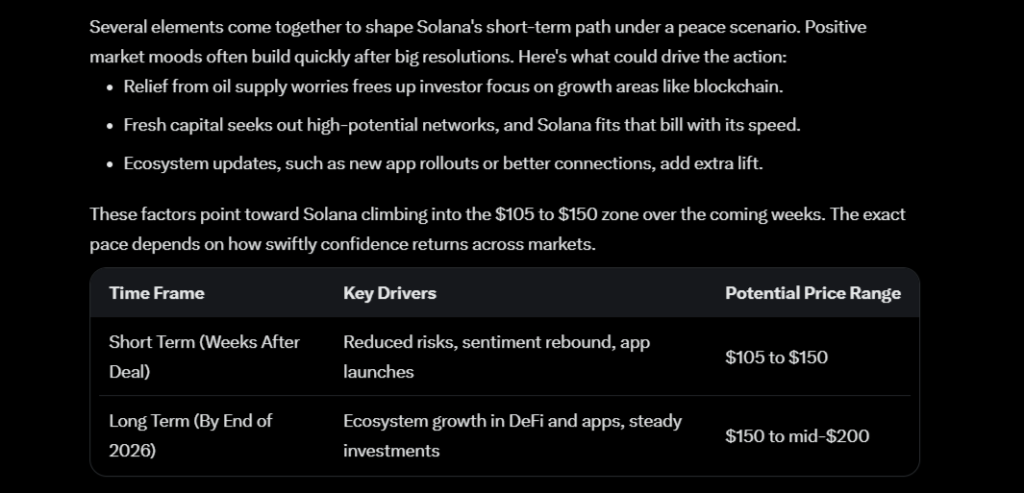
Improved global conditions could lift Solana toward the $105 to $150 range within weeks if market sentiment turns positive again. New decentralized applications or network integrations would reinforce that recovery.
Longer term growth depends heavily on ecosystem expansion. Continued development across decentralized finance and consumer applications could strengthen the network’s position throughout 2026.
Read Also: Gold Price Dumping Every Day At 8 AM: Is Bitcoin-Style Manipulation Appearing In Metals?
A peaceful global environment supports capital investment into innovative blockchain platforms. Solana could therefore trade within a range between $150 and the mid $200 region by the end of 2026 if network growth continues.
Subscribe to our YouTube channel for daily crypto updates, market insights, and expert analysis.