Gold briefly fell below $3,700 an ounce on Thursday, extending a selloff that has wiped out nearly 30% from its record close. That puts the decline almost exactly in line with the 2008 gold crash. Back then, investors who bought near the bottom went on to earn 168% by 2011. Anyone counting on a repeat has to answer one question: what happens when the Federal Reserve is still prepared to raise rates?
Spot gold traded at $3,722.84 by 04:52 GMT on November 19 after touching $3,693.13, its lowest price since September 2025. Reuters pointed to two pressures on bullion that morning. The dollar had strengthened, and traders were betting the Fed would raise interest rates again in December.
What you'll learn 👉
Why Higher US Rates Are Hurting Gold
An investor deciding where to park cash for the next six months can buy a Treasury bill and know roughly how much interest it will earn. With gold, the return depends on what someone else will pay for the metal. As Treasury yields rise, gold has to appreciate by more to give that investor the same return. A stronger dollar adds another obstacle by making an ounce more expensive for buyers paying in other currencies.
The September rate increase gave investors a reason to take another hike seriously. Then came the October 28 meeting. The Fed held its target range at 3.75% to 4%, but the vote was 10 to 2. Lisa Cook and Beth Hammack both wanted to raise rates by another quarter of a percentage point.
Coin Bureau put the market-implied odds of a December hike at 95% when it shared its gold chart. Those odds can move with each inflation report. They also help explain why gold can fall weeks before the Fed votes. Investors can already buy and sell bonds, dollars and bullion based on the decision they expect.
What the 2008 Gold Crash Actually Tells Us
Coin Bureau’s chart lines up the two selloffs from their respective record highs. Gold lost 29.7% during the financial crisis. The 2026 line ends at almost the same depth, but the part of the 2008 chart worth a closer look is how long the recovery took. Measured from the old peak, more than a year passed before gold recovered that ground for good. The much larger gain came later.
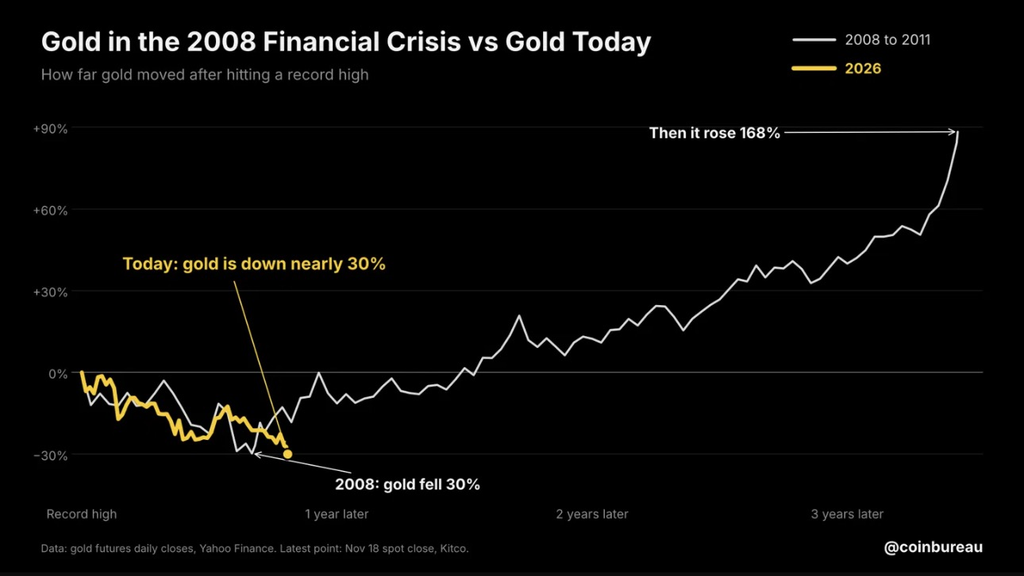
The Fed also gave that recovery a policy backdrop gold buyers would welcome today. In November 2008, it announced plans to buy up to $100 billion in housing-agency debt and $500 billion in agency mortgage-backed securities. The aim was to lower borrowing costs and make credit easier to obtain. By 2011, gold had risen roughly 168% from its crisis low. The gain was measured from the bottom, which investors could identify only in hindsight.
The 2008 comparison tells me how deep the current selloff has become. I’d put less weight on it as a guide to where the gold price goes next. A 30% loss takes a gain of nearly 43% just to recover the old high. In 2008, the Fed was already working to bring borrowing costs down. Today, two of its policymakers wanted to push them higher at the last meeting.
Why Central Banks Are Still Buying Gold
Central banks and other official institutions bought a net 321 tonnes of gold in the third quarter, up 42% from a year earlier. The World Gold Council estimates they added 675 tonnes over the first nine months of 2026. China and Poland led the purchases that countries publicly reported.
A reserve manager buying gold to diversify a country’s holdings can be comfortable owning it for years. A trader choosing between bullion and a Treasury bill has a much shorter deadline. There’s also a gap in the data worth paying attention to. The 321 tonnes cover purchases through September 30. That figure tells us how much official buyers wanted last quarter. We’ll need newer figures to know how aggressively they bought as gold fell through $3,700 in November.
For the next move, I’d watch how gold reacts to fresh US inflation data. If a softer reading brings Treasury yields and the dollar down, gold will have a chance to recover under more favorable conditions. If it keeps making lows even then, buyers have a bigger problem than the December Fed meeting.
For more financial news and price predictions, click here.
Subscribe to our YouTube channel for daily crypto updates, market insights, and expert analysis.