
The euro has started the week under heavy pressure, with EUR/USD falling to a 17-month low near 1.1161 as concerns around France’s debt and political outlook hit confidence in the currency.
The pair has now posted four consecutive weekly declines and is heading toward a fifth if the current weakness continues. France is at the center of the problem: its budget deficit remains elevated, debt is among the highest in the euro area relative to GDP, and investors are demanding a much larger premium to hold French government bonds.
France is also already under an EU excessive deficit procedure, with its deficit expected to remain near 5% of GDP next year.
The bond market is showing the stress clearly. The spread between French and German 10-year borrowing costs recently moved to around 140 basis points, after its largest weekly increase in 17 years. That has raised fears that pressure could eventually spread into other euro-area bond markets.
What you'll learn 👉
France’s Fiscal Problems Are Weighing on the Euro
The issue is not only debt.
Political uncertainty ahead of France’s 2027 presidential election has made investors question how realistic a meaningful fiscal repair will be in the near term.
France’s government faces the difficult task of reducing deficits without creating an even bigger political backlash, and markets are becoming less patient.
The ECB also has limited room to simply step in and absorb the pressure. Its Transmission Protection Instrument is designed for disorderly market stress, but France’s borrowing-cost increase is being driven by genuine concerns about public finances. That makes intervention much harder to justify.
The euro is also getting little help from the other side of the pair.
U.S. Treasury yields remain high, keeping the dollar attractive even after softer U.S. employment data reduced expectations for an October Fed hike. Safe-haven flows into the dollar have added another layer of pressure on EUR/USD.
EUR/USD Chart Analysis
The four-hour chart looks weak.
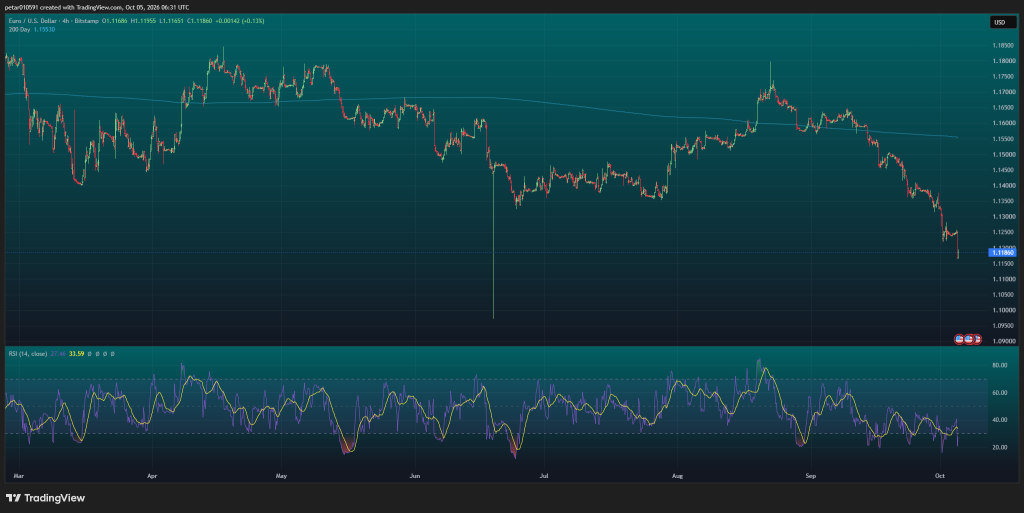
EUR/USD is trading around 1.1186, well below its 200-day moving average near 1.1553. That moving average has also been trending lower, which keeps the broader structure bearish.
The decline from the September area around 1.1650 has been persistent, with the pair repeatedly forming lower highs and lower lows.
Momentum is now stretched.
The RSI sits near 27, putting EUR/USD in oversold territory. That creates room for a short-term bounce, but oversold conditions alone do not mean the trend has reversed.
The first area bulls need to recover is roughly 1.1250-1.1300.
Above that, 1.1400 becomes the next meaningful resistance, followed by the 200-day average around 1.1550.
EUR/USD Price Prediction
The immediate downside level is 1.1150, close to today’s low.
If that breaks cleanly, 1.10 becomes the next major psychological target.
A move toward 1.10 would fit the current bearish structure, especially if French bond stress continues and the dollar stays supported by high U.S. yields.
The oversold RSI makes a temporary rebound toward 1.1250-1.1300 possible first.
But unless EUR/USD can recover above 1.14 and start building higher lows, the broader setup still favors sellers.
For now, 1.10 looks more realistic than a return to 1.16. The euro needs either a major improvement in French fiscal sentiment or a much weaker dollar backdrop before that changes.
For more financial news and price predictions, click here.
Subscribe to our YouTube channel for daily crypto updates, market insights, and expert analysis.