
Bitcoin price dipped 1% today and is now trading below $66,000. The broader crypto market is also in the red, with Ethereum holding near $1,900 and altcoins giving back some of their recent gains.
But the main crypto news today is again related to the Clarity Act. The bill is closer than ever to a vote, but new hurdles have emerged.
What you'll learn 👉
Eleanor Terrett: Pro-Crypto Democrats Unhappy with Several Provisions
Eleanor Terrett reported another big Clarity Act development:
“A group of pro-crypto Democrats say they’re unhappy not only with the Clarity Act’s ethics provisions as they currently stand, but also with several other areas of the bill, including its illicit finance and conflicts of interest provisions. The bill’s path to 60 votes remains challenging.”
This is a critical update. The Clarity Act needs 60 votes to pass the Senate. Republicans alone cannot get it across the finish line. They need Democratic support.
🚨NEW: A group of pro-crypto Democrats say they’re unhappy not only with the Clarity Act’s ethics provisions as they currently stand, but also with several other areas of the bill, including its illicit finance and conflicts of interest provisions.
— Eleanor Terrett (@EleanorTerrett) July 22, 2026
The bill’s path to 60 votes… pic.twitter.com/DUySDemvjR
The ethics package, negotiated between the White House and GOP senators Lummis and Moreno, has not received sign-off from Democrats. Key sticking points include:
- DOJ enforcement authority: Democrats are strongly opposed to giving the Department of Justice civil enforcement authority without state attorneys general having a role.
- Illicit finance provisions: Some Democrats believe the bill does not go far enough to prevent crypto from being used for illicit activities.
- Conflicts of interest: Concerns remain about potential conflicts of interest involving federal officials and digital assets.
The bill’s path to 60 votes remains challenging. Bipartisan negotiations are expected over the coming days.
What this means: The Clarity Act is not a done deal. While Republicans have released updated text, Democrats are pushing back. The bill could still pass, but it will require compromise.
Bitcoin ETFs Attract $900 Million in Inflows Last Week
While the Clarity Act faces political hurdles, institutional demand for Bitcoin is improving.
Bitcoin ETFs attracted +$900 million in inflows last week, the largest weekly inflow since early May. This marks a sharp acceleration from the +$197 million in inflows the prior week.
BlackRock’s IBIT led the surge, attracting +$193 million last week after bringing in +$282 million the week before. On Monday and Tuesday, IBIT had additional inflows of +$115 million and +$164 million.
BREAKING: Bitcoin ETFs attracted +$900 million in inflows last week, the largest weekly inflow since early May.
— The Kobeissi Letter (@KobeissiLetter) July 22, 2026
This marks a sharp acceleration from +$197 million in inflows in the prior week.
The largest Bitcoin ETF, $IBIT, led the surge, attracting +$193 million last week,… pic.twitter.com/tr8lo363oX
This brings total IBIT inflows to +$501 million so far in July, on track for the largest monthly intake since April and the 3rd-largest this year.
On July 23, U.S. spot Bitcoin ETFs recorded total net inflows of $68.99 million , led by BlackRock’s IBIT with $38.78 million. Spot Ethereum ETFs drew $72.64 million , with BlackRock’s ETHA posting the largest single-day inflow at $53.47 million.
Read also: Claude AI Predicts the Bitcoin Price If Clarity Act Actually Passes in 2026
Grayscale: Bear Market Could Last Until September or October
Grayscale released its outlook on the current bear market. The firm said Bitcoin’s current bear market could continue until September or October if the traditional four-year cycle holds. Previous downturns typically bottomed about a year after the market peak and produced average drawdowns of roughly 80%.
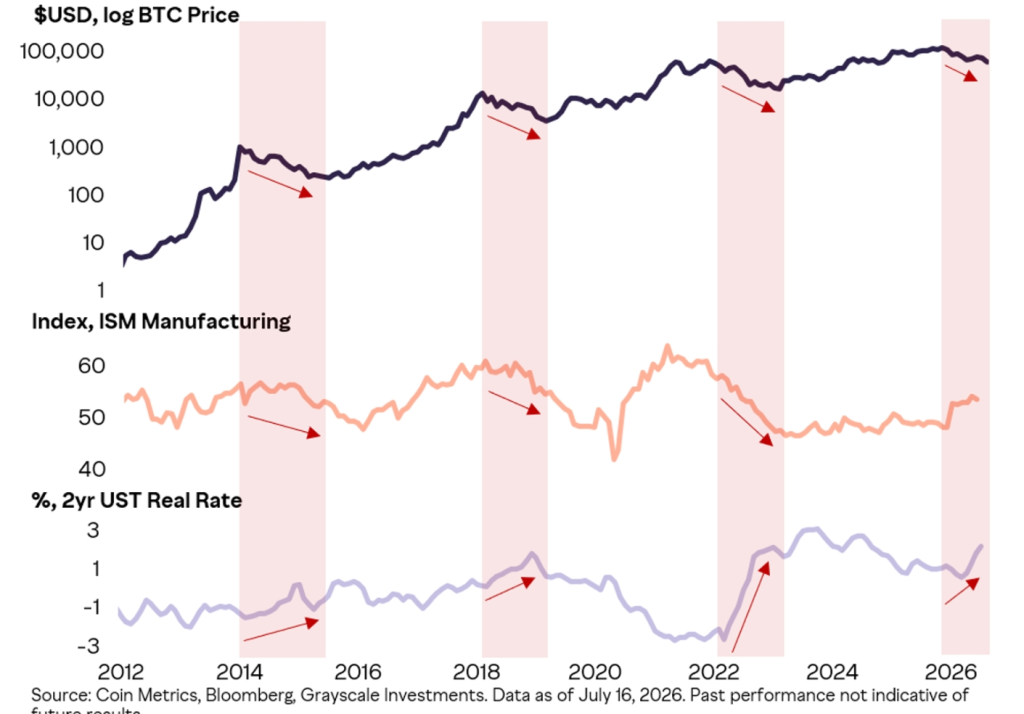
However, Grayscale favors a macro-driven framework . The firm argues that Bitcoin is becoming a more mature asset whose performance increasingly depends on economic growth and real interest rates.
Grayscale said Bitcoin may have already bottomed if the U.S. economy remains resilient and the Federal Reserve avoids further rate increases.
What this means: The traditional four-year cycle points to a September-October bottom. But Grayscale believes macro conditions could change that timeline. If the economy holds up and the Fed stops hiking, Bitcoin could bottom earlier than expected.
Subscribe to our YouTube channel for daily crypto updates, market insights, and expert analysis.