
Bitcoin has spent much of 2026 fighting to regain lost ground after a difficult start to the year. Another question has now entered the discussion. What happens if the CLARITY Act, one of the most closely watched crypto bills in the United States, does not become law until 2027?
That possibility could affect market confidence, especially among institutions that have waited for clearer rules before expanding deeper into digital assets. Claude AI explored exactly that scenario. The forecast assumes the legislation gets delayed, but most other major market conditions remain broadly unchanged. That makes it easier to isolate how regulatory uncertainty alone could influence Bitcoin and the BTC price.
What you'll learn 👉
Why The CLARITY Act Matters for Bitcoin and the Crypto Market
The CLARITY Act is designed to create clearer rules for the US crypto industry. The proposal aims to define which digital assets qualify as securities and which should be treated as commodities. It would also clarify the responsibilities of regulators such as the SEC and the CFTC.
Clearer rules could make life easier for crypto companies, investors, and developers. Many businesses have spent years dealing with uncertain regulations, legal disputes, and compliance questions.
Many analysts believe Bitcoin could benefit even though BTC already has relatively clear treatment as a commodity. A stronger regulatory framework could encourage:
- Greater institutional participation
- More investment products
- Better market confidence
- Faster blockchain development across the industry
Even so, a delay would not automatically become a disaster for Bitcoin. ETF demand, interest rates, liquidity, and corporate adoption remain major drivers of the BTC price.
Why Some Investors Are Watching a Possible Delay Closely
Passing major financial legislation often takes time. Lawmakers still need to settle questions involving digital asset classifications, consumer protections, and regulatory oversight before any final bill can move through Congress.
Election priorities could slow that process even further. If lawmakers fail to reach agreement during the current session, the legislation could move into the next congressional cycle.
Bitcoin has faced similar periods before. Regulatory uncertainty has created temporary volatility across previous market cycles. BTC eventually recovered after many of those setbacks, although short term price swings remained common.
What Claude AI Was Asked to Analyze
Claude AI examined one specific situation. The prompt assumed the CLARITY Act does not pass until 2027 and treated that delay as the main variable affecting market sentiment.
Most other conditions remained stable throughout the exercise.
Those assumptions included:
- Spot Bitcoin ETFs continue operating normally.
- Crypto exchanges and blockchain networks continue functioning.
- Institutional adoption progresses gradually.
- No major financial crisis or severe macroeconomic shock interrupts the market.
That structure allows the forecast to focus mainly on regulatory uncertainty instead of unrelated events.
Institutional Demand Could Still Support Bitcoin
A delayed CLARITY Act does not automatically remove institutional interest.
Spot Bitcoin ETFs would still offer regulated access to BTC. Companies could continue adding Bitcoin to their balance sheets if their financial strategies support those purchases.
Global adoption could also soften the impact of slower progress in Washington because Bitcoin remains a global asset.
Claude AI also noted that institutions now play a larger role in the Bitcoin market than ever before. Retail investors still influence price action during speculative periods, although sustained capital flows increasingly depend on institutional participation.
Bitcoin Price Has Faced a Difficult 2026
Bitcoin remains well below its October 2025 all time high of $126,198. As of late July 2026, BTC trades around $62,500 to $66,000 after recovering from its recent lows.
The year has followed a difficult path.
January opened with optimism as Bitcoin climbed from roughly $88,600 to almost $98,000. Hope surrounding inflation data and possible regulatory progress supported that rally.
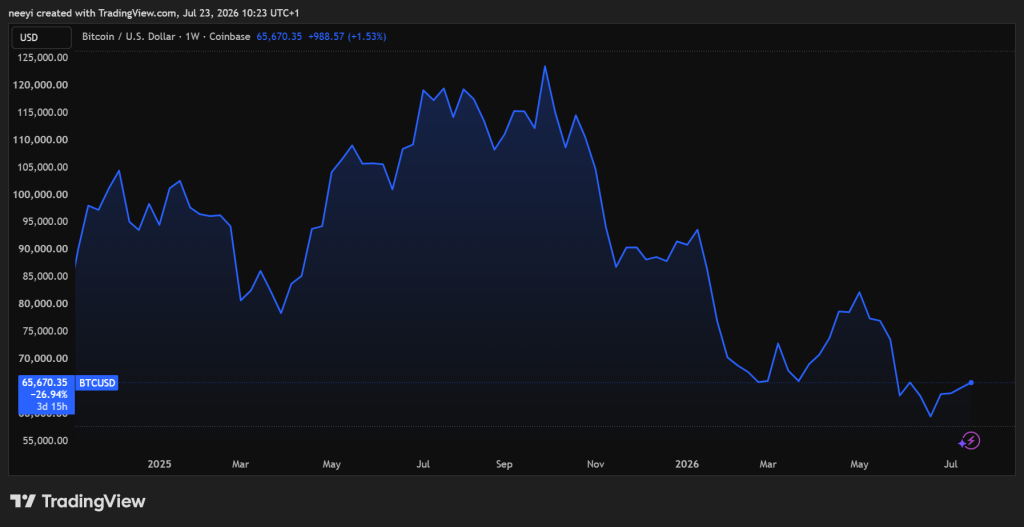
Selling pressure returned quickly during February. Bitcoin dropped toward $60,000 before spending much of the spring moving between $66,000 and $76,000.
Another decline arrived during June. BTC revisited the $60,000 area before buyers helped produce a modest rebound during July.
Several factors contributed to the weaker performance throughout 2026.
- Fewer expectations for Federal Reserve rate cuts
- Slower ETF inflows and institutional demand
- Competition from artificial intelligence related investments
- Heavy derivatives activity instead of stronger spot buying
Those conditions created a challenging backdrop long before questions about the CLARITY Act emerged.
Read Also: Why Ethena (ENA) Could Be Crypto’s Biggest Surprise This Year
Claude AI Expects Caution More Than Panic
Claude AI believes Bitcoin would probably face selling pressure if the CLARITY Act gets delayed until 2027. The model does not expect a market collapse.
A short term decline of about 5% to 10% appears possible under that scenario. That would place Bitcoin near the $58,000 to $60,000 region.
Claude AI expects caution to dominate because much of the market has already dealt with difficult conditions throughout 2026. Many institutions have already reduced exposure during the current cycle.
The forecast also suggests Bitcoin could spend several months moving between roughly $55,000 and $70,000 if no major catalyst changes the outlook.
Support around $60,000 becomes especially important. Lower support could appear near $58,000 and eventually the low $50,000 area if selling pressure grows stronger.
Claude AI’s Bitcoin Price Scenarios
Claude AI outlined several possible outcomes depending on how other market conditions develop.
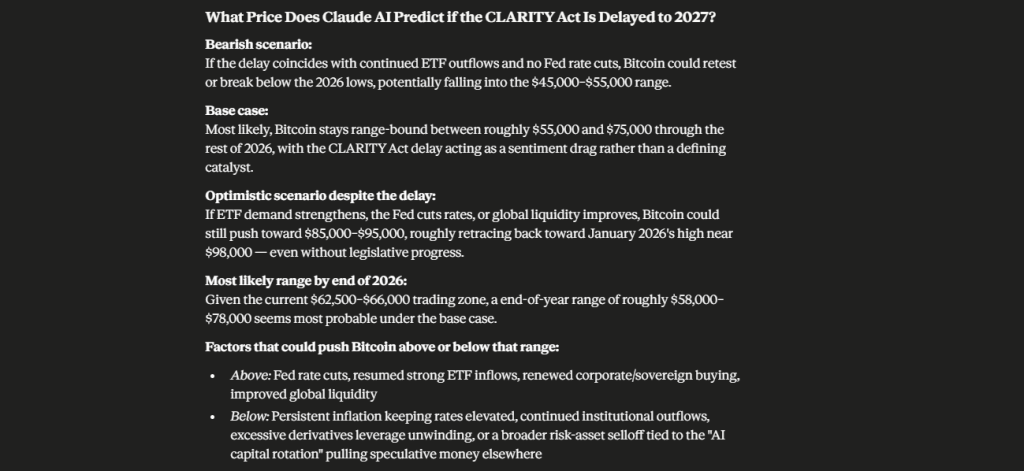
Bearish scenario
If ETF outflows continue and the Federal Reserve keeps interest rates elevated, Bitcoin could revisit the 2026 lows. BTC may even fall into the $45,000 to $55,000 range.
Base case
Claude AI considers this the most likely outcome.
Bitcoin could spend the rest of 2026 trading between roughly $55,000 and $75,000. The delayed CLARITY Act would reduce optimism without becoming the main force controlling the market.
Optimistic scenario
Better ETF demand, Federal Reserve rate cuts, or stronger global liquidity could still lift Bitcoin toward $85,000 to $95,000. That would bring BTC closer to its January 2026 peak even without legislative progress.
Most likely year end range
Claude AI expects Bitcoin to finish 2026 somewhere between $58,000 and $78,000 under its central outlook.
Read Also: Solana Powers 24/7 Trading Boom – 68% of Tokenized Stock Volume Happens Off-Hours
Several Events Could Easily Change Claude AI’s Forecast
Claude AI makes it clear that one piece of legislation cannot determine Bitcoin’s future by itself.
Federal Reserve rate cuts could provide stronger support than regulatory progress if lower borrowing costs encourage investors to return to risk assets.
ETF inflows also deserve close attention because sustained institutional demand can absorb selling pressure during uncertain periods.
Global liquidity may become another powerful driver. Easier financial conditions often support Bitcoin, whereas tighter liquidity can reduce demand across many asset classes.
Another country introducing favorable Bitcoin policies or reserve strategies could also improve market confidence even if US legislation moves slowly.
Major risks remain on the table as well. Persistent inflation, tighter monetary policy, exchange failures, excessive leverage, or another wave of ETF outflows could all weigh on the BTC price.
FAQs
Subscribe to our YouTube channel for daily crypto updates, market insights, and expert analysis.