Solana has spent much of 2026 rebuilding momentum after a correction from its all-time high of $294.33, reached on January 19, 2025. The token remains roughly 74% below its peak, yet the broader story around the network has continued to improve.
Developer activity remains among the strongest in crypto, network upgrades are becoming more ambitious, and institutional interest in Solana-based infrastructure continues to grow.
The key question for investors is whether those fundamentals can translate into a sustained price recovery by the end of 2026.
What you'll learn 👉
The Bullish Case for Solana’s Long-Term Outlook
The long-term investment case for Solana is built on utility rather than speculation. Few Layer 1 networks process as much real user activity while continuing to bring in developers at scale.
Performance remains a major advantage for Solana. The network already offers high throughput and low transaction costs, but upcoming infrastructure upgrades suggest the ecosystem is moving beyond simply being “fast.” The focus is now on making the chain more efficient, more predictable, and better suited for institutional-grade applications.
Developer participation also remains a major strength. Solana consistently ranks among the most active blockchain ecosystems by monthly developers.
DeFi, decentralized physical infrastructure (DePIN), payments, NFTs, gaming, and consumer applications continue expanding on the network. Unlike many chains that rely heavily on a single sector, Solana’s activity is spread across multiple use cases.
Stablecoin usage has grown meaningfully as well. The network has become an increasingly attractive settlement layer because of its low fees and near-instant execution. As more payment providers, fintech companies, and crypto applications integrate Solana, network utilization has continued to improve.
Another positive factor is the ecosystem’s resilience. Previous network outages damaged confidence, but reliability has improved considerably over the past two years. The roadmap now emphasizes infrastructure quality and validator performance rather than simply maximizing transaction throughput.
If the digital asset market remains constructive through the end of 2026, these fundamentals could support another expansion phase for SOL.
The Key Catalysts That Could Shape SOL Through the End of 2026
Several specific catalysts could influence Solana’s price trajectory over the next six months.
- Alpenglow Consensus Upgrade: This proposal aims to reduce block finality from roughly 12 seconds to around 150 milliseconds. Successfully deployed, this would create one of the fastest settlement layers in the blockchain industry.
- SIMD-0553 Fee Reform: This upgrade introduces a resource-based transaction fee model. Users would pay based on compute usage and network resources consumed. The proposal also increases the amount of SOL burned through transaction fees.
- Block Assembly Marketplace (BAM): BAM introduces Application-Controlled Execution, allowing developers to customize how transactions are ordered. For decentralized exchanges and advanced DeFi protocols, this could improve execution quality.
- Institutional Adoption: Major asset managers continue exploring tokenization and blockchain settlement systems. Additional regulated investment products or expanded institutional allocations could increase demand for SOL meaningfully.
- Ecosystem Growth: Higher stablecoin volumes, increased DEX activity, stronger DePIN adoption, and consumer applications all contribute to sustained network demand.
Our Solana Price Analysis: Can SOL Build Momentum From Current Levels?
From a market structure perspective, Solana appears to be in a recovery phase rather than a confirmed long-term breakout. Trading roughly 74% below its all-time high means much of the speculative excess has already been removed from the market.
Currently, SOL is consolidating near $75.17 after a rally from $73.33. The latest candle shows a sharp rejection from nearly $77.00, indicating sellers are active near resistance.
Key support levels sit at $75.00-$75.20 and $74.20-$74.40, with major support at $73.30-$73.50. On the upside, resistance waits at $76.30-$76.60 and $76.90-$77.20.
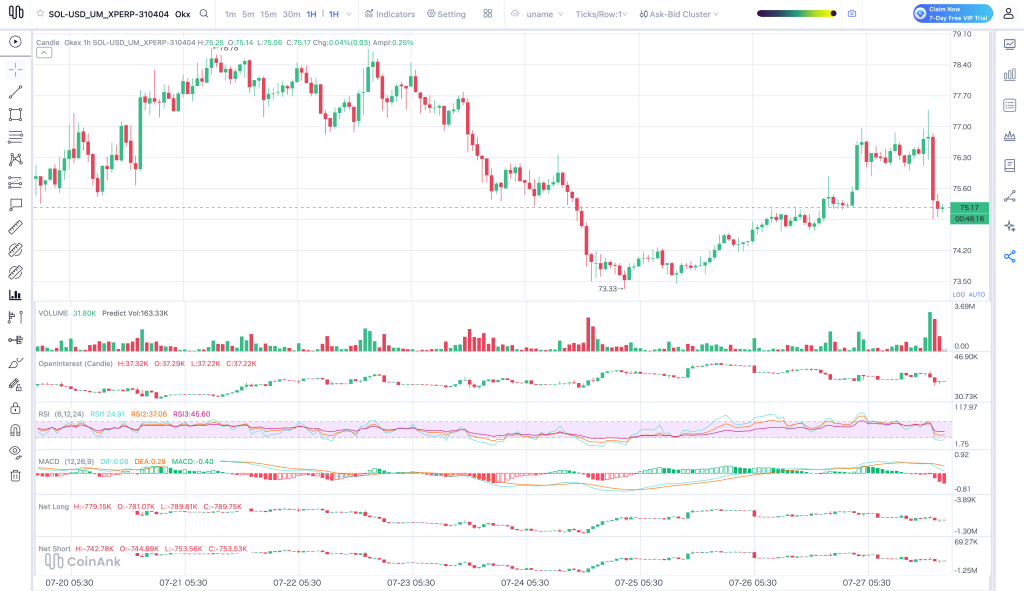
The latest bearish candle printed with above-average volume, suggesting distribution rather than a simple pullback. The RSI has cooled sharply, with fast RSI near 25 and briefly entering oversold territory.
The MACD has produced a fresh bearish crossover, with momentum changing in favor of sellers. Open interest has dropped alongside the selloff and shows that positions are being closed rather than aggressively added.
For buyers to regain control, SOL needs to hold above $75.00, reclaim $76.30-$76.60, and break above $77.00 with strong volume. The short-term trend is still cautiously bullish, but momentum has weakened after the rejection near $77.00.
Solana Price Prediction: How High Could SOL Climb by the End of 2026?
Forecasting cryptocurrency prices always involves considerable uncertainty. Market cycles, macroeconomic conditions, regulation, and investor sentiment can all change quickly. That said, Solana’s current fundamentals justify a constructive medium-term outlook.
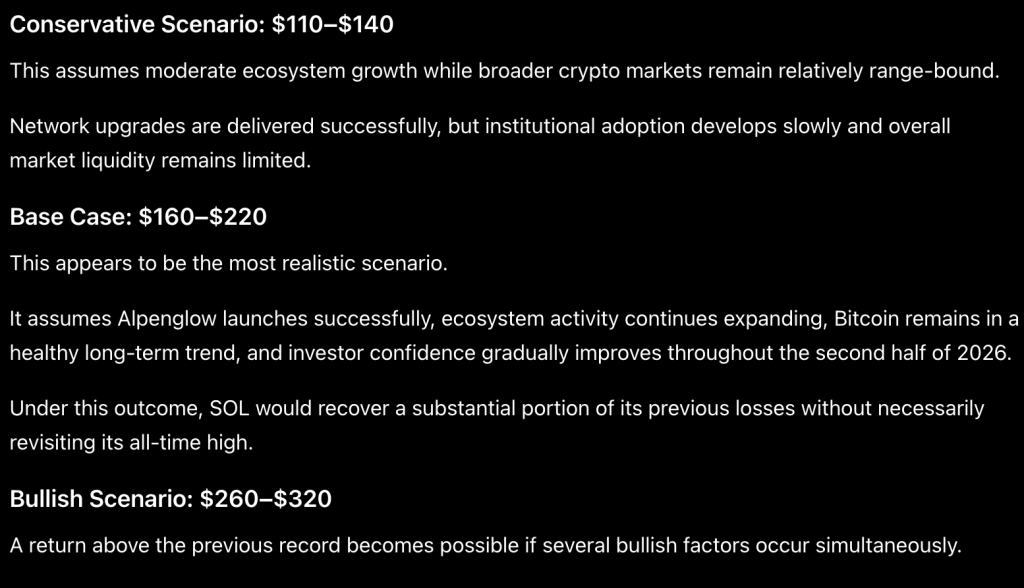
- Conservative Scenario: $110–$140. This assumes moderate ecosystem growth while the crypto markets remain relatively range-bound. Network upgrades are delivered successfully, but institutional adoption develops slowly.
- Base Case: $160–$220. This appears to be the most realistic scenario. It assumes Alpenglow launches successfully, ecosystem activity continues expanding, Bitcoin remains in a healthy long-term trend, and investor confidence gradually improves.
- Bullish Scenario: $260–$320. A return above the previous record becomes possible if institutional adoption improves, Solana gets hold of additional market share, and the crypto market enters another strong expansion phase.
Overall, ChatGPT’s base-case prediction places Solana between $160 and $220 by the end of 2026.
Read also: $5,000 in Dogecoin Today – Here’s Your Portfolio Value by 2027
Our Opinion: Can Solana Outperform Other Large-Cap Altcoins This Cycle?
Among large-cap Layer 1 networks, Solana has one of the strongest opportunities to outperform. Ethereum still benefits from the largest developer ecosystem, but its Layer-2-centric scaling strategy adds complexity for users. Solana offers a more unified experience on a single high-performance chain.
Solana combines strong developer activity, high real-world usage, ambitious infrastructure upgrades, and improving token economics in a way few other large-cap cryptocurrencies currently match. Newer competitors like Sui and Aptos have shown impressive technical capabilities, but neither has yet established the same level of liquidity or developer participation.
Frequently Asked Questions
Subscribe to our YouTube channel for daily crypto updates, market insights, and expert analysis.