Cardano is not dead, but ADA’s chart is giving traders very little reason to be excited right now.
ADA is trading around $0.216 on Binance after falling steadily through most of October. The two-hour chart shows a clear sequence of lower highs and lower lows from the October 6 peak near $0.2825, leaving the token roughly 23% below that local high.
The broader concern is not simply that ADA has fallen. Many altcoins have struggled recently. The problem is that Cardano’s price structure, momentum indicators, derivatives positioning and DeFi activity all remain weak at the same time.
That makes the question more nuanced than “Is Cardano dead?”
The network is still developing. The harder question is whether ADA offers a compelling enough setup compared with other large-cap altcoins.
What you'll learn 👉
ADA Price Action Is Still Clearly Bearish
I (thoroughly) analyzed the Binance ADA/USDT two-hour chart dated October 20.
ADA’s visible October structure is not attractive.
Price peaked near $0.2825 early in the month, then broke lower in several stages:
- first toward roughly $0.24
- then into the $0.225-$0.23 region
- and most recently toward a low around $0.2108
Every rebound has been weaker than the one before it.
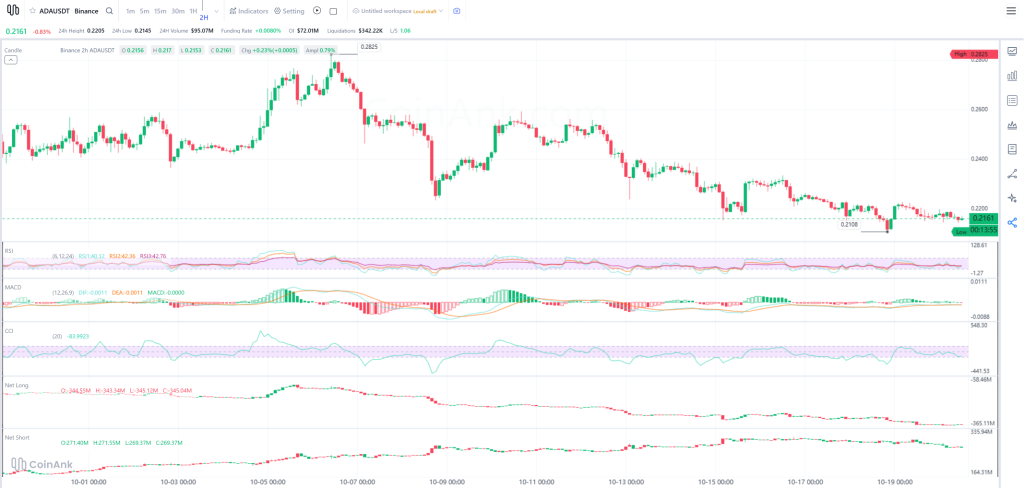
ADA is now hovering around $0.216, which places the immediate support zone at roughly $0.210-$0.215.
If that area fails, I would watch $0.20 next. It is both a psychological level and the kind of round-number area where buyers may attempt another defense.
Resistance begins close to $0.22-$0.225. Above that, $0.23-$0.235 becomes more important, followed by approximately $0.24-$0.245.
I would need to see ADA reclaim at least the $0.23-$0.24 region before calling the short-term structure meaningfully healthier.
The Indicators Are Weak, Not Capitulation-Level Weak
The momentum readings reinforce the bearish price structure.
Short RSI is near 40.1, with the medium and longer readings around 42.4 and 42.8.
That is below neutral, but not deeply oversold.
In other words, ADA is weak without yet reaching the kind of extreme RSI reading that automatically makes the chart interesting as a mean-reversion trade.
CCI is around -84.
That also points to negative momentum, but again, it is not at the sort of extreme level that would make me assume sellers are exhausted.
MACD is arguably the least helpful indicator right now.
Both DIF and DEA are near -0.0011 and the histogram is essentially flat. The indicator is below zero, confirming that the broader momentum remains negative, but the almost-flat histogram also tells us selling acceleration has eased.
That can precede stabilization.
It is not the same as a bullish reversal.
Net Shorts Still Have the Advantage
The positioning data is another reason I would remain cautious.
The chart shows net longs around -345 million, compared with net shorts near 269 million.
More importantly, the trend in those panels has been unfavorable for bulls throughout the visible period.
Net-long positioning has deteriorated substantially since early October, while net shorts increased as ADA declined.
There has been a small easing in shorts near the latest candles, but I would not read much into that yet.
Until price starts making higher highs at the same time long positioning improves, traders appear much more willing to bet against ADA than aggressively accumulate it.
Cardano Development Is Not Dead
This is where the “Cardano is dead” argument becomes too simplistic.
Development continues.
Ouroboros Leios is one of the biggest items on the roadmap. The upgrade is designed to materially increase Cardano’s base-layer throughput, and recent testing has reportedly reached around 1,000 transactions per second under test conditions. The broader goal is to address one of Cardano’s long-standing weaknesses: raw scalability.
Charles Hoskinson has described Leios as competitively necessary, and recent Cardano reporting indicates a mainnet release candidate remains under development.
Project Catalyst is also trying a more results-oriented funding model.
Twelve projects were recently selected from 117 applications for a roughly 2 million ADA pilot. The projects include stablecoin payments, lending, tokenized assets, identity and supply-chain applications, and a large portion of funding is tied to measurable adoption rather than simply shipping a product.
That is a sensible change because Cardano does not need more announcements as much as it needs more actual usage.
Read also: Cardano News: Founder Teases New Midnight Concept as ADA Nears Completion
The DeFi Gap Is the Bigger Problem
This is where I become more critical.
Cardano currently has only around $62 million in DeFi TVL. Its 24-hour DEX volume is roughly $1.4 million, with about 14,140 active addresses and 32,148 transactions over the latest 24-hour period tracked by DefiLlama.
Compare that with Solana.
Solana currently has approximately $5.8 billion in DeFi TVL and around $1.4 billion in daily DEX volume, depending on the snapshot.
That is not a minor gap.
Cardano’s TVL is roughly 1% of Solana’s.
And daily DEX volume is smaller by orders of magnitude.
So although Cardano remains technically active and has meaningful upgrades ahead, the network still has a serious liquidity and adoption problem relative to its largest competitors.
That is what ADA bulls need to confront.
Is Cardano Dead?
No.
A dead chain does not continue funding development, improving its consensus architecture, launching new developer tooling and onboarding new applications.
But ADA price action currently looks poor, and Cardano’s ecosystem activity remains too small relative to its valuation and age for me to ignore.
The token still carries an approximately $8 billion market capitalization, despite DeFi TVL of only about $62 million.
That does not mean ADA is overvalued by definition. Market capitalization reflects expectations about future adoption, staking, governance and the broader network.
But investors are paying for a lot of future execution.
Read also: Grok AI Predicts a Stunning End to 2026 for Cardano (ADA)
Is ADA a Good Buy Before the Next Bull Run?
I would classify ADA as a higher-risk turnaround bet rather than an obvious bull-market buy at $0.216.
There is a bullish case.
Leios could materially improve throughput. Catalyst may produce more real-world usage. Better stablecoin infrastructure, DeFi tools and developer incentives could gradually close the activity gap. And if the entire altcoin market enters another speculative phase, ADA does not need perfect fundamentals to appreciate strongly.
But traders have alternatives.
At the moment, networks such as Solana already have far deeper liquidity, higher application revenue, substantially larger DeFi usage and more daily economic activity.
So I would not buy ADA simply because it is down heavily or because it traded above $3 in a previous cycle.
For me, the more compelling signal would be a combination of three things:
- ADA recovering $0.23-$0.24 and breaking the current lower-high structure
- Cardano DeFi and stablecoin liquidity showing sustained growth
- Leios and other roadmap items translating into measurable network usage rather than only technical progress
Until then, $0.210-$0.215 is the immediate technical area that keeps ADA alive in the short term.
Losing that zone would put $0.20 in play.
Reclaiming $0.23-$0.24 would finally give traders something more constructive to work with.
So, is Cardano dead? No.
For more crypto news and price predictions, click here.
Subscribe to our YouTube channel for daily crypto updates, market insights, and expert analysis.