Gold and silver prices are falling again, but Peter Schiff believes traders have misunderstood what the bond market is telling them. His comments raise an interesting question about the latest decline, especially as both metals struggle below important price levels.
Gold dropped around 2.3% yesterday before recovering a little, and the price currently trades near $4,120. Silver has fallen roughly 4% between yesterday and the time of writing, with its price around $58.
Both charts leave room for further losses. Schiff, however, believes the reason behind the selling could eventually support precious metals. Understanding that disagreement means looking beyond the latest price drop.
What you'll learn 👉
Gold And Silver Prices Decline As Traders Respond To Rising Bond Yields
Peter Schiff described the latest selling as a familiar reaction to rising bond yields. His post stated that gold fell almost $100 and silver dropped more than $2, which pushed silver back below $60.
Schiff believes traders have read that development incorrectly. His argument is that falling bond prices and rising yields are extremely bullish for precious metals.
The usual explanation points in the opposite direction. Gold and silver do not pay interest, so higher bond yields give investors an income option that metals cannot provide.
An investor who holds gold depends on price appreciation for a return. An investor who holds a government bond receives interest payments, although the bond’s market price can change before maturity.
Higher yields therefore increase the opportunity cost of holding precious metals. That helps explain why gold and silver can decline when bond yields rise, even when inflation remains a concern.
Peter Schiff Believes Falling Bond Prices Reveal A Bigger Problem
Schiff’s argument focuses on the reason behind rising yields. Bond prices fall when investors demand higher returns to hold the debt, and he sees that as a potential warning about confidence in government finances.
His view connects the bond selloff to large federal deficits and inflation expectations. Investors may demand higher yields because they worry that future payments will buy less than they do today.
That brings real yields into the discussion. A nominal yield is the interest rate a bond offers, but a real yield accounts for inflation.
Here we go again. Traders have reacted to rising bond yields by selling gold and silver. Gold fell almost $100 and silver dropped over $2, back below $60. Yet falling bond prices and rising yields are extremely bullish for precious metals. Buy now. https://t.co/CY02g7N0Nj
— Peter Schiff (@PeterSchiff) October 7, 2026
A simplified example makes the difference clearer. A bond that pays 5% does not preserve purchasing power if inflation runs at 6%.
Schiff believes this kind of environment could eventually push investors toward physical gold and silver. His reasoning is that interest payments offer limited protection if inflation erodes the value of the money received.
That argument depends on inflation and confidence in government debt. Rising yields alone do not prove either condition has become severe enough to drive a precious metals recovery.
Higher Real Returns And Dollar Strength Could Challenge Schiff’s View
Schiff could be wrong if bond yields rise faster than inflation. Government debt would then offer a positive real return, which creates stronger competition for gold and silver.
The Federal Reserve could keep interest rates high for longer, and investors might decide that the income available from bonds outweighs the potential benefits of holding metals.
Several factors could work against Schiff’s outlook:
- Higher real yields could favour bonds. Investors can earn income above inflation instead of depending entirely on precious metals prices.
- A stronger dollar could weaken demand. Gold and silver become more expensive for buyers who use other currencies.
- Slower industrial activity could pressure silver. Higher borrowing costs can reduce demand from businesses.
- Urgent cash needs could cause further selling. Investors facing margin calls may sell gold and silver to raise money.
The dollar presents a particular challenge to Schiff’s argument. Higher US yields can attract overseas capital, which supports the currency. Dollar strength can then put additional pressure on precious metals prices.
Silver also needs separate consideration because more than half of its demand comes from industry. Solar panels, electronics, and cars use silver, so weaker manufacturing activity can affect its price.
That means silver could continue falling even if gold begins to recover.
Read Also: Cardano Founder Pressures Gemini To Finally List ADA
A Bond Market Crisis Could Push Investors Toward Cash First
Schiff expects deeper bond market trouble to encourage demand for gold and silver. However, the early stages of financial stress can produce a different reaction.
Leveraged investors may face margin calls when their positions lose value. They must then provide additional cash or reduce their exposure, sometimes through the sale of assets they would otherwise keep.
Gold and silver can become part of that selling because they can be converted into cash. A metal’s reputation as a haven does not prevent investors from selling it when immediate payment obligations take priority.
This creates a timing problem for Schiff’s outlook. His broader argument could develop later, but precious metals might still fall first.
Gold Price Outlook Leaves $4,000 And $3,900 As Downside Targets
A look at the gold price chart shows that the supplied analysis places the support breakdown near $4,480 around the end of September. Gold subsequently retested that former support as resistance.
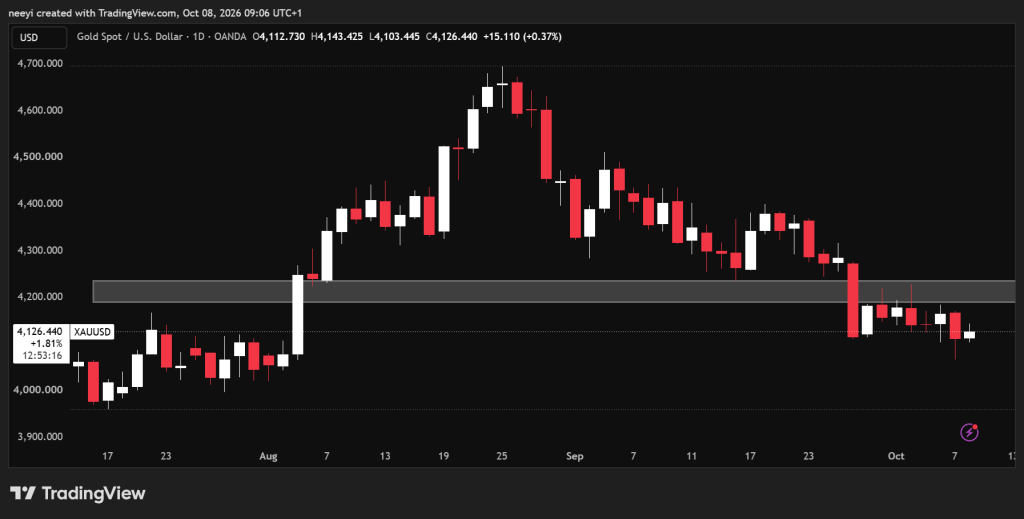
The current setup indicates that the retest may have finished. Gold trading around $4,120 leaves the price vulnerable to another decline if sellers maintain control.
The immediate downside target is $4,000, which could come into view before today ends if pressure continues. A deeper move could take gold toward $3,900 before the end of the week.
Those targets remain conditional on further selling. The support breakdown provides a bearish setup, but it cannot guarantee how quickly the price will move.
A break above $4,200 would invalidate this immediate bearish position. That would weaken the case for a direct move toward the lower targets.
Read Also: Crypto Crash Warning: How Low Can Bitcoin and Ethereum Prices Go?
Silver Price Outlook Points Toward $56 After The $60 Breakdown
A look at the silver price chart shows a break below support near $60 yesterday. Silver then retested that level as resistance and currently trades around $58.
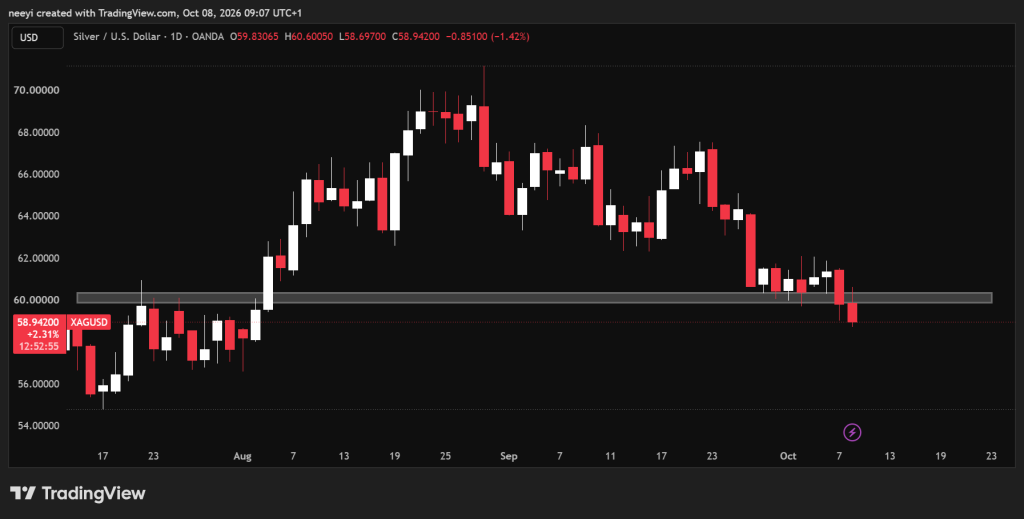
That failed recovery leaves $56 as the next downside target. Continued selling could bring that level into play before today ends.
A further decline could expose $54 if buyers fail to stop the move. Silver’s industrial demand adds another reason to examine its outlook separately from gold.
A break above $61 would invalidate this immediate bearish position. Such a recovery would weaken the argument that the retest below $60 has finished.
FAQs
Subscribe to our YouTube channel for daily crypto updates, market insights, and expert analysis.