The EUR/USD price is taking a hit right now. New U.S. numbers came out, and they’re confusing. Growth is slowing, but prices aren’t coming down. That’s got traders second-guessing what the Fed will do next.
The euro is down to 1.16431, a drop of 0.11% today. It already broke below 1.16600, which used to be a floor. And if you zoom out, this fits the bigger picture, the euro has been falling since July, when it was above 1.18000.
What’s behind it? Inflation is still hot. PCE came in at 3.7% yearly for July, way above the Fed’s 2% goal. And GDP stayed stuck at 1.5% in the second quarter. That mix makes another rate hike more likely. So all eyes are on Kevin Warsh’s Jackson Hole speech Friday, that could decide where the euro goes next.
What you'll learn 👉
The Fed Faces a Difficult Rate Decision
Bull Theory put it well in their latest post, the Fed is stuck. The U.S. economy is slowing down, but prices aren’t cooling off enough for them to cut rates.
GDP grew at just 1.5% in the second quarter, down from 2.1% early in the year. That’s the slowdown. But here’s the catch: domestic demand, what people and businesses are actually spending, rose 4.2%. So underneath the surface, things aren’t as weak as the main GDP number makes it look.
🚨 THE FED IS NOW STUCK BETWEEN A SLOWING ECONOMY AND INFLATION THAT WON'T COME DOWN EASILY.
— Bull Theory (@BullTheoryio) August 26, 2026
GDP grew just 1.5% in Q2, in line with expectations but well below last year's pace.
The economy is slowing.
PCE inflation came in at 3.7% in July, above the 3.6% expected and nearly… pic.twitter.com/p2BxknO7xU
Inflation is the real headache for the EURUSD price. July PCE prices rose 0.2% for the month and 3.7% year over year. Core PCE, which takes out food and energy, was up 0.2% monthly and 3.3% annually. Both are still miles above the Fed’s 2% target.
So what do they do? Cut rates to help growth, or keep them high to fight inflation? They can’t do both.
The markets are already betting on the latter. Reuters says odds of a September rate hike jumped to 40.1% on Wednesday, up from 36% before the numbers came out. For the euro, that’s bad news. Higher U.S. rates make the dollar more attractive, and that pushes the euro down.
Why Warsh’s Jackson Hole Speech Matters for EUR/USD
The next major catalyst is Kevin Warsh’s Jackson Hole speech on Friday. The event matters because traders need more clarity on how the Fed will respond to inflation that remains above target and an economy growing at only 1.5%.
Warsh’s comments could therefore influence Treasury yields, the dollar and the EUR/USD price at the same time.
The week’s calendar gives traders more data before that speech. US unemployment claims are due Thursday, with a forecast of 208,000 versus 206,000 previously.
Friday also brings the preliminary benchmark payrolls revision, University of Michigan sentiment and inflation expectations. The calendar places these releases immediately around the Jackson Hole event, increasing the potential for rate expectations to move quickly.
Read Also: Silver Price at a Bitcoin (BTC) 2015 Moment? Analyst Explains Why It Could Rise 10x
EUR/USD Price Breaks 1.16600 Support
The technical picture is also leaning bearish. The EUR/USD price is around 1.16431 after breaking below 1.16600, which had provided support during the previous few sessions. The pair has also maintained a broader sequence of lower highs and lower lows since reaching above 1.18000 in July.
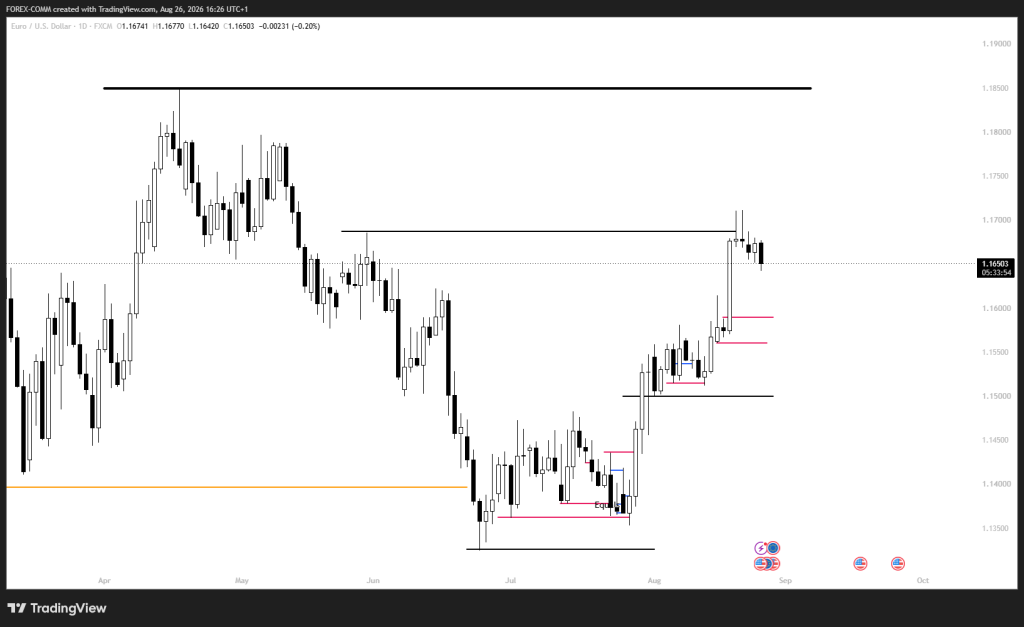
The next technical level is 1.15800, followed by the psychological 1.15000 area. If sellers push through 1.15800, the weekly objective around 1.14993 becomes the next area to monitor. That level is close to the weekly low highlighted in the provided technical analysis.
There is still a route for the EUR/USD price to recover. The daily levels at 1.15901 and 1.15610 could provide areas where buyers attempt to enter.
If either level holds and the pair regains 1.16600, the bearish setup would weaken. A stronger recovery could eventually target the 1.18500 monthly level, but that would require a clear change in dollar and rate expectations.
Where Could the EUR/USD Price Go Next?
The immediate EUR/USD price bias remains bearish as long as $1.16600 stays above the market. A break toward $1.15800 would put $1.14993 into view, giving sellers a clear technical path lower.
The bigger risk for bears is Jackson Hole. A hawkish Warsh message, stronger US labor data or higher inflation expectations could reinforce September hike bets and support the dollar. A softer message could do the opposite, especially if traders interpret slower GDP growth as a reason for the Fed to avoid another hike.
For now, the EURUSD price is caught between two competing forces: a US economy growing at 1.5% and inflation running at 3.7%. Until Warsh provides more clarity, the 1.16600 resistance-turned-support level and the 1.15800 downside target are the key levels to watch.
Frequently Asked Questions
Subscribe to our YouTube channel for daily crypto updates, market insights, and expert analysis.